


Smart Grid Vs Conventional Grid Powerpoint Presentation Slides




Try Before you Buy Download Free Sample Product
 Impress Your
 Audience
 100%
100% Editable
 Save Hours
 of Time


Check out our PowerPoint presentation on Smart Grid vs. Conventional Grid that gives a brief idea about intelligent grid technology, including its comparison with traditional grids, market size, objective, importance, technology gap, and its working with IoT. It covers an overview of the intelligent grid covering its introduction, features, infrastructure, what makes a grid smart, and a brief idea of the traditional grid system and its problems. Our Smart Grid Infrastructure deck contains the market size, objective, and importance of smart grid technology. It also includes an overview of the smart grid technology gap, its components, functions, and applications in different areas. Also, Smart Grid Technology PPT consists of the relationship between the smart grid and the Internet of Things IoT, user involvement and energy decentralization in the smart grid, the innovative grid maturity model, and different smart grid technologies. It further caters to a comparison between intelligent and traditional grids, implementation, and impact of smart grid technology. Moreover, this Smart Grid Maturity Model deck comprises a modernization cost of the conventional grid, an evolution roadmap, and an innovative home dashboard for appliance monitoring. Download our 100 percent editable and customizable template, which is also compatible with Google Slides.
People who downloaded this PowerPoint presentation also viewed the following :
Content of this Powerpoint Presentation
Slide 1: This slide introduces Smart Grid vs. Conventional Grid. Commence by stating Your Company Name.
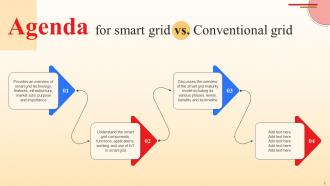
Slide 2: This slide depicts the Agenda of the presentation.
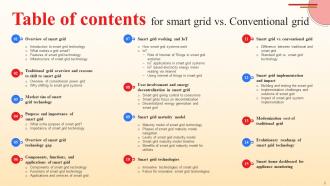
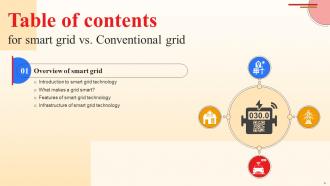
Slide 3: This slide includes the Table of contents.
Slide 4: This slide highlights the Title for the Topics to be covered further.
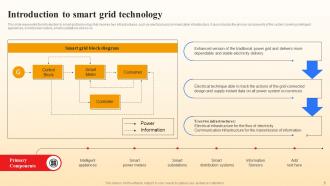
Slide 5: This slide represents the introduction to smart grid technology.
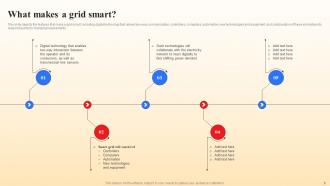
Slide 6: This slide depicts the features that make a grid smart.
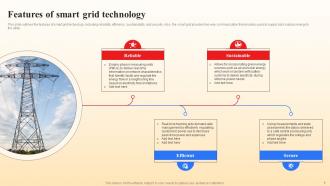
Slide 7: This slide outlines the features of smart grid technology.
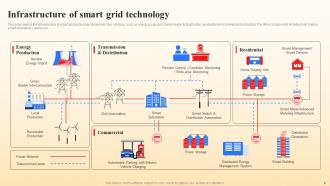
Slide 8: This slide displays the infrastructure of smart grid technology divided into four sections.
Slide 9: This slide includes the Heading for the Contents to be discussed next.
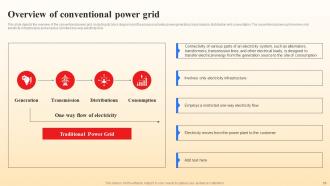
Slide 10: This slide portrays the overview of the conventional power grid.
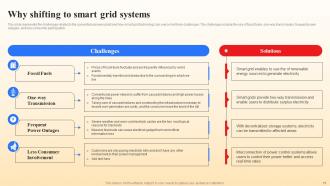
Slide 11: This slide represents the challenges related to the conventional power plant and how smart grid technology can overcome those challenges.
Slide 12: This slide contains the Title for the Ideas to be covered in the upcoming template.
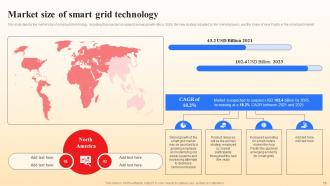
Slide 13: This slide depicts the market size of smart grid technology.
Slide 14: This slide highlights the Heading for the Ideas to be discussed in the next template.
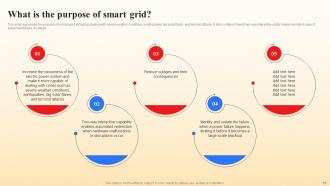
Slide 15: This slide represents the purpose of a smart grid.
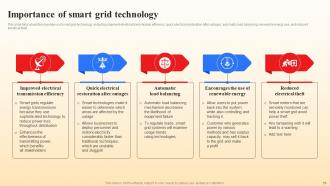
Slide 16: This slide reveals the Importance of smart grid technology.
Slide 17: This slide exhibits the Title for the Contents to be covered in the upcoming template.
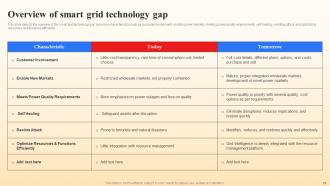
Slide 18: This slide depicts the overview of the smart grid technology gap.
Slide 19: This slide includes the Title for the Contents to be covered in teh upcoming template.
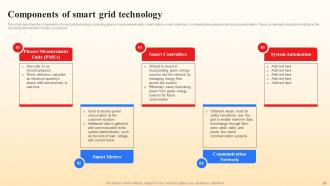
Slide 20: This slide describes the components of smart grid technology.
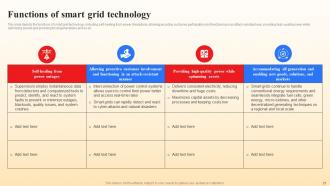
Slide 21: This slide depicts the functions of smart grid technology.
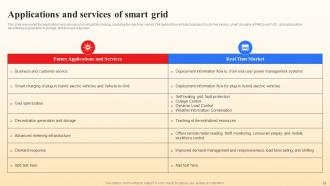
Slide 22: This slide represents the applications and services of smart grid technology, including the real-time market.
Slide 23: This slide portrays the Heading for the Topics to be discussed further.
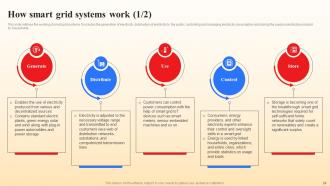
Slide 24: This slide outlines the working of smart grid systems.
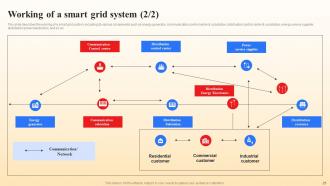
Slide 25: This slide describes the working of a smart grid system.
Slide 26: This slide includes the Title for the Topics to be covered in the upcoming template.
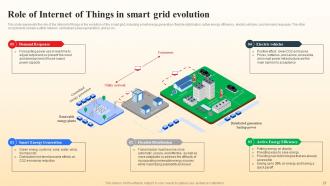
Slide 27: This slide represents the role of the internet of things in the evolution of the smart grid.
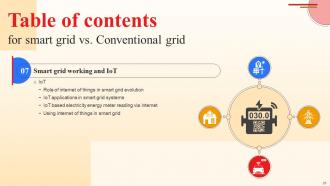
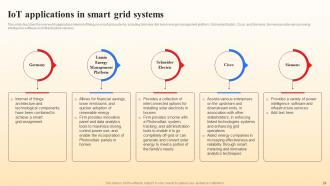
Slide 28: This slide describes the real-world applications internet of things in smart grid systems.
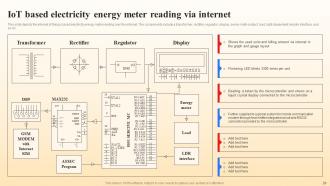
Slide 29: This slide depicts the internet of things based electricity energy meter reading over the internet.
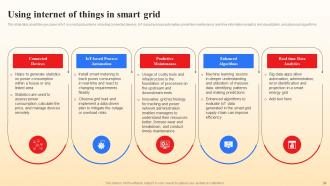
Slide 30: This slide talks about the use cases of IoT in smart grid systems.
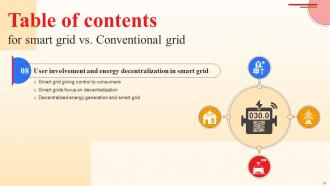
Slide 31: This slide includes the Heading for the Contents to be discussed next.
Slide 32: This slide outlines how the smart grid gives control to consumers.
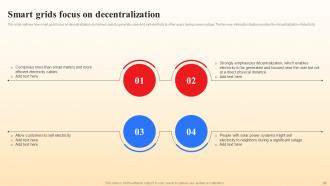
Slide 33: This slide portrays how smart grids focus on decentralization.
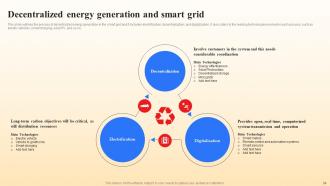
Slide 34: This slide exhibits the process of decentralized energy generation in the smart grid.
Slide 35: This slide presents the Title for the topics to be covered in the upcoming template.
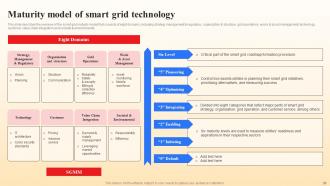
Slide 36: This slide describes the overview of the smart grid maturity model that consists of eight domains.
Slide 37: This slide reveals the Phases of smart grid maturity model navigation.
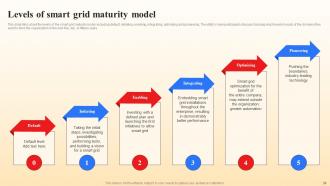
Slide 38: This slide talks about the levels of the smart grid maturity model.
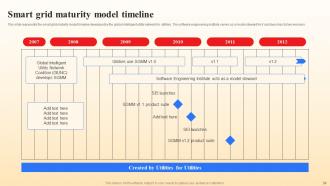
Slide 39: This slide represents the smart grid maturity model timeline developed by the global intelligent utility network for utilities.
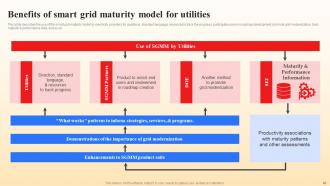
Slide 40: This slide describes the use of the smart grid maturity model by electricity providers.
Slide 41: This slide reveals the Heading for the Ideas to be discussed further.
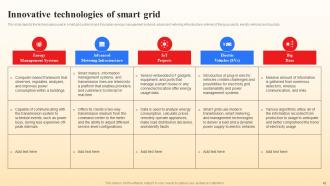
Slide 42: This slide depicts the technologies used in smart grid systems.
Slide 43: This slide shows the Future for innovative smart grid technologies.
Slide 44: This slide displays the Title for the Contents to be covered in the upcoming template.
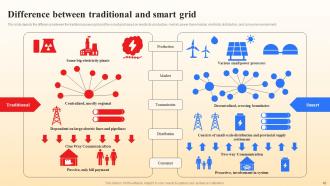
Slide 45: This slide highlights the Difference between traditional and smart grid.
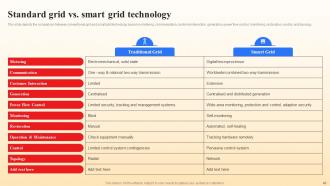
Slide 46: This slide depicts the comparison between conventional grid and smart grid technology.
Slide 47: This slide includes the Heading for the Topics to be discussed in the upcoming template.
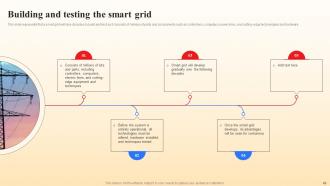
Slide 48: This slide represents that a smart grid will take decades to build and test as it consists of millions of parts and components.
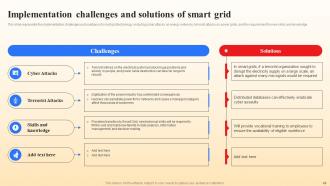
Slide 49: This slide deals with Implementation challenges and solutions of smart grid.
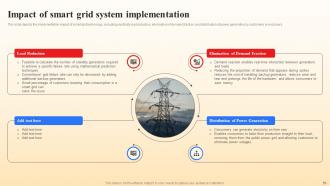
Slide 50: This slide highlights the Impact of smart grid system implementation.
Slide 51: This slide includes the Title for the Topics to be covered in the upcoming template.
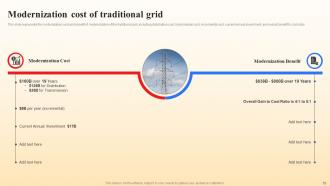
Slide 52: This slide represents the modernization cost and benefit of modernization of the traditional grid.
Slide 53: This slide presents the Heading for the Contents to be further discussed.
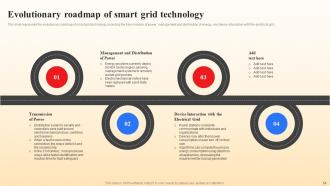
Slide 54: This slide represents the evolutionary roadmap of smart grid technology.
Slide 55: This slide contains the Title for the Ideas to be covered in the next template.
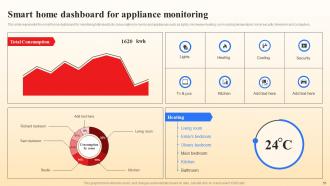
Slide 56: This slide represents the smart home dashboard for monitoring total electricity consumption by rooms and appliances.
Slide 57: This is the Icons slide containing all the Icons used in the plan.
Slide 58: This slide is used for depicting some Additional information.
Slide 59: This is the Quotes slide for motivation.
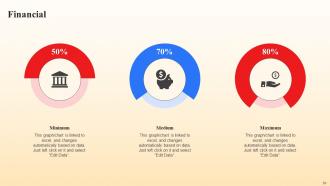
Slide 60: This slide elucidates information related to the Financial topic.
Slide 61: This slide exhibits the Mind map of the company.
Slide 62: This slide includes the organization's mission, vision, and values.
Slide 63: This is the 30,60,90 days plan slide for effective planning.
Slide 64: This is the Venn diagram slide.
Slide 65: This slide exhibits the firm's Timeline.
Slide 66: This is the Idea Generation slide for encouraging fresh ideas.
Slide 67: This is the Target slide. State your company-targets here.
Slide 67: This slide exhibits the firm's Roadmap.
Slide 69: This is the Thank You slide for acknowledgement.
Smart Grid Vs Conventional Grid Powerpoint Presentation Slides with all 77 slides:
Use our Smart Grid Vs Conventional Grid Powerpoint Presentation Slides to effectively help you save your valuable time. They are readymade to fit into any presentation structure.















FAQs for Smart Grid Vs Conventional Grid
Honestly, the biggest difference is communication - smart grids can actually talk both ways while old grids are just one-way. So like, smart grids have all these sensors and IoT stuff constantly monitoring what's going on. They'll tell you if something's wrong instead of you finding out when everything goes dark, you know? Old grids are basically flying blind until they break. Plus smart grids handle solar and wind power way better. They can reroute electricity automatically during outages too. If you're looking at upgrading, start with the communication tech - that's where you'll see the real difference. Makes everything so much smarter.
So smart grids basically let you see what's happening with your energy in real-time - you can catch waste as it's happening instead of getting surprised by huge bills later. Old grids are pretty much guessing games until something breaks. The cool part is everything adjusts automatically. Peak demand gets smoothed out, and it'll actually warn you before equipment craps out. Way better than crossing your fingers and hoping nothing fails. I'd start with whatever areas eat the most power first - that's where you'll see the biggest difference. It's honestly like night and day once you have that visibility.
Hey! So smart grids are basically what make renewable energy actually work. Traditional power grids just send electricity one way from power plants to your house, but renewables are way more unpredictable - your solar panels might produce tons of power at noon then nothing when clouds roll in. Smart grids handle that chaos with real-time monitoring and automatic adjustments. They can even take excess power from your panels and send it back to the grid, which is pretty cool. Just heads up though - if you're thinking about installing solar or whatever, make sure your local infrastructure can handle power flowing both directions.
Dude, smart grids are game-changers for power outages. You get real-time monitoring of everything instead of waiting for angry customers to call. When something breaks, the system automatically routes power around the problem - honestly feels like magic sometimes. All those sensors can pinpoint exactly where issues are happening, so your crews aren't driving around aimlessly. Minor faults? The grid basically fixes itself. I've seen utilities cut outage time by 60-80% after upgrading. It's pricey upfront but worth it if you're tired of dealing with blackout complaints.
Look, it's a huge upfront hit - we're talking billions for smart meters, sensors, all that infrastructure stuff. But most utilities break even in like 5-10 years through way lower outage costs and better maintenance. Peak load management is where you really save though - millions per year since you don't have to build new plants. The predictive maintenance thing is clutch too, honestly. You spot issues before everything goes sideways. My cousin works for ConEd and says it's been a game changer for them. Short-term it sucks, but long-term you're golden.
Smart grids are actually pretty game-changing for your electric bill. Your utility gives you real-time data so you can see exactly when power's cheapest. Then you just shift the heavy stuff - dishwasher, EV charging, whatever - to off-peak hours. If you've got solar panels, you can even sell power back at market rates, which honestly feels like winning the lottery sometimes. The detailed breakdowns also show you which appliances are secretly draining your wallet. My neighbor saved like 30% just by switching when she does laundry. Call your utility about time-of-use rates first.
Oh man, smart grids are SO much easier to hack than the old ones. Traditional grids are mostly analog - just mechanical switches and barely any network stuff. But smart grids? They're packed with digital sensors, IoT devices, all talking back and forth over networks. Hackers can hit them remotely now. It's honestly like comparing a landline to your iPhone - way bigger attack surface. Plus they're collecting customer data left and right, which is basically catnip for cybercriminals. You'll need serious encryption and network monitoring, not just locks on the door anymore.
Honestly, the money thing is brutal - you're talking about replacing infrastructure that's been there for decades. Plus cybersecurity freaks everyone out since you're basically putting the whole grid online (can't blame them). Integration is a nightmare too because old systems weren't built to work with smart meters and all that new tech. Don't even get me started on regulatory approval - takes forever. Your workforce needs complete retraining on stuff they've never seen. My take? Run small pilot programs first. Work out all the messy details before you commit to the full thing.
So basically, smart grids can talk back and forth with your house to balance electricity demand. Your AC might cycle down for like 10 minutes when the grid's stressed, or your water heater waits a bit - you probably wouldn't even notice. They'll actually pay you to use power during off-peak hours too, which is pretty sweet. Oh, and if you're buying new appliances anyway, definitely go for the "smart" or "grid-responsive" ones. You'll save cash and help keep everyone's lights on. Win-win situation.
Smart grids are actually pretty impressive - they cut carbon emissions by 12-20% compared to old school grids. The big thing is they can handle renewables way better since solar and wind are so unpredictable. Your conventional grid wasn't designed for that kind of variability, honestly. They also do this cool demand response thing where your usage automatically shifts to off-peak hours, so we don't need as many of those gross peaker plants. Real-time monitoring cuts transmission losses too. If you're looking at grid projects, I'd focus on the renewable integration stuff first - that's where the real environmental impact happens.
Smart grids basically make electricity way more efficient - they can balance supply and demand automatically instead of just guessing. Solar and wind power integrate much better too. Less energy gets wasted, and you don't need as many dirty backup plants running 24/7. Your smart appliances can actually time themselves to use power when it's cleanest, which is pretty cool. It's honestly a huge upgrade from our current ancient grid system. The whole two-way communication thing means the grid gets smarter about everything. If you're looking at sustainability stuff, this is one that actually makes a real difference at scale.
So basically smart grids let your car actually talk to the power company, which is pretty cool. No more everyone charging at once and overloading things. Your car can charge overnight when it's way cheaper - like seriously, the price difference is huge. The crazy part? Your EV can even sell power back during peak hours. My neighbor makes like $30/month doing that. Check if your utility has time-of-use rates before you buy though. Makes a massive difference on your electric bill.
Oh man, smart grids are a regulatory nightmare compared to regular ones. Traditional grids just deal with the usual utility stuff - rates, keeping the lights on, that kind of thing. But smart grids? You've got FERC breathing down your neck, state commissions, NIST setting cyber rules - honestly it's because of all the data privacy and cybersecurity issues that come with two-way power flows. The whole regulatory landscape is still figuring itself out, which is fun. If you're doing any projects in this space, definitely get a regulatory consultant early and budget way more time than you think for compliance stuff.
Dude, there are some killer examples out there. South Korea's Jeju Island cut energy use by 13% with real-time monitoring. Italy went absolutely nuts and rolled out 32 million smart meters nationwide - that's commitment right there. Denmark's wind setup is honestly wild - they sometimes make 140% of what they need just from renewables. Amsterdam's pilots saved 14% through dynamic pricing, which is pretty solid. Oh, and start with small pilots first - maybe focus on demand response or getting renewables hooked up better. Don't try to do everything at once, you'll just stress yourself out. Scale up after you've got some wins under your belt.
Look, smart grids are actually pretty solid for helping out underserved communities. Better reliability is huge - when outages happen, the system can automatically reroute power instead of leaving low-income neighborhoods in the dark for days. Utilities can finally offer prepaid options and flexible payment plans too. Solar integration becomes way easier, so communities aren't stuck with whatever rates the utility decides. The data piece is interesting - it shows utilities exactly which areas need infrastructure upgrades instead of them just ignoring certain neighborhoods. Definitely worth asking your utility how they're using smart grid money for equity stuff.
-
Editable templates with innovative design and color combination.
-
Based on my personal experience, I would recommend other people to subscribe to SlideTeam. No one can be disappointed here!