


Smart Grid Technology Powerpoint Presentation Slides




Try Before you Buy Download Free Sample Product
 Impress Your
 Audience
 100%
100% Editable
 Save Hours
 of Time


Explore our PowerPoint presentation on Smart Grid Technology for a concise overview of intelligent grid technology. The Smart Grid Infrastructure deck encompasses key aspects such as market size, objectives, and the significance of smart grid technology. It offers an in-depth exploration of the technology gap, its components, functions, and applications across various domains. The presentation also highlights the relationship between the smart grid and the Internet of Things IoT, emphasizing user involvement, energy decentralization, and the innovative grid maturity model. The Smart Grid Technology PPT elucidates the distinctions between intelligent and traditional grids, shedding light on implementation strategies and the transformative impact of smart grid technology. Additionally, it covers aspects like the user interface, grid maturity model, and various smart grid technologies. Our template is available for download and offers 100 percent editability and customization, compatible with Google Slides for seamless integration into your presentations.
People who downloaded this PowerPoint presentation also viewed the following :
Content of this Powerpoint Presentation
Slide 1: This slide introduces Smart Grid Technology. Commence by stating Your Company Name.
Slide 2: This slide depicts the Agenda of the presentation.
Slide 3: This slide includes the Table of contents.
Slide 4: This slide highlights the Title for the Topics to be covered further.
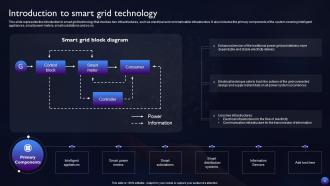
Slide 5: This slide represents the introduction to smart grid technology.
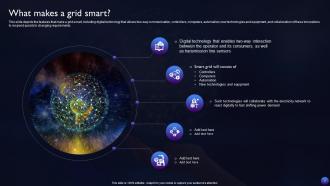
Slide 6: This slide depicts the features that make a grid smart.
Slide 7: This slide outlines the features of smart grid technology.
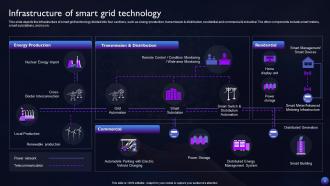
Slide 8: This slide displays the infrastructure of smart grid technology divided into four sections.
Slide 9: This slide includes the Heading for the Contents to be discussed next.
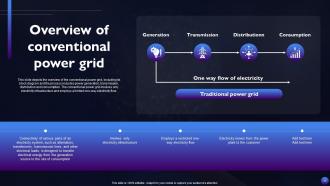
Slide 10: This slide portrays the overview of the conventional power grid.
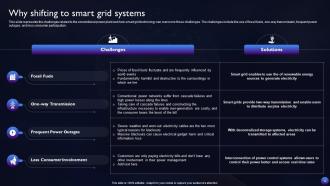
Slide 11: This slide represents the challenges related to the conventional power plant and how smart grid technology can overcome those challenges.
Slide 12: This slide contains the Title for the Ideas to be covered in the upcoming template.
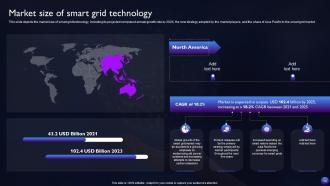
Slide 13: This slide depicts the market size of smart grid technology.
Slide 14: This slide highlights the Heading for the Ideas to be discussed in the next template.
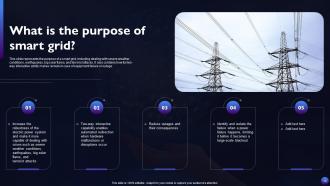
Slide 15: This slide represents the purpose of a smart grid.
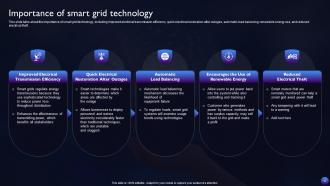
Slide 16: This slide reveals the Importance of smart grid technology.
Slide 17: This slide exhibits the Title for the Contents to be covered in the upcoming template.
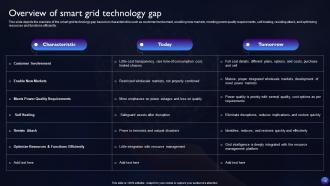
Slide 18: This slide depicts the overview of the smart grid technology gap.
Slide 19: This slide includes the Title for the Contents to be covered in teh upcoming template.
Slide 20: This slide describes the components of smart grid technology.
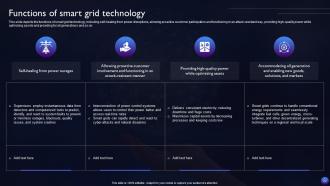
Slide 21: This slide depicts the functions of smart grid technology.
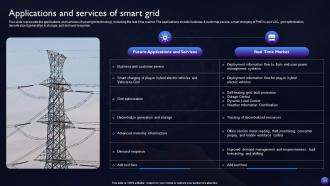
Slide 22: This slide represents the applications and services of smart grid technology, including the real-time market.
Slide 23: This slide portrays the Heading for the Topics to be discussed further.
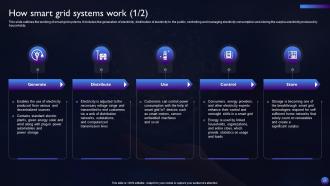
Slide 24: This slide outlines the working of smart grid systems.
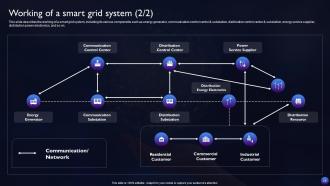
Slide 25: This slide describes the working of a smart grid system.
Slide 26: This slide includes the Title for the Topics to be covered in the upcoming template.
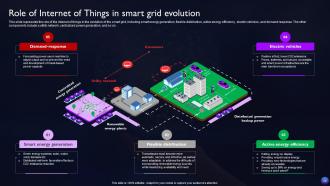
Slide 27: This slide represents the role of the internet of things in the evolution of the smart grid.
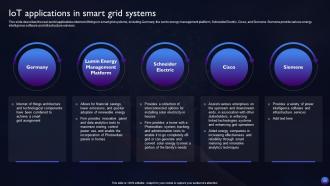
Slide 28: This slide describes the real-world applications internet of things in smart grid systems.
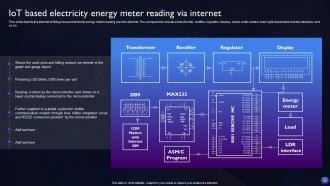
Slide 29: This slide depicts the internet of things based electricity energy meter reading over the internet.
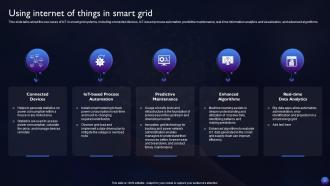
Slide 30: This slide talks about the use cases of IoT in smart grid systems.
Slide 31: This slide includes the Heading for the Contents to be discussed enxt.
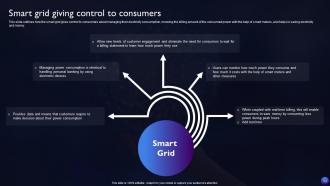
Slide 32: This slide outlines how the smart grid gives control to consumers.
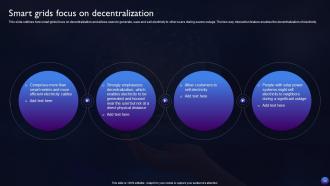
Slide 33: This slide portrays how smart grids focus on decentralization.
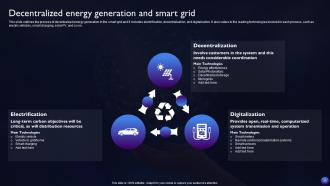
Slide 34: This slide exhibits the process of decentralized energy generation in the smart grid.
Slide 35: This slide presents the Title for the Idaes to be covered in the upcoming template.
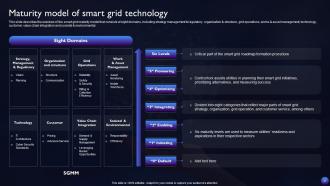
Slide 36: This slide describes the overview of the smart grid maturity model that consists of eight domains.
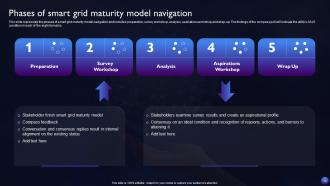
Slide 37: This slide reveals the Phases of smart grid maturity model navigation.
Slide 38: This slide talks about the levels of the smart grid maturity model.
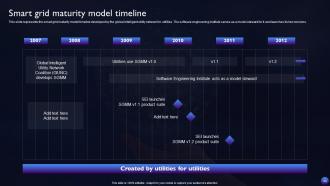
Slide 39: This slide represents the smart grid maturity model timeline developed by the global intelligent utility network for utilities.
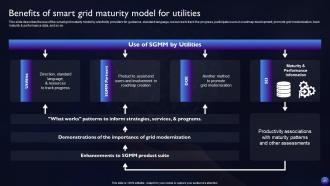
Slide 40: This slide describes the use of the smart grid maturity model by electricity providers.
Slide 41: This slide reveals the Heading for the Ideas to be discussed further.
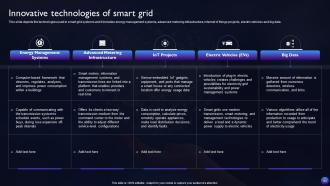
Slide 42: This slide depicts the technologies used in smart grid systems.
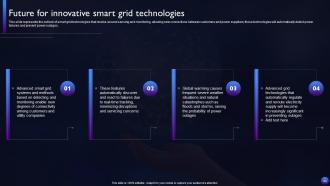
Slide 43: This slide shows the Future for innovative smart grid technologies.
Slide 44: This slide displays the Title for the Contents to be covered in the upcoming template.
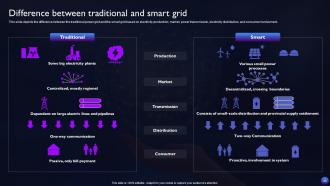
Slide 45: This slide highlights the Difference between traditional and smart grid.
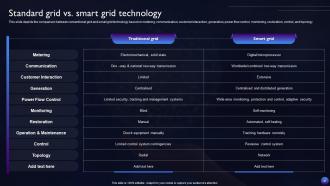
Slide 46: This slide depicts the comparison between conventional grid and smart grid technology.
Slide 47: This slide includes the Heading for the Topics to be discussed in the upcoming template.
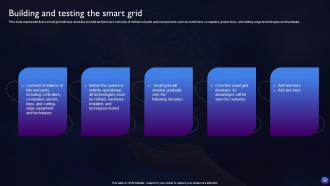
Slide 48: This slide represents that a smart grid will take decades to build and test as it consists of millions of parts and components.
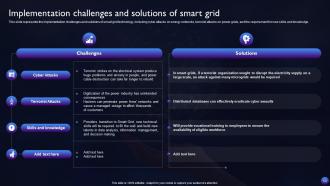
Slide 49: This slide deals with Implementation challenges and solutions of smart grid.
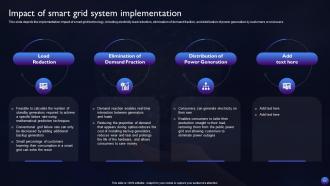
Slide 50: This slide highlights the Impact of smart grid system implementation.
Slide 51: This slide includes the Title for the Topics to be covered in the upcoming template.
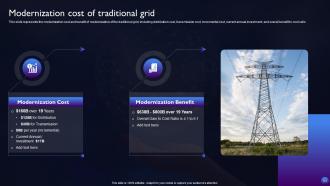
Slide 52: This slide represents the modernization cost and benefit of modernization of the traditional grid.
Slide 53: This slide presents the Heading for the Contents to be further discussed.
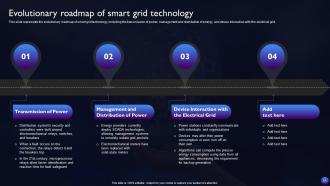
Slide 54: This slide represents the evolutionary roadmap of smart grid technology.
Slide 55: This slide contains the Title for the Ideas to be covered in teh next template.
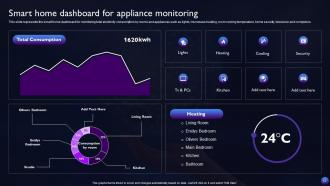
Slide 56: This slide represents the smart home dashboard for monitoring total electricity consumption by rooms and appliances.
Slide 57: This is the Icons slide containing all the Icons used in the plan.
Slide 58: This slide is used for depicting some Additional information.
Slide 59: This is the Quotes slide for motivation.
Slide 60: This slide elucidates information related to the Financial topic.
Slide 61: This slide exhibits the Mind map of the company.
Slide 62: This slide includes the organization's mission, vision, and values.
Slide 63: This is the 30,60,90 days plan slide for effective planning.
Slide 64: This is the Venn diagram slide.
Slide 65: This is the Thank You slide for acknowledgement.
Smart Grid Technology Powerpoint Presentation Slides with all 73 slides:
Use our Smart Grid Technology Powerpoint Presentation Slides to effectively help you save your valuable time. They are readymade to fit into any presentation structure.


















FAQs for Smart Grid Technology
So smart grids have a few key pieces - advanced metering (AMI), two-way communication networks, automated controls, and energy storage. It's basically like going from a flip phone to smartphone for the power grid. Demand response systems automatically tweak usage during busy times, plus you can plug in renewables like solar and wind. The cool part is how everything talks to each other and optimizes power flow instantly. Oh, and if this is for work - honestly I'd figure out your specific needs first before diving into all the tech specs. Way easier that way.
So basically, smart grids give you real-time info about your energy use and automatically balance power distribution. Traditional grids just push electricity one direction, but these use two-way communication to match supply and demand instantly. They'll redirect power during busy times and work way better with solar/wind stuff. Your appliances can even "talk" to the grid to run when electricity's cheaper - which honestly blows my mind a little. Bottom line: you get lower bills, more reliable power, and the whole system stops wasting so much energy through better coordination.
So smart grids are actually a game-changer for renewables. The main thing is they solve that whole inconsistency problem with solar and wind - you know, when it's cloudy or not windy enough. They use real-time data to balance everything automatically, storing extra power when there's too much and releasing it when you need more. Pretty cool that they can even predict weather patterns to get ahead of output changes. My neighbor just installed solar panels and honestly should've thought about grid compatibility first. Multiple renewable sources can work together without screwing up the whole system.
Honestly, smart grids are kind of a nightmare security-wise. Hackers could literally cause blackouts or mess with power flows - that's the scary part. Plus there's all the customer data getting transmitted everywhere, which is another headache. You're dealing with thousands of connected devices that each need protection. My old professor used to say it's like putting your power plant on the internet, which... yikes. Multi-layered security helps though. Encryption, constant updates, keeping critical systems separate from everything else. It's a lot but you kinda have to do all of it.
So smart grids let utilities see power usage in real time across their whole network. When demand spikes somewhere, they can automatically bump up prices or tell your smart appliances to chill for a bit. Like your water heater might wait 30 minutes if the grid's overloaded - honestly pretty clever. The old system was basically utilities guessing how much power people would use and hoping for the best. Now there's actual two-way communication happening. You get fewer blackouts, cheaper electricity, and way better efficiency. My neighbor's obsessed with tracking his usage through the app.
So AMI is basically how your utility company can actually talk to your smart meter in real-time. No more meter readers walking around once a month - now they get all your usage data automatically. Pretty cool actually. Two-way communication means you can see your own energy patterns, and they'll know about outages right when they happen. Dynamic pricing becomes possible too, which honestly can save you money if you're smart about when you run your dishwasher. Bottom line? You get way more control over costs and they fix problems faster.
So basically smart grids let your EV charge way more efficiently. Instead of everyone hitting the grid at 6pm and overloading it, the system spreads out charging during cheaper off-peak times. Dynamic pricing helps too - you'll pay less when demand is low. Your car can even sell power back to the grid, which honestly blows my mind. The whole thing adjusts based on how much solar and wind power is available. Oh, and definitely check if your utility has time-of-use rates for EVs. Could save you decent money.
Hey! So smart grids are actually pretty sweet investments. Automated outage detection saves tons since you're not sending crews out for every little thing. Same with remote meter reading - way more efficient. The big money maker though? Demand response programs where you basically pay customers to use less power during peak hours. Genius, right? Your system starts optimizing itself too, which helps with asset utilization. Most utilities I've heard about hit their ROI around 5-7 years. Definitely worth crunching the numbers for your area though.
Smart grids basically let you see what's happening across your whole electrical network in real-time. You can catch problems before they turn into massive outages. They've got sensors and automated controls that instantly reroute power around busted lines or failed equipment - kinda like when your GPS finds alternate routes during traffic jams. The system can even predict when components might fail based on usage patterns and weather. My cousin works for the utility company and he's always going on about this stuff. But honestly, if you're having reliability issues, smart grid tech should definitely be near the top of your list.
Dude, smart grids totally change how you think about electricity. You get real-time data showing exactly when you're using the most power - it's weirdly addictive trying to beat last month's usage. Time-of-use pricing means you'll start running your dishwasher at midnight when rates drop. Plus if you've got solar panels, you can actually sell power back to the grid (which feels pretty cool tbh). Instead of just paying whatever bill shows up, you're actively managing everything. Most people cut their usage by 10-15% once they can see what's happening.
So you're gonna need AMI systems first - that's your real-time data collection backbone. Communication networks are huge too, like fiber optic or wireless mesh to move all that info around. Honestly, cloud platforms are basically mandatory unless you want to drown in data volumes. Machine learning analytics help spot consumption patterns and forecast demand, which is pretty cool actually. Oh, and don't skip cybersecurity protocols - that stuff's critical. Edge computing speeds up local processing too. But real talk? Start by figuring out what gaps you've got in your current setup before diving into anything else.
Think of smart grids like your neighborhood's brain for energy. Your roof solar, that wind farm down the road, batteries - they're all chatting with each other constantly. When your panels make too much juice, the grid automatically sends it to your neighbor who needs it. Pretty slick, right? It balances everything in real-time without anyone having to think about it. Storage kicks in when the sun's not shining. Honestly, it's way smarter than the old "one massive power plant feeds everyone" setup we grew up with. Energy's becoming this local network thing now.
Smart grids basically make the whole energy system way more efficient - they automatically balance supply and demand so there's less waste. The cool part is how they handle renewables like solar and wind, which are normally unpredictable. Your house can even sell excess energy back to the grid. Utilities don't have to fire up those dirty backup power plants as much either. It's honestly a huge upgrade from our current system. One thing though - if you're thinking about solar panels, definitely check if your area has smart grid tech first. Makes a big difference.
Dude, regulatory stuff is huge for smart grid rollouts. Some states let utilities pass those upgrade costs to customers through rate hikes - those places move way faster. Others? Total nightmare. Their regulators are stuck in like 2005 or something and block everything. The good ones actually create incentives for utilities to modernize and hit renewable targets. Honestly, if you're planning deployment, figure out your state's cost recovery rules first. Save yourself the headache. Public utility commissions can make your project fly or die - it's wild how much power they have over this stuff.
Honestly, getting all these people to work together is like herding cats. Utilities need to actually talk to tech companies about data standards. Regulators have to write policies that don't suck (good luck with that). And somehow you've got to convince customers that new pricing models won't screw them over. Everyone's on different timelines too, which makes it even messier. My advice? Figure out who your main players are right away and set up regular check-ins. Those weekly meetings feel annoying but they'll save you from the "oh shit, nobody was doing that" disasters.
-
Wow! The design and quality of templates on SlideTeam are simply the best.
-
Thank you for offering such helpful pre-designed templates. They are really beneficial to me in my job.