


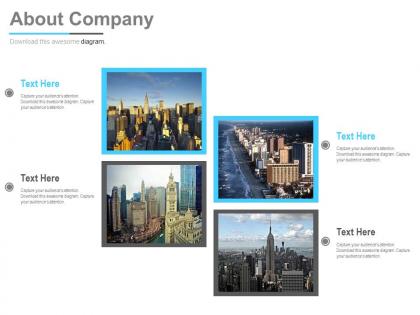
Different cities introduction portfolio powerpoint slides




Try Before you Buy Download Free Sample Product
 Impress Your
 Audience
 100%
100% Editable
 Save Hours
 of Time


Our Different Cities Introduction Portfolio Powerpoint Slides generate furious activity. They will experience a gush of energy.
People who downloaded this PowerPoint presentation also viewed the following :
Different cities introduction portfolio powerpoint slides with all 4 slides:
Crunch the numbers with our Different Cities Introduction Portfolio Powerpoint Slides. You will provide definitive answers.
FAQs for Different cities introduction
An effective city portfolio includes comprehensive demographic analysis, economic development strategies, infrastructure assessments, sustainability initiatives, and governance frameworks. These components work together by providing data-driven insights, strategic planning tools, and performance metrics, with many municipal governments finding that integrated portfolios enhance resource allocation, attract investment opportunities, and ultimately deliver improved citizen services.
A city portfolio enhances branding by showcasing key assets, successful projects, economic opportunities, and quality of life indicators in a cohesive, professional format. This strategic presentation enables cities to attract investors, tourists, and businesses more effectively, while demonstrating competitive advantages to potential residents and partners, ultimately delivering stronger economic development outcomes.
Key metrics for evaluating city portfolio success include economic indicators like GDP growth and employment rates, quality of life measures such as healthcare access and education outcomes, infrastructure efficiency ratings, environmental sustainability scores, and fiscal health assessments. These comprehensive metrics enable city leaders to balance economic development with livability standards, ultimately delivering improved citizen services and competitive urban advantages that attract businesses and residents.
City portfolios differ significantly across environments, with urban areas emphasizing high-density infrastructure, public transit systems, and mixed-use developments, while suburban portfolios focus on residential zones, commercial centers, and road networks. Rural portfolios prioritize agricultural land management, resource extraction, and connectivity infrastructure, with many municipalities finding that tailored approaches deliver better resource allocation and community outcomes.
Public-private partnerships enable cities to leverage private sector expertise, financing, and innovation while maintaining public oversight and community benefit objectives. Through strategic collaborations in infrastructure, housing, transportation, and smart city initiatives, municipalities can accelerate portfolio development, reduce public financial burden, and deliver enhanced services, with many cities finding that these partnerships ultimately provide greater scalability and operational efficiency than traditional public-only approaches.
Technology enables dynamic city portfolios through IoT sensors, real-time data analytics, AI-powered predictive modeling, blockchain for transparent governance, and integrated digital platforms that connect infrastructure systems. These technologies streamline urban planning, enhance resource allocation, and automate service delivery, with cities like Barcelona and Singapore finding that smart city frameworks ultimately deliver improved citizen experiences and operational efficiency.
Sustainability considerations for city portfolios include renewable energy integration, green infrastructure development, waste management systems, water conservation strategies, and carbon footprint reduction initiatives. These approaches streamline urban resource allocation by enhancing environmental resilience, reducing operational costs, and improving citizen quality of life, with many municipalities finding that sustainable portfolios deliver long-term competitive advantages while attracting environmentally conscious residents and businesses.
City portfolios should be updated quarterly for major developments and annually for comprehensive reviews, with real-time updates for significant projects or policy changes. This strategic approach ensures portfolios accurately reflect evolving urban landscapes, infrastructure improvements, and economic developments, with many municipal governments finding that regular updates enhance investor confidence, support grant applications, and maintain competitive positioning in an increasingly dynamic urban development environment.
Common pitfalls include neglecting stakeholder engagement, overlooking data quality and accessibility, failing to align projects with strategic objectives, underestimating resource requirements, and insufficient risk assessment protocols. These challenges can derail urban initiatives by creating disconnected projects, budget overruns, and community resistance, with many cities finding that comprehensive planning and continuous stakeholder communication ultimately delivers more sustainable outcomes.
Citizen feedback can be integrated into city portfolios through digital platforms, community surveys, public forums, social media monitoring, and mobile applications that capture real-time input on services and infrastructure. These engagement mechanisms enable city managers to track satisfaction metrics, identify priority areas, and demonstrate responsive governance, ultimately enhancing public trust and service delivery effectiveness.
Demographic changes significantly influence city portfolios by reshaping infrastructure priorities, housing demands, transportation needs, and service allocations to reflect evolving population characteristics. Cities experiencing aging populations, youth migration, or cultural diversification must strategically realign their portfolios, with many municipalities finding that demographic-responsive planning ultimately delivers more targeted public services, enhanced community satisfaction, and sustainable urban development outcomes.
Cities can access urban planning software, GIS mapping systems, stakeholder engagement platforms, financial modeling tools, and sustainability assessment frameworks to develop comprehensive portfolios. These resources enable municipalities to streamline project planning, enhance community participation, and optimize resource allocation, with many cities finding that integrated digital platforms ultimately deliver more transparent governance and improved citizen services.
Storytelling enhances city portfolios by creating emotional connections, simplifying complex urban data, and making achievements more memorable for stakeholders and investors. Through compelling narratives, cities can transform technical metrics into relatable success stories, showcase community impact alongside infrastructure developments, and build stronger cases for funding, ultimately delivering greater stakeholder engagement and strategic support.
Cities can balance their portfolios by presenting assets strategically alongside transparent acknowledgment of ongoing challenges, emphasizing improvement trajectories and investment opportunities rather than avoiding difficult topics. Through integrated storytelling, cities like Detroit and Pittsburgh showcase economic diversification, infrastructure modernization, and community revitalization projects, ultimately demonstrating resilience and forward momentum that attracts investors while maintaining credibility.
Successful city portfolio examples globally demonstrate strategic diversification across economic sectors, robust public-private partnerships, and data-driven urban planning that prioritizes sustainability and innovation. Cities like Singapore, Copenhagen, and Barcelona showcase integrated approaches combining smart infrastructure, talent retention programs, and adaptive governance frameworks, ultimately delivering enhanced livability, economic resilience, and competitive positioning in increasingly interconnected global markets.
-
Appreciate the research and its presentable format.
-
Top Quality presentations that are easily editable.