


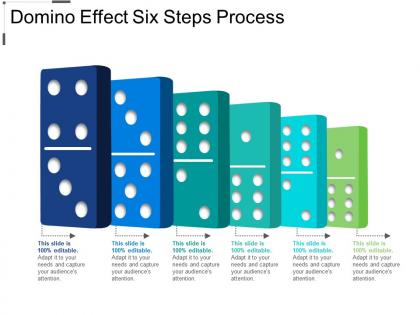
Domino effect six steps process




Try Before you Buy Download Free Sample Product
 Impress Your
 Audience
 100%
100% Editable
 Save Hours
 of Time


Our Domino Effect Six Steps Process are as good as a barcode. They contain all the applicable data.
People who downloaded this PowerPoint presentation also viewed the following :
Domino effect six steps process with all 5 slides:
Increase your social quotient with our Domino Effect Six Steps Process. Befriend your audience with your views.

FAQs for Domino effect
So you know how knocking over one domino makes the whole line fall? That's basically what happens with people too. Someone leaves work early and suddenly half the office is doing it. Or one person starts clapping and boom - everyone's applauding. I swear it's like we're all just waiting for permission sometimes. Your small actions actually influence way more people than you'd think. Pretty wild when you realize it. If you want something to change in your group, just start doing it yourself first. Others will follow.
Dude, the domino effect makes executives paranoid about every decision. They spend forever mapping out consequences because one move can mess up like five different departments. Honestly, some meetings drag on way too long over tiny changes – it's kinda ridiculous. But there's an upside: teams actually talk to each other more now since everyone needs to weigh in. You can't just make choices in a vacuum anymore. My advice? Always think "what breaks next?" and loop in anyone who might get screwed over by your call.
Markets are crazy interconnected - one thing breaks and suddenly everything's falling apart. Remember Lehman in 2008? Banking mess turned into housing crash, credit freeze, people stopped buying stuff, global markets tanked. It's honestly kind of scary how fast things spread now. Supply chain gets messed up in Asia and boom, your grocery prices jump here. Works the other way too though. Tech breakthrough creates jobs, people spend more, economy grows. I swear I notice these chain reactions everywhere once you start looking for them in your analysis.
Yeah, so the Arab Spring's probably the best example - that fruit vendor in Tunisia basically started a domino effect across the whole region. Same thing happened in '89 when Hungary opened its borders and communist governments just started falling everywhere. Oh, and the American Revolution totally inspired the French one, though theirs went completely off the rails. Social media makes everything happen way faster now too. When you're looking at political movements, find that initial spark event - there's usually tons of anger already bubbling under the surface waiting to explode.
Honestly, once you get how the domino effect works, you'll start seeing project disasters coming from miles away. Map out those dependencies early - trust me on this. Our designer got sick last month and boom, three teams were just sitting around doing nothing! So frustrating. The trick is figuring out your critical path first, then build in some buffer time for the really important stuff. Think of your whole project like dominoes lined up. Where are the weak spots? Those are where you need backup plans, because one little push and everything goes sideways fast.
Honestly, the domino effect is everything when it comes to going green. Start with one big move - like renewable energy - and watch it snowball. Your costs drop, so boom, more budget for other eco stuff. Plus you'll attract better employees who actually care about this stuff. Brand reputation gets a boost too, and suppliers start copying what you're doing. It's wild how it spreads. Kind of like when you clean one drawer and suddenly you're Marie Kondo-ing your entire life! Focus on changes that hit multiple departments at once - that's where you get the biggest ripple effect going.
Try setting up activities where students actually need each other's work to move forward. Like research chains - one person gathers background info, next builds analysis from that, then someone else creates the presentation. Can't skip ahead without the previous step being done well. Jigsaw activities work great for this too. Honestly, I've seen kids get way more invested when they know their teammate is counting on them to deliver something solid. It's like academic relay racing but actually fun. Collaborative storytelling is another good one - each person adds a chapter and you're stuck if the previous writer didn't finish.
Think of it like dominoes falling - one marketing action triggers the next. Get influencers to create content, then their followers start making their own posts, which becomes social proof for everyone else. Referral programs are gold for this too. One happy customer brings friends, who bring more friends. Sequential emails work the same way - each one builds on the last to guide people through your sales process. Honestly, I'd start by mapping out where customers interact with your brand. Look for spots where you can naturally create these chain reactions. It's pretty satisfying when it all connects!
So basically we copy what we see around us - it's called social contagion. You know how one grumpy person ruins the whole vibe? That's your brain automatically mirroring their energy. Then there's reciprocity, where we feel this weird obligation to match how people treat us. Your brain also does this thing where it hunts for reasons to justify being negative back to someone (confirmation bias, but whatever). I swear I catch myself doing this all the time. The cool part though? You can flip it. Start with the energy you actually want back and watch it spread.
Okay so basically, public health campaigns are all about that domino effect. You get one influential person or org on board, and suddenly everyone else wants in too - it's social proof but way more powerful. I've seen it work firsthand and it's pretty wild how fast things can spread. But here's the thing that keeps me up at night: if those first few dominoes fall the wrong way? You're screwed. One bad experience goes viral and kills community trust instantly. That's why I always tell people to obsess over those first key players - they'll make or break everything.
Okay so three main things to think about here. First - don't put everything in one basket, you know? Spread your suppliers, revenue sources, key people around so one failure doesn't kill you. Second thing is setting up systems that actually catch problems early, before they snowball into disasters. I made this mistake once and wow, learned my lesson fast! Also build backup plans for your critical stuff and actually practice them - not just write them down and forget. Oh and redundancy is huge for your weak spots. Keep communication super open too so problems come to light instead of hiding until they explode.
Flowcharts with arrows work great for this - or timeline animations if you're doing it digitally. Actually saw someone use real domino footage once which was pretty cool. Make each step visually different so people can actually follow along. Don't overcomplicate it though. Consistent colors for each stage, and reveal them one by one as you talk. Otherwise everyone just reads ahead instead of listening to you. I'd build slides where each consequence pops up when you explain it. Keeps things way more engaging than dumping everything on screen at once.
For domino effect stuff, I'd go with Monte Carlo simulations first - they're solid for probability scenarios. Agent-based modeling is where it gets interesting though. AnyLogic and NetLogo are both decent platforms, especially when you need to see how individual pieces interact. Think supply chain mess-ups or financial contagion spreading. Neural networks can work too if you've got tons of historical data to feed them. Honestly though? Start simple with Monte Carlo in Python or R, test your assumptions there. You can always get fancy with ABM later if you need it. Really depends on what you're modeling and how clean your data is.
Honestly, start small with stuff that'll make everyone's daily grind easier - like fixing that one annoying process we all deal with. People get excited when they see quick wins, then they're actually down for the next change. Way better than trying to flip everything upside down at once (learned that the hard way). Map out which tweaks will ripple through different teams. The trick is picking changes that genuinely help people do their jobs better. Once a few folks are on board, that energy spreads naturally. Trust me, it works.
So basically when one crisis hits, it sets off this whole chain reaction that can mess things up for decades. Look at 2008 - banks are still being way more careful about loans because of that disaster. The problem is each crisis actually makes us weaker for the next one, which honestly feels pretty depressing when you think about it. People lose faith in institutions, economies get shakier, and there's this weird "crisis fatigue" thing where bouncing back takes forever. Building backup systems ahead of time helps, plus keeping good relationships with other countries. But yeah, it's kinda like dominoes - once they start falling, good luck stopping them.
-
Amazing product with appealing content and design.
-
Easily Editable.