

Driver diagram plan template ppt example 2017




Try Before you Buy Download Free Sample Product
 Impress Your
 Audience
 100%
100% Editable
 Save Hours
 of Time


Driver diagram plan template PPT example 2017 PowerPoint slide is an outstanding model for presenting analytical reports on the business or market drivers. Needless to say that in order to gain beneficial and productive results in any business, the framework of the new ideas has to be clear and comprehensible in the mind of creator. By using this business force blueprint 2017 PowerPoint slide, the creator will make a successful attempt in expressing his / her new ideas to the team, employees, business partner(s) in the context of primary and secondary drivers which are in force in the business or market and are to be considered to achieve the destination. The incorporated components of this PowerPoint presentation have been adequately and purposely designed by our professionals keeping the view of making your presentation more professional, clear and precise. Submit this statistics key forces diagram plan 2017 PPT and draw the attention, focus and interest of your employees, workers, business partners, team members and / or colleagues, which will surely create curiosity and urge in them to follow your plan and ideas. Undoubtedly, this slideshow will make your new creative ideas more understandable and the concerned will be able to implement it as per your visionary ideas. Folks feel compelled to hear you out with our Driver Diagram Plan Template Ppt Example 2017. Their attention gets drawn to your ideas.
People who downloaded this PowerPoint presentation also viewed the following :
Content of this Powerpoint Presentation
Description:
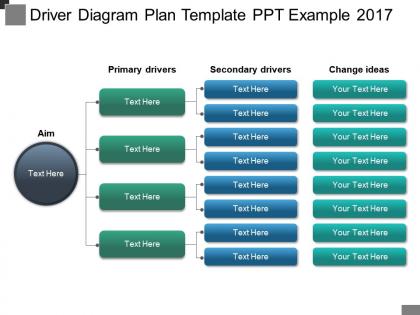
The image presents a PowerPoint slide with a driver diagram template from 2017. A driver diagram is a tool used to visually display the logical relationships between the aim of a project or strategy, its primary drivers, secondary drivers, and change ideas:
The diagram starts with an "Aim," which is the main objective or goal. This is typically a broad statement of what the project or initiative is intended to achieve. In this template, there's a place to input the specific aim in the gray circle on the left side.
Branching off from the aim is "Primary Drivers," which are major elements or areas that need to be addressed to achieve the aim. These are represented by green rectangles, and they are directly linked to the aim, signifying their direct impact on achieving the goal.
Each primary driver has associated "Secondary Drivers," depicted by blue rectangles. These are more detailed factors that influence the primary drivers. They represent specific areas to focus on or actions that need to be taken to impact the primary drivers positively.
Lastly, there are "Change Ideas," shown in teal rectangles, which are specific interventions or actions that one could implement to affect the secondary drivers.
Use Cases:
This type of slide can be utilized in multiple industries for strategic planning and project management, including:
1. Healthcare:
Use: Patient care improvement projects.
Presenter: Healthcare Administrator.
Audience: Medical staff, department heads.
2. Education:
Use: School improvement plans.
Presenter: School Principal.
Audience: Teachers, school board.
3. Manufacturing:
Use: Process optimization initiatives.
Presenter: Operations Manager.
Audience: Production team, stakeholders.
4. Technology:
Use: Product development strategies.
Presenter: CTO or Product Manager.
Audience: Development team, investors.
5. Consulting:
Use: Organizational change management.
Presenter: Senior Consultant.
Audience: Client leadership teams.
6. Non-Profit Organizations:
Use: Program impact strategies.
Presenter: Program Director.
Audience: Staff, volunteers, donors.
7. Government:
Use: Policy implementation plans.
Presenter: Policy Analyst.
Audience: Government officials, public stakeholders.
Driver diagram plan template ppt example 2017 with all 5 slides:
Our Driver Diagram Plan Template Ppt Example 2017 follow established etiquette. They adhere to accepted norms.
FAQs for Driver diagram plan template
A driver diagram is a visual framework that maps the relationship between primary drivers, secondary drivers, and specific change ideas to achieve a project's aim or goal. In project management, teams use these diagrams to systematically identify improvement opportunities, prioritize initiatives, and track cause-and-effect relationships, with many organizations finding that this structured approach streamlines decision-making and enhances project outcomes.
A driver diagram template helps visualize complex processes by breaking them into primary drivers, secondary drivers, and change ideas, creating clear cause-and-effect relationships that stakeholders can easily understand. Through structured mapping, organizations streamline process analysis, identify improvement opportunities, and enhance team alignment, with many healthcare systems and manufacturing companies finding that these visual frameworks ultimately accelerate decision-making and strategic implementation.
Driver diagram templates include primary drivers, secondary drivers, outcome measures, process measures, and change ideas. These components work together by connecting strategic objectives to specific actions, enabling organizations to visualize cause-and-effect relationships, track progress systematically, and implement targeted improvements, ultimately delivering measurable results and enhanced operational efficiency.
A driver diagram facilitates goal-setting by visually connecting high-level strategic objectives to specific drivers, intermediate outcomes, and actionable initiatives through a structured hierarchy. This approach enables organizations to break down complex goals into measurable components, identify key performance indicators, and align cross-functional teams around shared priorities, ultimately delivering clearer accountability and faster strategic execution.
Driver diagram templates are most commonly utilized in healthcare for patient safety initiatives, manufacturing for quality control processes, financial services for risk management, and public sector organizations for performance improvement programs. These industries leverage driver diagrams to systematically identify improvement opportunities, streamline complex operational challenges, and ultimately deliver measurable outcomes while enhancing organizational efficiency and competitive advantage.
Driver diagrams are highly valuable for non-profit organizations, helping them map the relationship between their mission, strategic initiatives, and measurable outcomes like donor engagement, volunteer retention, and community impact metrics. These visual tools enable non-profits to streamline resource allocation, demonstrate accountability to stakeholders, and enhance program effectiveness, with many organizations finding that clear cause-and-effect mapping ultimately delivers improved transparency and stronger results in achieving their social missions.
Customizing driver diagram templates effectively involves aligning primary drivers with strategic objectives, selecting relevant secondary drivers that directly influence outcomes, and incorporating organization-specific metrics and terminology. Healthcare systems, manufacturing companies, and financial institutions find that tailoring visual elements, color coding by priority levels, and including sector-specific KPIs enhances team understanding while delivering clearer strategic focus and improved implementation success.
Driver diagrams differ from traditional flowcharts by focusing on cause-and-effect relationships between strategic outcomes, primary drivers, and secondary drivers, rather than sequential process steps. While flowcharts map procedural workflows, driver diagrams strategically connect improvement initiatives to desired results, enabling organizations to visualize how specific actions influence key performance indicators and ultimately deliver measurable business outcomes.
Data serves as the foundation for developing accurate driver diagrams by identifying key performance indicators, validating cause-and-effect relationships, establishing baseline measurements, and prioritizing improvement opportunities based on statistical evidence. Through comprehensive data analysis, organizations can create more targeted interventions, track meaningful outcomes, and ensure their driver diagrams reflect actual operational realities rather than assumptions, ultimately delivering measurable improvements and strategic advantage.
Teams ensure stakeholder alignment using driver diagrams by creating visual clarity around shared objectives, key drivers, and specific change ideas that connect everyone's efforts to measurable outcomes. This structured approach enables cross-functional collaboration, eliminates conflicting priorities, and establishes accountability frameworks, with many organizations finding that transparent cause-and-effect mapping significantly improves project coordination and strategic focus.
Common pitfalls when creating a driver diagram include defining vague objectives, selecting drivers without clear data support, creating overly complex hierarchies, and failing to involve key stakeholders in the development process. These challenges often result in diagrams that lack strategic focus and actionability, with many organizations finding that successful driver diagrams require iterative refinement, cross-functional input, and regular validation against measurable outcomes to maintain effectiveness.
Driver diagram templates integrate into existing project management tools through API connections, direct imports, and collaborative dashboards that sync with platforms like Asana, Monday.com, and Microsoft Project. These integrations enable teams to automatically track driver metrics, update progress indicators, and maintain real-time visibility across departments, ultimately streamlining strategic alignment while enhancing operational efficiency.
Driver diagrams enhance communication within teams by providing a shared visual framework that connects strategic objectives to specific actions, creating clarity around roles, dependencies, and progress tracking. Through structured cause-and-effect relationships, teams can better align priorities, identify gaps in understanding, and facilitate focused discussions, with many organizations finding that these templates streamline decision-making and accountability across departments.
Feedback can be effectively incorporated by regularly reviewing driver relationships with stakeholders, updating primary and secondary drivers based on performance data, and adjusting metrics through structured feedback sessions. Organizations in healthcare and manufacturing enhance their driver diagrams by conducting quarterly reviews, integrating frontline insights, and modifying outcome measures, ultimately delivering more accurate strategic alignment and improved operational efficiency.
Teams can enhance their driver diagram skills through structured training programs, online courses, quality improvement workshops, peer collaboration sessions, and mentorship from experienced practitioners. Healthcare systems, manufacturing companies, and service organizations increasingly find that combining formal training with hands-on practice sessions delivers faster skill development and more effective process improvement outcomes.
-
Very unique and reliable designs.
-
Commendable slides with attractive designs. Extremely pleased with the fact that they are easy to modify. Great work!