


Edgar schein organisational culture model




Try Before you Buy Download Free Sample Product
 Impress Your
 Audience
 100%
100% Editable
 Save Hours
 of Time


Drive home the advantage of functioning as a group with our Edgar Schein Organisational Culture Model. Create a desire for cohesion.
People who downloaded this PowerPoint presentation also viewed the following :
Content of this Powerpoint Presentation
“The culture of a workplace – an organization’s values, norms and practices – has a huge impact on our happiness and success.” ~Adam Grant
When the organization's culture is deeply rooted in the mission of the company, it can increase employee productivity, build a reputed brand image, and often help retain top talents.
In the words of Edger Schein, culture can be determined at different levels by focusing on learning and group dynamics. It does not happen in one day; it is shaped by experiences and practiced every day to form a workplace culture.
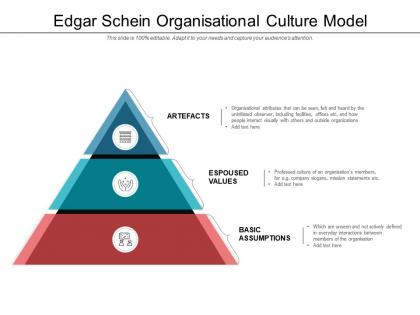
As a strategic leader, when you apply this model to your organization, you analyze three interconnected layers, namely, artefacts, espoused values, and underlying beliefs.
What are these three levels?
-
Artefacts: Visible aspects of culture including dress code, rituals, physical environment, and communication style.
-
Espoused Values: Corporate policies, mission and vision statements, forming a company philosophy.
-
Basic Underlying Assumptions: The former perceived assumptions that are developed due to interactions and attitude.
Explore the organizational culture PPT bundle here to analyze your company’s culture structure.
Slideteam’s PPT templates are customizable, which means you can identify the elements of the Edgar Schein organizational culture model according to your organizational differences. This template can transform complex concepts into more straightforward and more understandable forms. They are 100% editable and customizable.
Let's head straight to the explanation of this slide, which can help you better manage your culture.
Template 1: Edgar Schein Organizational Culture Model PPT Template
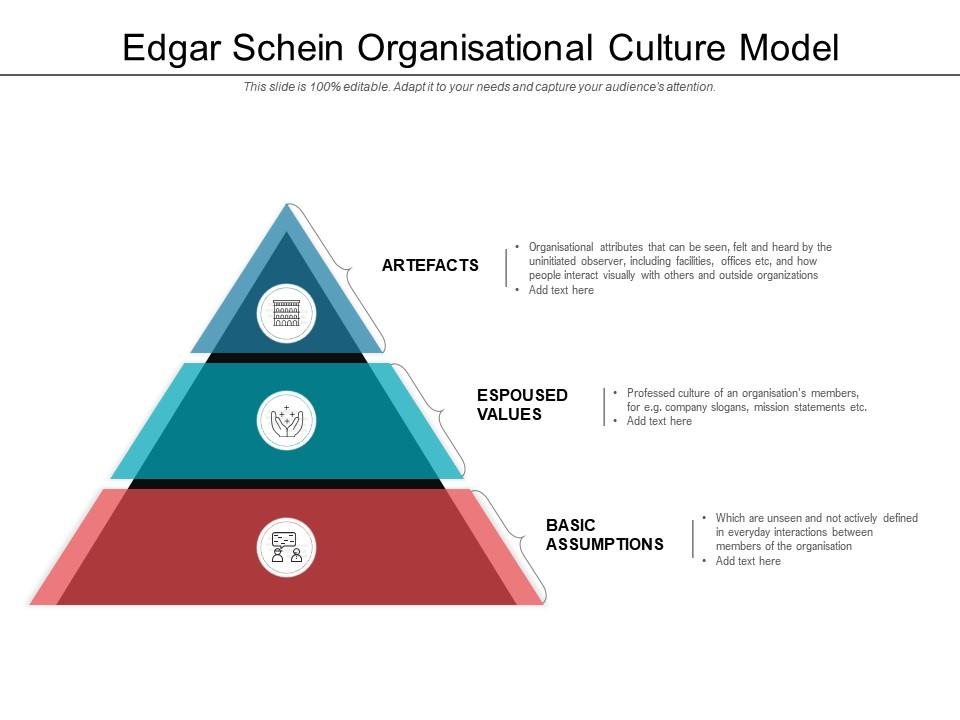
This slide will demonstrate your organizational culture in three steps or levels. You can add your logo and information to get started. You can explain this specific model to explain the elements with clarity. Your audience will get an understanding of the current organizational culture and gather insights about the strengths, weaknesses and areas of improvement.
Use this template to make your new team aware of the organization's culture and to set a benchmark that they need to follow. It will focus on aligning the culture with the strategy for developing an environment that supports organizational goals. By opening up the core elements, you are in a better position to communicate and collaborate with everyone in order to develop a culture that truly thrives.
Turning into a Useful Way to Think About Organizational Culture!
Schein’s model of organizational culture provides a comprehensive framework to unlock the complex layers of the culture. The purpose is to create an understanding and realize how effectively it can interact with the behavior of the organization. Organizational culture templates will make your presentation quick and appropriate. Focus on three levels at a deeper level and embrace the change with the instant download of this slide!
Edgar schein organisational culture model with all 2 slides:
Discover an assortment of choices with our Edgar Schein Organisational Culture Model. Find an entire array of alternatives.
FAQs for Edgar schein
So there's this whole iceberg thing with culture - artifacts at the top, then espoused values, and basic assumptions way down deep. Start with artifacts since they're obvious. Office setup, how people dress, weird company rituals. That stuff's easy to spot. Espoused values are what leadership claims they believe in - you know, all those mission statements and core values posters. But here's where it gets interesting. Basic assumptions are the real drivers - unconscious beliefs people don't even know they have. Honestly, this is where most companies fool themselves because nobody wants to admit what's actually going on beneath the surface. My advice? Begin with what you can see first.
So artifacts are basically all the stuff you can actually see and touch at a company - office setup, how people dress, their weird meeting rituals, even the jargon everyone throws around. Pretty straightforward, right? Wrong. Here's where it gets tricky though: just because you can spot these things easily doesn't mean you'll understand what they actually represent. Like, open offices might scream "we're collaborative!" but maybe everyone just hates it and works from home whenever possible. The visible stuff is honestly the most misleading part of figuring out company culture. You've got to look way deeper.
So in Schein's model, values are like the middle layer - they connect what people actually do with those deep unconscious beliefs everyone carries around. They're your company's decision-making guide, telling folks "this is our way." But here's the thing that trips people up: what companies *say* they value isn't always what they actually reward. You'll figure out the real values by watching what happens when things get stressful - who gets promoted, what gets resources, that kind of stuff. Those gaps between talk and action? That's where the truth lives.
Okay so underlying assumptions are like the invisible rules everyone follows without thinking about it. They're buried super deep in Schein's model - way below the stuff you can actually see. These beliefs are so automatic that nobody questions them, which is honestly why changing company culture is such a nightmare. You could spend forever tweaking the surface-level things, but if you don't dig down and figure out what these hidden assumptions actually are, you're basically just moving furniture around. They end up controlling everything - your values, your day-to-day practices, all of it flows from these unconscious beliefs.
Just become a workplace detective for a week! Walk around and actually look at stuff - how people dress, their desk setups, office layouts. Listen to the stories people tell about "how we do things" and what gets praised in meetings. The language everyone uses is super telling too. Honestly, it's like being an anthropologist but you don't have to travel anywhere lol. Don't focus on random one-time things though. Look for patterns that show what your company really cares about versus what they claim in those cheesy mission statements.
Artifacts are all the visible stuff you can actually observe in an organization - office layouts, dress codes, logos, those mission statements plastered on walls. Meeting rituals matter too. So does language - are people calling the CEO "Bob" or "Mr. Johnson"? Even something random like where they put the coffee machine says something about the culture (though maybe I'm reading too much into that). But here's the thing - these are just surface-level clues. They don't tell you the whole story about what people actually believe or how things really work underneath.
So basically, your company culture gets shaped by all the external stuff you're dealing with - customer demands, regulations, competition, market pressures. Schein calls these "external adaptation challenges." Organizations develop shared ways of thinking and acting as responses to these outside forces. A tech startup's vibe is totally different from a bank's, right? That's the external environment doing its thing. I find it interesting how culture isn't just something that develops internally - it's actually your team's collective way of learning to survive in whatever specific context you're in. When you're trying to figure out your culture, always look at what environmental pressures helped create it.
Honestly, look at what your people actually see every day - that's where the real culture lives. Your hiring process, performance reviews, how you spend money... does any of it match those fancy values posters? I mean, saying "people first" while slashing training budgets is pretty transparent. Pick one core value and follow it through every single employee interaction. Where are the gaps? Leadership has to walk the walk too - and I'm talking consistently, not just when it's convenient. Start redesigning those systems one by one. It's tedious work but that's literally how culture shifts happen.
So Schein's thing is basically about peeling back layers - like an onion but less crying involved. You can't just change the surface stuff and call it a day. There are three levels: what people actually do, the beliefs underneath that, and then the really deep assumptions that nobody talks about but totally run the show. Most change fails because people only hit the first layer. You gotta work through all three if you want anything to stick. Start by figuring out what's really going on at each level first, then tackle them systematically. Otherwise you're just rearranging deck chairs.
Dude, communication is literally how culture spreads through your company. Every time leaders talk - whether it's big meetings or just chatting by the coffee machine - they're showing what actually matters. The informal stuff hits different though, way more impact than official emails. Your word choices, what you avoid mentioning, even your tone - all of it sends signals about what's really valued. Honestly, most people don't realize how much power they have here. Want to change your culture? Start with how you communicate. It's the biggest tool you've got.
So Schein's model breaks culture into three parts - what you actually see (artifacts), what people claim they care about (values), and the hidden stuff that really drives decisions (assumptions). Check if these match up. Your company might preach work-life balance while everyone's pulling 60-hour weeks - boom, there's your disconnect. I've seen this so many times. Watch daily behaviors first, then stack them against whatever's written in the employee handbook. The gaps will show you where the real culture lives versus what HR wants you to believe.
Schein's model works basically anywhere you've got established group dynamics. Mergers, leadership changes, dysfunctional teams - that kind of stuff. Honestly, it's most useful when you're trying to change actual behavior, not just update some policy nobody reads anyway. The model digs past all the surface-level mission statement BS to find what people really believe. I've watched it work in startups, hospitals, even government places. You need time though - like, real time to observe and talk to people at different levels. Don't go in expecting some magic overnight transformation.
Honestly, Schein's three-level thing is pretty solid for this. Look at your visible stuff first - office setup, how people dress, meeting vibes. That daily environment hits harder than most leaders realize. Next, get clear on your actual values and make sure your leadership team isn't just talking the talk. The deep layer is trickiest though - those underlying beliefs about trust and autonomy that nobody really discusses but everyone feels. I've seen companies nail the surface stuff but still have terrible culture because the deeper assumptions were toxic. You want all three levels telling the same story, otherwise people sense the disconnect immediately.
Honestly, the worst part is people don't even know they have these assumptions - they're totally invisible. Like, employees think "this is just how we do things" instead of realizing it's actually a choice. When you try questioning it, they freak out because it feels super threatening. Kind of like asking someone to walk backwards everywhere, you know? Short sentences work here. Your current systems keep reinforcing the same old thinking patterns too. You've got to help people see what they can't see first through real conversations. Then brace yourself - changing mindsets takes forever and requires serious patience before anything actually shifts.
So with remote culture, you're basically looking at digital stuff instead of office vibes. Same three levels though - artifacts are now like Slack etiquette and how people act on Zoom calls. Response times, emoji use (I know it sounds dumb but it actually matters). Values-wise, check if leadership preaches work-life balance but then side-eyes people who log off early. The deep assumptions part is huge here - does your company really trust remote workers or secretly think they're slacking? I'd start by looking at all your digital touchpoints. What messages are they actually sending about your culture?
No Reviews