


Effective cio transitions to create organizational value powerpoint presentation slides





Try Before you Buy Download Free Sample Product
 Impress Your
 Audience
 100%
100% Editable
 Save Hours
 of Time


A CIO is a high-ranking executive in charge of managing and successfully implementing a companys information and computer technology systems. In collaboration with the other C-level executives, the CIOs responsibility is to assist set and leading an organizations technology strategy. At present, the company wants to explain the requirement and processes of the CIO transition in the digitalization world, cover fundamental challenges faced by new CIOs and various ways to address those challenges, and provide details related to traditional and new roles of the CIO in creating organizational value. Here is an effectively designed template on Effective CIO Transitions that delivers the information on the role of CIO in building corporate value, required skills for an influential CIO role, primary reasons or CIO transition, three critical dimensions of CIO transition such as time allocation for CIO transition, talent management, and points to build a strong relationship within the business along with four scenarios of CIO transition. This template also covers details on common challenges faced by new CIO, multiple ways to address the challenges and benefits of CIO transition to the company. Customize this 100 percent editable template based on your needs. Get access now.
People who downloaded this PowerPoint presentation also viewed the following :
Content of this Powerpoint Presentation
Slide 1: This slide introduces Effective CIO Transitions to Create Organizational Value. State Your Company Name and begin.
Slide 2: This is an Agenda slide. State your agendas here.
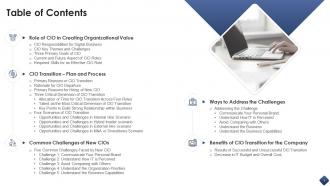
Slide 3: This slide shows Table of Content for the presentation.
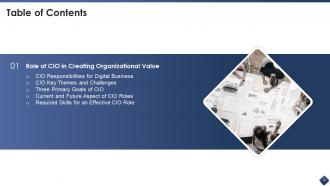
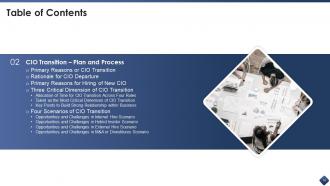
Slide 4: This slide presents Table of Content for the presentation.
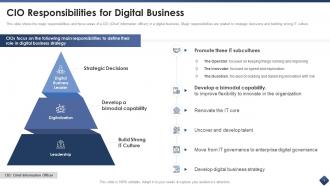
Slide 5: This slide shows the major responsibilities and focus areas of a CIO (Chief information officer) in a digital business.
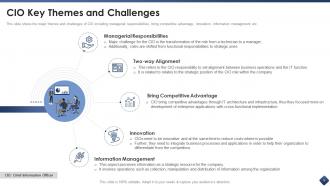
Slide 6: This slide displays the major themes and challenges of CIO including managerial responsibilities, bring competitive advantage, innovation, information management etc.
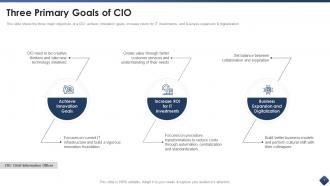
Slide 7: This slide represents the three major objectives of a CIO: achieve innovation goals, increase return for IT investments, etc.
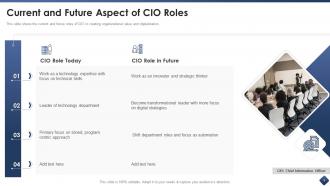
Slide 8: This slide shows the current and future roles of CIO in creating organizational value and digitalization.
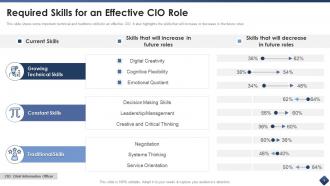
Slide 9: This slide presents some important technical and traditions skills for an effective CIO.
Slide 10: This slide shows Table of Content for the presentation.
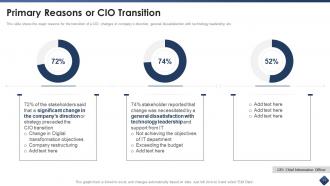
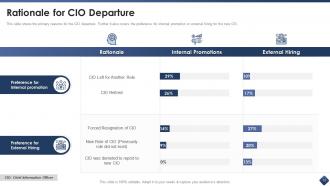
Slide 11: This slide displays the primary reasons for the CIO departure.
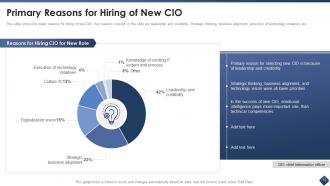
Slide 12: This slide represents the major reasons for hiring of new CIO. Key reasons covered in this slide are leadership and credibility, Strategic thinking, etc.
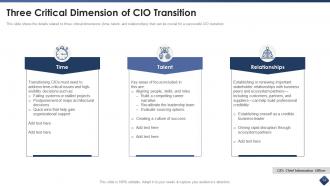
Slide 13: This slide shows the details related to three critical dimensions (time, talent, and relationships) that can be crucial for a successful CIO transition
Slide 14: This slide presents the details related to three critical dimensions (time, talent, and relationships) that can be crucial for a successful CIO transition
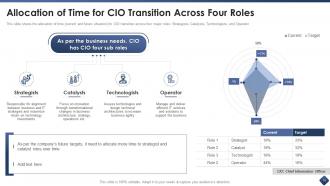
Slide 15: This slide shows the allocation of time (current and future situation) for CIO transition across four major roles.
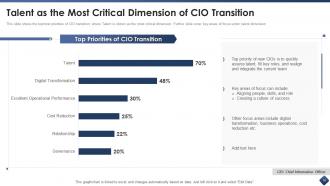
Slide 16: This slide displays the topmost priorities of CIO transition, where Talent is shown as the most critical dimension.
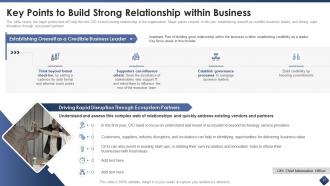
Slide 17: This slide represents the major points that will help the new CIO to build strong relationship in the organization.
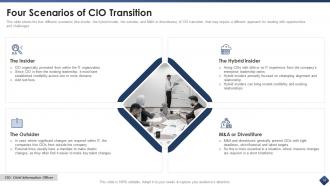
Slide 18: This slide shows the four different scenarios (the insider, the hybrid insider, the outsider, and M&A or divestitures) of CIO transition.
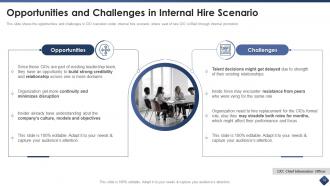
Slide 19: This slide presents the opportunities and challenges in CIO transition under internal hire scenario.
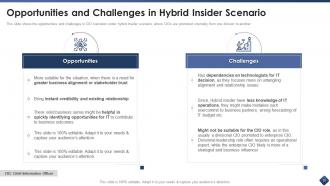
Slide 20: This slide shows the opportunities and challenges in CIO transition under hybrid Insider scenario.
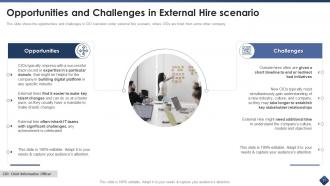
Slide 21: This slide displays the opportunities and challenges in CIO transition under external hire scenario.
Slide 22: This slide represents the opportunities and challenges in CIO transition under M&A or divestitures hire scenario.
Slide 23: This slide shows Table of Content for the presentation.
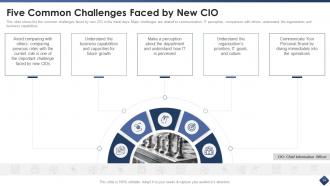
Slide 24: This slide presents the five common challenges faced by new CIO in the initial days.
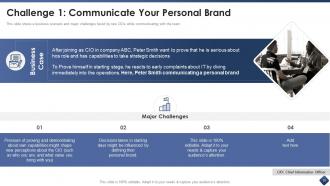
Slide 25: This slide shows a business scenario and major challenges faced by new CIOs while communicating with the team
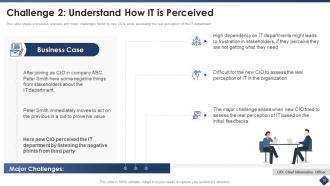
Slide 26: This slide displays a business scenario and major challenges faced by new CIOs while assessing the real perception of the IT department
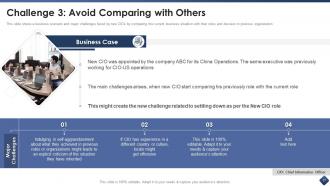
Slide 27: This slide represents a business scenario and major challenges faced by new CIOs by comparing the current business situation with their roles.
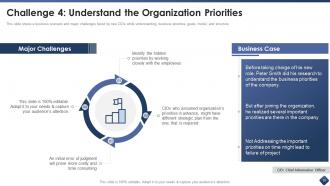
Slide 28: This slide shows a business scenario and major challenges faced by new CIOs while understanding business priorities.
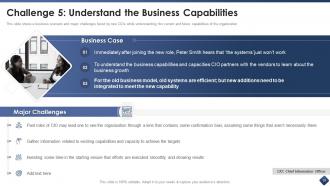
Slide 29: This slide presents a business scenario and major challenges faced by new CIOs while understanding the current and future capabilities of the organization
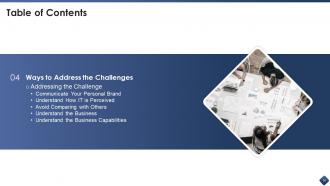
Slide 30: This slide shows Table of Content for the presentation.
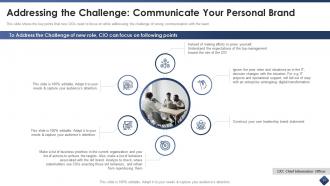
Slide 31: This slide displays the key points that new CIOs need to focus on while addressing the challenge of wrong communication with the team
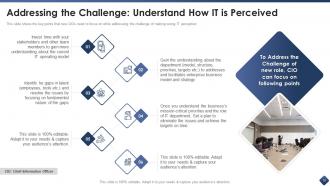
Slide 32: This slide represents the key points that new CIOs need to focus on while addressing the challenge of making wrong IT perception
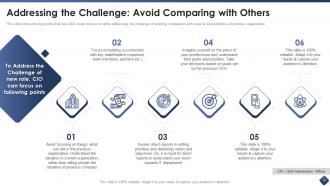
Slide 33: This slide shows the key points that new CIOs need to focus on while addressing the challenge of avoiding comparison with roles & responsibilities of previous organization.
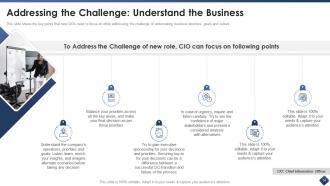
Slide 34: This slide presents the key points that new CIOs need to focus on while addressing the challenge of understating business priorities.
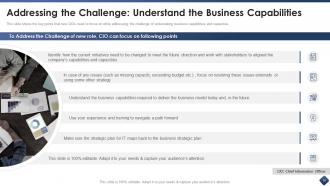
Slide 35: This slide shows the key points that new CIOs need to focus on while addressing the challenge of understating business capabilities and capacities.
Slide 36: This slide displays Table of Content for the presentation.
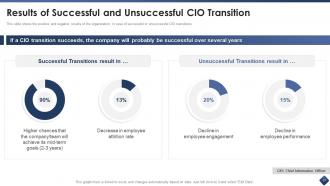
Slide 37: This slide represents the positive and negative results of the organization, in case of successful or unsuccessful CIO transitions
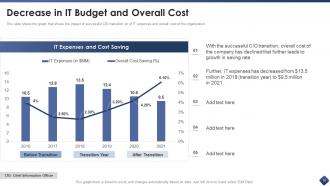
Slide 38: This slide shows the graph that shows the impact of successful CIO transition on of IT expenses and overall cost of the organization
Slide 39: This slide presents Icons for- Effective CIO Transitions to Create Organizational Value.
Slide 40: This slide is titled as Additional Slides for moving forward.
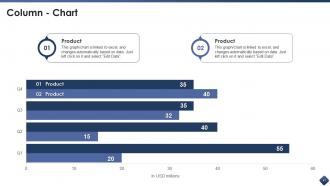
Slide 41: This slide displays Column chart with two products comparison.
Slide 42: This is About Us slide to show company specifications etc.
Slide 43: This is Our Goal slide. State your firm's goals here.
Slide 44: This is Our Mission slide with related imagery and text.
Slide 45: This is Our Team slide with names and designation.
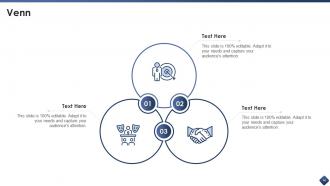
Slide 46: This slide displays Venn diagram with text boxes.
Slide 47: This is a Thank You slide with address, contact numbers and email address.
Effective cio transitions to create organizational value powerpoint presentation slides with all 47 slides:
Use our Effective CIO Transitions To Create Organizational Value Powerpoint Presentation Slides to effectively help you save your valuable time. They are readymade to fit into any presentation structure.






FAQs for Effective cio transitions to create organizational value
CIO transitions present challenges including knowledge transfer gaps, stakeholder relationship management, technology infrastructure assessment, team integration concerns, and strategic priority alignment. These obstacles can disrupt operational continuity and decision-making processes, with many organizations finding that structured transition planning, comprehensive documentation, and early stakeholder engagement ultimately streamline the process and minimize business disruption.
Effective communication involves comprehensive documentation of strategic initiatives, ongoing projects, stakeholder relationships, and technology roadmaps, while conducting structured knowledge transfer sessions. Through detailed handover meetings, the outgoing CIO can share critical insights about organizational culture, vendor relationships, and implementation challenges, ultimately ensuring continuity and enabling the incoming leader to build upon established foundations rather than starting from scratch.
Company culture significantly influences CIO transition success by determining stakeholder acceptance, collaboration levels, communication effectiveness, and change management approaches. Organizations with adaptive, innovation-focused cultures typically experience smoother leadership transitions, while rigid environments may present resistance challenges, with many technology leaders finding that early cultural assessment and alignment strategies ultimately deliver faster integration and stronger organizational support.
New CIOs can assess organizational technology through comprehensive IT audits, stakeholder interviews, system inventory reviews, performance analytics evaluation, and security assessments. These approaches streamline understanding by mapping current infrastructure, identifying integration gaps, and evaluating vendor relationships, with many executives finding that structured assessment frameworks ultimately deliver faster strategic decision-making and clearer technology roadmaps.
Ensuring IT strategy continuity requires comprehensive documentation of current initiatives, clear handover protocols, and stakeholder alignment sessions. Organizations can maintain momentum by establishing transition committees, preserving vendor relationships, and conducting thorough knowledge transfer meetings, while many companies find that appointing interim leadership and maintaining regular communication with key teams ultimately delivers seamless operations and strategic consistency.
Stakeholder engagement significantly impacts CIO transitions by building trust, ensuring alignment with business objectives, securing necessary resources, and facilitating smoother organizational change management. Through strategic communication with board members, department heads, and IT teams, incoming CIOs can accelerate integration, minimize resistance, and establish credibility, ultimately delivering faster implementation of technology initiatives and stronger cross-functional collaboration.
New CIOs should prioritize stakeholder meetings, IT infrastructure assessments, team evaluations, strategic alignment reviews, and quick-win identification during their first 90 days. This comprehensive approach enables understanding organizational needs, building crucial relationships, and establishing credibility, while many successful CIOs find that balancing immediate operational improvements with long-term strategic planning ultimately delivers enhanced IT performance and business alignment.
New CIOs can leverage assessment frameworks, stakeholder interviews, technology audits, team surveys, and process mapping sessions to gather comprehensive IT insights. These methodologies enable systematic evaluation of current infrastructure, team capabilities, and operational workflows, while one-on-one discussions with key personnel reveal critical knowledge gaps and strategic opportunities, ultimately delivering faster organizational alignment and informed decision-making foundations.
Mentorship from the outgoing CIO proves invaluable by providing institutional knowledge, stakeholder relationship insights, strategic context, and operational understanding that formal documentation cannot capture. This guidance enables faster decision-making, smoother vendor negotiations, and enhanced team confidence, with many organizations finding that structured mentorship reduces transition risks while accelerating the new CIO's strategic impact.
Best practices for integrating a new CIO include establishing clear strategic alignment with business objectives, facilitating comprehensive stakeholder introductions across departments, creating structured communication channels with fellow executives, and defining measurable technology roadmaps. Through regular executive briefings and cross-functional collaboration sessions, organizations enable seamless leadership integration while building trust and credibility, ultimately delivering enhanced digital transformation outcomes and stronger business-technology partnerships.
A new CIO gains trust by actively listening to team concerns, transparently communicating strategic vision and priorities, and delivering quick wins that demonstrate competence. Building relationships through regular one-on-ones, involving stakeholders in decision-making processes, and consistently following through on commitments helps establish credibility, with many organizations finding that authentic leadership and collaborative approaches accelerate team confidence and organizational alignment.
Key metrics include system uptime and performance, project delivery timelines, budget adherence, team retention rates, and stakeholder satisfaction scores. These indicators help organizations assess whether the new CIO effectively maintains operational stability while driving strategic initiatives, with many companies finding that balanced scorecards combining technical performance with business outcomes provide the most comprehensive evaluation framework.
CIO transitions in large enterprises involve complex stakeholder management, extensive system integrations, and multi-layered governance structures, while small businesses typically require more hands-on operational involvement and direct team leadership. Large organizations often have longer transition periods with formal handover processes, whereas smaller companies enable faster decision-making and immediate strategic pivots, ultimately delivering more agile responses to market changes.
Retention strategies include competitive compensation packages, clear career development paths, transparent communication about organizational direction, flexible work arrangements, and involving key personnel in transition planning. During leadership changes, many organizations find that offering retention bonuses, maintaining project continuity, and providing early visibility into the new CIO's vision helps minimize talent flight while ensuring operational stability.
A new CIO can leverage digital transformation by prioritizing quick-win automation projects, implementing cloud migration strategies, and establishing data analytics frameworks that demonstrate measurable ROI within 90 days. These initiatives streamline operations, reduce costs, and enhance decision-making capabilities, with many organizations finding that strategic automation and cloud adoption deliver immediate operational efficiency and competitive advantage.
-
Unique research projects to present in meeting.
-
Unique design & color.
-
Presentation Design is very nice, good work with the content as well.
-
Professional and unique presentations.