


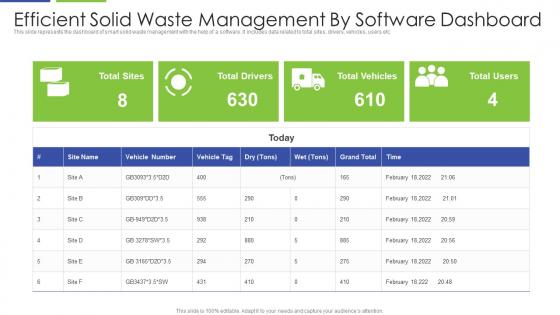
Efficient Solid Waste Management By Software Dashboard




Try Before you Buy Download Free Sample Product
 Impress Your
 Audience
 100%
100% Editable
 Save Hours
 of Time


This slide represents the dashboard of smart solid waste management with the help of a software. It includes data related to total sites, drivers, vehicles, users etc.
People who downloaded this PowerPoint presentation also viewed the following :
Efficient Solid Waste Management By Software Dashboard with all 6 slides:
Use our Efficient Solid Waste Management By Software Dashboard to effectively help you save your valuable time. They are readymade to fit into any presentation structure.





FAQs for Efficient Solid Waste Management
Community-level solid waste reduction methods include comprehensive recycling programs, composting initiatives, waste-to-energy systems, community education campaigns, and source reduction strategies. These approaches streamline waste management by minimizing landfill dependency, reducing collection costs, and creating revenue streams through material recovery, with many municipalities finding that integrated programs deliver both environmental benefits and operational efficiency.
Composting significantly reduces landfill waste by converting organic materials into nutrient-rich soil amendments, diverting approximately 30% of household waste from disposal facilities. This process enables municipalities, agricultural operations, and commercial facilities to minimize waste management costs, reduce methane emissions, and create valuable products for landscaping and farming, ultimately delivering both environmental benefits and economic opportunities.
Technology enhances waste collection and processing through smart bin sensors, route optimization software, automated sorting systems, IoT-enabled fleet management, and AI-powered waste analytics. These innovations streamline operations by reducing collection costs, minimizing fuel consumption, and improving recycling accuracy, with municipalities and waste management companies finding that automated systems ultimately deliver faster processing times and significantly lower operational expenses.
Regulations and policies establish mandatory frameworks for waste collection, treatment standards, recycling requirements, landfill operations, and environmental compliance measures. These regulatory structures drive organizations toward sustainable practices by setting clear guidelines for waste reduction, resource recovery, and disposal methods, with municipalities and businesses finding that comprehensive policy frameworks ultimately deliver improved environmental outcomes, cost efficiency, and operational transparency.
Public awareness campaigns improve recycling participation by educating communities about proper sorting methods, highlighting environmental benefits, and demonstrating economic impacts through clear messaging and visual demonstrations. These initiatives streamline waste management processes by reducing contamination rates, increasing collection volumes, and building sustainable habits, with many municipalities finding that targeted education campaigns ultimately deliver higher recycling rates and lower operational costs.
Urban areas face higher waste volumes, limited landfill space, complex logistics, diverse waste streams, and stricter environmental regulations compared to rural regions. While cities struggle with population density and infrastructure constraints, they benefit from advanced recycling facilities and economies of scale, with many municipalities finding that strategic waste-to-energy programs deliver operational efficiency.
Businesses can implement zero waste principles through comprehensive waste audits, circular design strategies, employee training programs, supplier partnerships, and robust recycling systems. These approaches streamline operations by reducing disposal costs, enhancing resource efficiency, and improving brand reputation, with many organizations finding that strategic waste reduction ultimately delivers significant cost savings and competitive environmental advantages.
Landfilling creates methane emissions, groundwater contamination risks, and long-term soil degradation, while incineration produces air pollutants, ash residues, and carbon emissions but reduces waste volume significantly. Through advanced emission controls and energy recovery systems, many municipalities find that modern waste-to-energy facilities minimize environmental impacts while delivering renewable energy and operational efficiency.
Circular economy thinking transforms solid waste management by shifting from linear disposal models to resource recovery systems, emphasizing waste-to-energy conversion, material reuse, and closed-loop recycling processes. Manufacturing companies and municipalities increasingly find that these approaches reduce landfill dependency, create new revenue streams from recovered materials, and ultimately deliver cost savings while enhancing environmental sustainability and operational efficiency.
Innovations in materials science include biodegradable plastics, edible packaging, self-healing materials, bio-based polymers, and circular design principles that enable full recyclability. These advances streamline waste reduction by extending product lifecycles, eliminating single-use items, and creating closed-loop systems, with manufacturing and retail sectors finding that sustainable materials ultimately deliver cost savings and competitive advantage.
Local governments can assess their waste management systems through waste audits, cost analysis, recycling rate evaluations, and citizen satisfaction surveys. By implementing data-driven improvements like optimized collection routes, expanded recycling programs, and public-private partnerships, municipalities streamline operations while reducing costs, ultimately delivering enhanced services and environmental outcomes for their communities.
Investing in solid waste management infrastructure delivers cost savings through reduced disposal fees, revenue generation from recycling and waste-to-energy programs, job creation, and enhanced property values. These systems streamline operations while creating circular economy opportunities, with many municipalities finding that strategic waste infrastructure investments ultimately reduce long-term operational costs and attract sustainable business development.
Behavioral psychology informs waste reduction strategies through nudging techniques, social proof messaging, feedback loops, and habit formation principles. Retailers use strategic bin placement and clear recycling labels to guide consumer choices, while municipalities implement gamification and community challenges, ultimately reducing waste volumes by 15-30% and enhancing environmental compliance across neighborhoods.
NGOs and community organizations play crucial roles in solid waste management through awareness campaigns, grassroots education, recycling programs, policy advocacy, and community mobilization efforts. These organizations bridge gaps between government initiatives and local communities, with many finding that neighborhood-level programs, school education initiatives, and local recycling cooperatives deliver more sustainable waste reduction outcomes than top-down approaches alone.
Collaboration between stakeholders enhances solid waste management by aligning government policies with private sector efficiency, community participation, and technical expertise from environmental organizations. Through strategic partnerships, municipalities streamline collection systems, businesses implement sustainable packaging, and residents increase recycling rates, ultimately delivering cost reductions and improved environmental outcomes across urban areas.
-
The slides come with appealing color schemes and relevant content that helped me deliver a stunning presentation without any hassle!
-
Kudos to SlideTeam for achieving the high success rate in delivering the top-notch slides.