


Employee Incentives Powerpoint Presentation Slides




Try Before you Buy Download Free Sample Product
 Impress Your
 Audience
 100%
100% Editable
 Save Hours
 of Time


Check out this content ready employee incentives PowerPoint presentation slides to keep your employees engaged and motivated. This employee appraisal PPT theme is content ready complete deck which consists of 24 editable and ready to use slides. Effective benefit strategies can attract and retain all the top employees. List down various types of advantages such as health insurance, paid vacations, par appraisal, pay incentives, bonuses, meal breaks, employee allowance, social security, health and wellness, learning, parenting leaves, etc. All the slides in employee benefit PowerPoint deck are completely customizable and users can edit the colors, fonts, and size as per their needs. The employees’ allowance PPT template is very useful for HR managers so that they can educate the staff and teach them the importance of being part of the organization. Download this professionally designed and visually appealing achievement award PPT theme to showcase the benefits and perks of working in the organization. Draw the admiration of your listeners. Each of our Employee Incentives Powerpoint Presentation Slides will generate applause.
People who downloaded this PowerPoint presentation also viewed the following :
Content of this Powerpoint Presentation
Slide 1: This slide introduces Employee Incentives. State Your Company Name and begin.
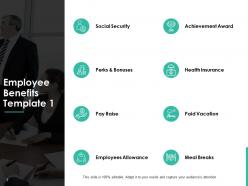
Slide 2: This slide shows Employee Benefits Template 1 describing- Social Security, Meal Breaks, Perks & Bonuses, Paid Vacation, Pay Raise, Health Insurance, Employees Allowance, Achievement Award.
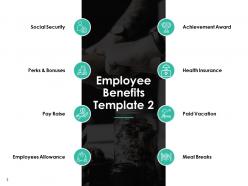
Slide 3: This slide presents Employee Benefits Template 2. You can add or edit data as per requirements.
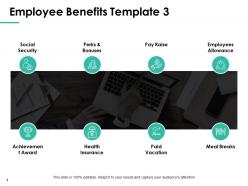
Slide 4: This slide represents Employee Benefits Template 3 with related imagery and text.
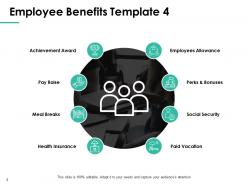
Slide 5: This slide displays Employee Benefits Template 4 with related icons and imagery. You can modify the template as per requirements.
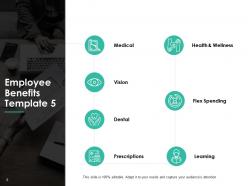
Slide 6: This slide represents Employee Benefits Template 5.
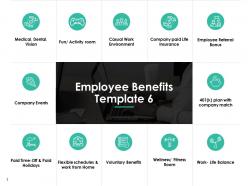
Slide 7: This slide shows Employee Benefits Template 6 describing- Fun/ Activity Room, Medical, Dental, Vision, Casual Work Environment, Company Paid, Life Insurance, Company Events, Employee Referral Bonus, 401(k) Plan With Company Match, Paid Time-off & Paid Holidays, Voluntary Benefits, Flexible Schedules & Work From Home, Wellness/ Fitness Room, Work- Life Balance.
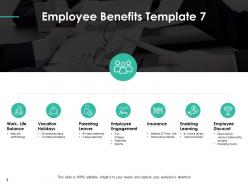
Slide 8: This slide presents Employee Benefits Template 7 describing- Employee Discount, Enabling Learning, Insurance, Employee Engagement, Vacation Holidays, Parenting Leaves, Work- Life Balance.
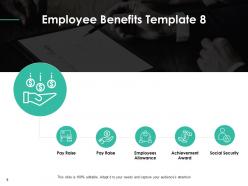
Slide 9: This slide displays Employee Benefits Template 8 describing- Union, Pay Raise, Employee Allowance, Health Insurance, Social Security.
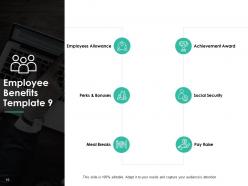
Slide 10: This slide represents Employee Benefits Template 9.
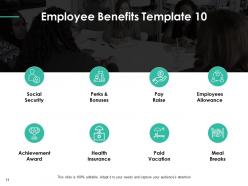
Slide 11: This slide showcases Employee Benefits Template 10 describing- Health Insurance, Perks & Bonuses, Achievement Award, Meal Breaks, Social Security, Employees Allowance, Pay Raise, Paid Vacation.
Slide 12: This slide displays Employee Incentives Icons.
Slide 13: This slide is titled as Additional Slides for moving forward.
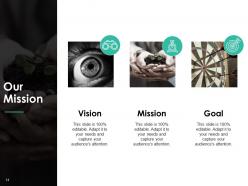
Slide 14: This is Our Mission slide with related imagery and text.
Slide 15: This is About us slide to show company specifications etc.
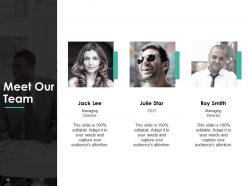
Slide 16: This is Meet Our Team slide with names and designation.
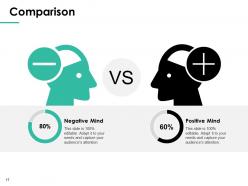
Slide 17: This is a Comparison slide to state comparison between commodities, entities etc.
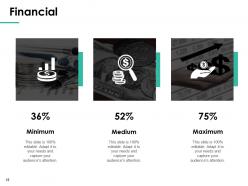
Slide 18: This is a Financial slide. Show your finance related stuff here.
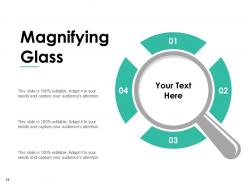
Slide 19: This slide shows Magnifying Glass to highlight information, specifications etc.
Slide 20: This slide is titled as Post it. Post your important notes here.
Slide 21: This is a Puzzle slide with text boxes.
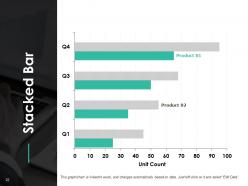
Slide 22: This slide shows Stacked Bar chart with two products comparison.
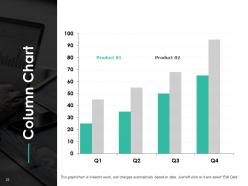
Slide 23: This slide displays Column Chart with two products comparison.
Slide 24: This is a Thank You slide with address, contact numbers and email address.
Employee Incentives Powerpoint Presentation Slides with all 24 slides:
Display exemplary competence with our Employee Incentives Powerpoint Presentation Slides. Create benchmarks for others to follow.
FAQs for Employee Incentives
Hey! So I'd start with the obvious stuff - flexible hours and performance bonuses tied to actual deliverables work really well. Professional development money is huge too. But honestly? Don't sleep on the simple things. Public shoutouts in team meetings or Slack channels still hit different, even remotely. A genuine thank-you note can be surprisingly powerful. Home office stipends are clutch since everyone's stuck staring at their setup all day. Oh, and here's the thing - just ask your team what they actually want first. Saves you from throwing money at stuff nobody cares about.
Honestly, most companies screw this up by rewarding the wrong stuff then act shocked when nothing changes. Figure out your top 3-5 priorities first. Want better customer retention? Don't just pay for new deals - reward renewals and upsells too. I've watched so many teams chase whatever gets them paid instead of what actually helps the business. Your metrics need to connect to real revenue or whatever success means for you specifically. Short sentences work. Longer ones should flow naturally when you're explaining the why behind each incentive. Check in quarterly and tweak things - markets shift, priorities change, people adapt.
Track the basics first - participation rates, how happy people actually are with the program, and whether they're sticking around. Business stuff matters too obviously: productivity, sales, quality scores, whatever makes sense for what you're trying to incentive. Don't overcomplicate it though. I'd say pick 3-4 things max and check them monthly. The biggest thing is getting your baseline numbers before you launch anything - otherwise you're just guessing if it's working. Then just tweak based on what you're seeing. Way easier than trying to measure everything at once.
Yeah, you've gotta switch up your approach for different generations. Boomers love the classic stuff - bonuses, formal recognition, job security. Gen X? They're all about work-life balance and flexible schedules. Millennials want professional development and feedback constantly (honestly they can be a lot but whatever works). Gen Z needs instant recognition and wants their work to mean something. But here's the thing - don't just assume based on age. I've met plenty of exceptions to these rules. Survey your actual team to see what drives them individually. That's way more reliable than guessing.
Look, transparency is everything here. People need to actually understand how these incentives work and why you set them up that way. Otherwise they'll just get cynical - which honestly happens way too often at most companies. You've gotta be crystal clear about who's eligible, how you're measuring stuff, when payouts happen. The whole nine yards. When employees can connect their work directly to rewards, that's when the magic happens. But if things feel random or unfair? Even your best incentive plan will totally bomb. Oh and don't just explain what the incentives are - tell them your reasoning too.
Honestly, just ask your team what they actually want before throwing money at random perks. Run some quick surveys or focus groups first. I've watched companies blow their budget on stuff like branded water bottles when people really wanted extra PTO days or training opportunities. Cash isn't always king either - some folks would rather have flexibility than a bonus check. Once you get the program going, keep checking in with pulse surveys or casual one-on-ones. Make it ongoing, not just a one-and-done thing. Start simple though - anonymous survey asking what would genuinely get them excited.
Dude, don't overthink your incentive system. Seriously, complex structures just confuse people and kill motivation. I've watched managers turn into human calculators trying to explain their convoluted bonus plans - it's painful to see. Pick maybe 2-3 metrics that actually matter. Make them stupid simple to understand. When people can't figure out how they're getting rewarded, they either get frustrated or start gaming the system in weird ways you never saw coming. Honestly, if your team can't explain their incentives over a beer, you've made it too complicated.
Honestly, just ask your team what they actually want instead of guessing. Some people light up when you call out their wins in meetings - way better than those bland thank-you emails. Others want stretch projects or flexible hours. I've seen managers blow money on pizza parties when their people really wanted mentorship or just basic recognition for good work. Survey them about non-monetary stuff that'd get them excited. Growth opportunities, autonomy, public praise - it's different for everyone. The personalized approach works way better than one-size-fits-all perks.
Honestly, transparency is everything here. Spell out exactly how people earn incentives and when they get paid - don't assume anyone will figure it out. Email gets buried so use multiple channels. Quick all-hands meetings work great, plus have managers bring it up during one-on-ones. I've literally seen programs tank because nobody knew they existed (so frustrating!). Repetition matters since people forget details constantly. Always give concrete examples like "do X, get Y." Make a simple FAQ that's easy to find. Oh, and put everything on your intranet too.
Oh man, you're so right about this! What works in the US totally backfires elsewhere. Like our "Employee of the Month" thing was a disaster in Tokyo - turns out public recognition can be super awkward in collectivist cultures. They'd rather celebrate the whole team. Work-life balance expectations are wildly different too, and don't even get me started on hierarchy stuff. Honestly, just survey each region first. Ask what actually motivates them instead of assuming everyone wants the same things. Way better than rolling out some generic program and watching it crash and burn everywhere.
Honestly, recognition hits different than just throwing money at people. Sure, we all need to pay bills, but when someone actually acknowledges your work publicly? That sticks with you way longer than a bonus does. Money gives you that quick rush, then it's gone. Plus it can make everything feel transactional - like you're just dancing for dollars, you know? Recognition taps into that deeper stuff we crave, like actually belonging somewhere and feeling proud of what we do. The magic happens when you do both though. Give genuine praise AND fair pay. Shows you actually get it.
Don't let your seasonal bonuses create that whole feast-or-famine thing where people only feel appreciated during crunch time. Instead of just throwing cash at them and moving on, try converting those rewards into year-round stuff - extra PTO, professional development money, flexible work options that stick around. I've watched teams get totally fried from being treated like heroes one month then completely ignored the next. It's honestly pretty brutal. Convert those seasonal wins into things that actually improve their daily work life or help their careers long-term. Short bursts of recognition are nice, but lasting perks keep people way more engaged.
Honestly, people hate change - especially when it messes with their paychecks. Your team's gonna push back on new stuff like peer recognition or flexible benefits because they're used to the old way. Leadership might not get it either, which makes everything harder. Tracking ROI on creative incentives is such a nightmare compared to simple commission structures (why can't everything be that straightforward?). Communication's everything though. Run some small pilot programs first to see what actually works. Don't go company-wide until you know people are buying into it. Test the waters, you know?
Oh man, remember those awful spreadsheets we used to manage all this stuff with? Technology totally changed the game here. BambooHR and Workday can automatically track performance metrics and send notifications when people hit milestones. Digital gift cards or bonus payments happen instantly instead of making your team wait weeks for manual processing. Honestly, the analytics are probably the best part - you'll actually see which incentives work vs which ones just drain your budget. I'd start with automating whatever rewards you give out most often first.
Honestly, the biggest trap is setting vague or impossible goals - nothing kills motivation faster. Survey your team first about what actually drives them because one-size-fits-all programs are basically useless. Don't assume cash is king either; sometimes recognition or flexibility works way better. Oh, and definitely track your results! I've watched companies spend months on these elaborate programs without measuring jack. Short goals work better than long ones too. Your people are different, so treat them that way instead of copy-pasting some generic corporate playbook.
No Reviews