


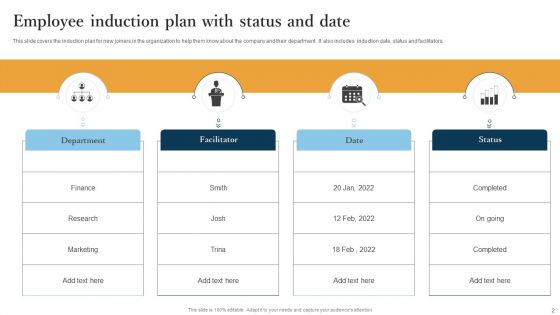
Employee Induction Plan With Status And Date




Try Before you Buy Download Free Sample Product
 Impress Your
 Audience
 100%
100% Editable
 Save Hours
 of Time


This slide covers the induction plan for new joiners in the organization to help them know about the company and their department. It also includes induction date, status and facilitators.
People who downloaded this PowerPoint presentation also viewed the following :
Employee Induction Plan With Status And Date with all 6 slides:
Use our Employee Induction Plan With Status And Date to effectively help you save your valuable time. They are readymade to fit into any presentation structure.





FAQs for Employee Induction Plan With
Key objectives of an effective employee induction plan include accelerating role competency, integrating new hires into company culture, establishing clear performance expectations, building essential workplace relationships, and ensuring regulatory compliance understanding. These comprehensive onboarding strategies streamline productivity timelines, reduce early turnover rates, and enhance employee engagement, with many organizations finding that structured induction programs deliver faster time-to-contribution and stronger long-term retention outcomes.
An employee induction plan enhances team integration by facilitating structured introductions, mentorship programs, collaborative projects, and cultural immersion activities that build meaningful connections from day one. Through comprehensive orientation processes, new hires develop stronger workplace relationships, understand organizational values more deeply, and contribute to team objectives faster, ultimately reducing turnover while strengthening overall team cohesion and productivity.
Essential employee induction checklist components include workspace setup, IT equipment access, company policy documentation, role-specific training materials, and mentor assignment. These elements streamline onboarding by ensuring administrative completion, accelerating productivity timelines, and enhancing retention rates, with many organizations finding that comprehensive checklists reduce new hire adjustment periods while delivering improved employee satisfaction and faster integration into company culture.
Different industries tailor employee induction through sector-specific training, compliance requirements, regulatory protocols, mentorship structures, and technology integration. While healthcare emphasizes safety certifications and patient care standards, financial services focus on regulatory compliance and risk management, with many organizations finding that combining structured learning paths, digital onboarding platforms, and personalized mentoring delivers faster productivity and improved retention rates.
Technology streamlines employee induction through digital onboarding platforms, automated document processing, virtual reality training modules, mobile learning applications, and AI-powered personalization systems. These technologies enhance efficiency by reducing paperwork, accelerating compliance completion, and delivering interactive experiences, with many organizations finding that automated workflows significantly improve new hire engagement while minimizing administrative overhead.
**INPUT**: How can feedback from new hires be incorporated to improve the induction experience? **OUTPUT**: Feedback from new hires can be incorporated through exit interviews, structured surveys, focus groups, and digital feedback platforms that capture real-time insights during onboarding. Organizations streamline this process by implementing continuous feedback loops, analyzing response patterns, and adapting induction materials accordingly, with many companies finding that regular feedback integration enhances retention rates and accelerates time-to-productivity significantly.
Common induction challenges include information overload, lack of structured processes, insufficient manager engagement, poor cultural integration, and inadequate feedback mechanisms. These issues can be mitigated by creating phased learning schedules, standardizing workflows through comprehensive templates, assigning dedicated mentors, and implementing regular check-ins, ultimately delivering improved retention rates and faster productivity.
Remote induction plans should incorporate virtual onboarding sessions, digital collaboration tool training, structured video introductions with team members, and clear communication protocols for different work locations. These approaches streamline integration by establishing regular check-ins, providing dedicated remote mentorship, and ensuring consistent access to resources, with many organizations finding that hybrid-specific orientation ultimately delivers stronger employee engagement and faster productivity ramp-up.
Key metrics include time-to-productivity rates, employee retention during probationary periods, engagement survey scores, training completion rates, and manager satisfaction assessments. These measurements enable organizations to identify program gaps, streamline onboarding processes, and enhance new hire experiences, with many companies finding that systematic evaluation reduces turnover costs while accelerating workforce integration and operational efficiency.
Mentoring integrates into induction through pairing new hires with experienced employees, structured guidance programs, regular check-ins, skill-building sessions, and cultural integration activities. This strategic combination streamlines onboarding by accelerating learning curves, enhancing job satisfaction, and reducing turnover rates, with many organizations finding that mentorship programs ultimately deliver stronger employee retention and faster productivity gains.
Training resources during induction should include comprehensive orientation materials, role-specific skill modules, mentorship programs, digital learning platforms, and hands-on workshops tailored to departmental needs. These resources enhance employee readiness by accelerating competency development, building confidence, and ensuring consistent knowledge transfer, with many organizations finding that structured induction training reduces time-to-productivity significantly while improving long-term retention rates.
Company history and values are fundamental to employee induction, establishing organizational identity, cultural context, and behavioral expectations that guide decision-making and performance. These elements help new hires understand the company's mission, connect with its purpose, and align their work with strategic objectives, ultimately fostering engagement, retention, and consistent service delivery across teams.
Strategies include structured milestone checkpoints, mentorship pairings, phased responsibility introduction, regular feedback sessions, and progressive goal setting throughout the first 90 days. These approaches streamline the transition by maintaining engagement momentum, reducing uncertainty, and building confidence, with many organizations finding that systematic progression significantly enhances retention and accelerates productivity.
Cross-departmental collaboration enhances induction effectiveness by providing comprehensive role understanding, facilitating broader network building, and ensuring consistent organizational messaging across all touchpoints. This strategic approach enables new hires to understand interdependencies between teams like HR, IT, and operations, while delivering faster integration and improved retention rates for growing organizations.
Managers and team leaders serve as primary facilitators, mentors, and cultural ambassadors during employee induction, providing guidance, setting expectations, and ensuring seamless integration into workflows and company values. Through direct coaching, regular check-ins, and relationship building, these leaders accelerate new hire productivity, reduce turnover rates, and foster engagement, with many organizations finding that strong managerial involvement significantly enhances retention and performance outcomes.
-
Best way of representation of the topic.
-
You guys are life-saver when it comes to presentations. Honestly I cannot do much without your services. Thank you!!!