


Employee life cycle powerpoint presentation slides




Try Before you Buy Download Free Sample Product
 Impress Your
 Audience
 100%
100% Editable
 Save Hours
 of Time


Use this professionally designed Employee Life Cycle PowerPoint Presentation Slides to scan the various stages an employee goes through within an organization. HR managers can utilize this content-ready HR model PowerPoint slideshow to optimize the progress of employees. Map the employee lifecycle to not only attract the best talent but to also enhance the customer experience. This HR lifecycle PowerPoint presentation comprises of different stages in the career of an employee, starting from recruitment to termination or retirement. Use this ready-made employee lifecycle complete PowerPoint presentation templates to build great teams. This content-ready HR cycle PPT deck covers topics like employee lifecycle framework, talent acquisition, current vacancies, job description, candidate assessment, employee management, attendance tracker, and more. These PPT templates are customizable. You can edit the template as per your requirement. Change the color, text, icon, and font size as pe your requirement. Grab this complete presentation on HR model to increase the employee engagement and maximise your returns. Elaborate on the contents of the deal with our Employee Life Cycle Powerpoint Presentation Slides. Clarify every aspect of the agreement.
People who downloaded this PowerPoint presentation also viewed the following :
Content of this Powerpoint Presentation
Slide 1: This slide introduces Employee Life Cycle with imagery. State company name.
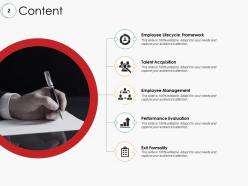
Slide 2: This is Content slide showing- Employee Lifecycle Framework, Talent Acquisition, Employee Management, Performance Evaluation, Exit Formality.
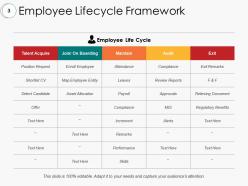
Slide 3: This slide showcases Employee Lifecycle Framework in tabular form.
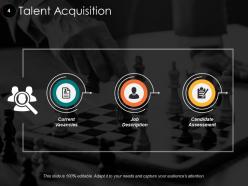
Slide 4: This is Talent Acquisition slide with respect to- Current Vacancies, Job Description, Candidate Assessment.
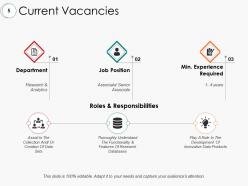
Slide 5: This slide shows Current Vacancies in terms of- Department, Job Position, Min. Experience Required, Roles & Responsibilities.
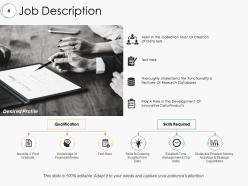
Slide 6: This is a Job Description slide with details and information about- Skills Required, Qualification.
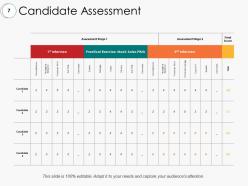
Slide 7: This is a Candidate Assessment slide.
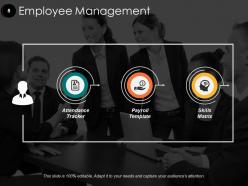
Slide 8: This slide presents Employee Management with respect to- Attendance Tracker, Payroll Template, Skills Matrix.
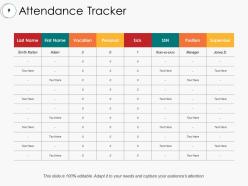
Slide 9: This slide showcases Attendance Tracker.
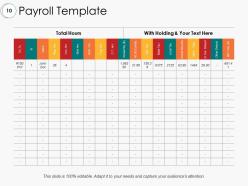
Slide 10: This is a Payroll Template slide. Add your information here.
Slide 11: This is a Skills Matrix slide with Basic Skill, Advanced Skill, Needs Training parameters.
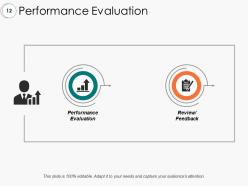
Slide 12: This slide showcases Performance Evaluation in people silhouttes and icon imagery.
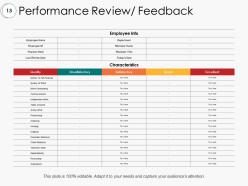
Slide 13: This slide showcases Performance Review/ Feedback in a tabular form.
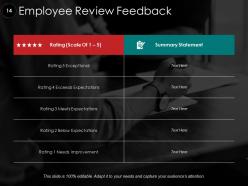
Slide 14: This is Employee Review Feedback slide with Ratings and Summary Statement.
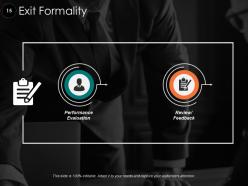
Slide 15: This is Exit Formality slide with- Performance Evaluation, Review/ Feedback.
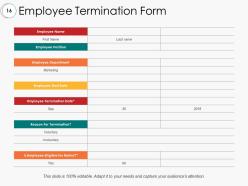
Slide 16: This slide presents Employee Termination Form.
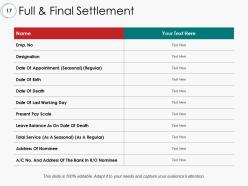
Slide 17: This is Full & Final Settlement slide with text boxes.
Slide 18: This is Employee Life Cycle Icons Slide. Use/add icons on the basis of your requirement.
Slide 19: This slide is titled Additional slides for moving forward. You may change the content as per need.
Slide 20: This is a Coffee break slide with image. Change image as per need.
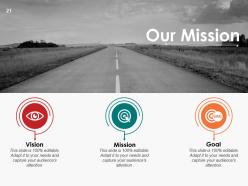
Slide 21: This slide presents Our Mission. State your mission, goals etc. here.
Slide 22: This slide showcases Our Team with Name and Designation to fill.
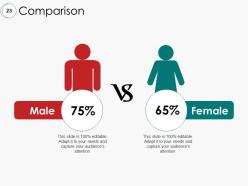
Slide 23: This is a Comparison slide to compare two entities/ products etc.
Slide 24: This is an About Us slide with Professional, Creative and Talented as examples.
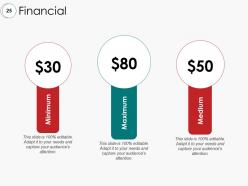
Slide 25: This slide presents company Financial scores. State financial aspects etc. here with Minimum, Maximum and Medium as its parameters.
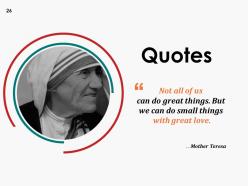
Slide 26: This is a Quotes slide with imagery to convey message, beliefs etc. You may change the slide content as desired.
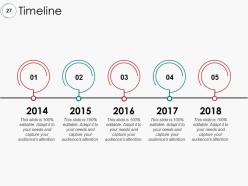
Slide 27: This slide presents a Timeline. Jot down your highlights, or present milestones etc. here.
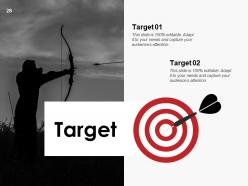
Slide 28: This is a Target slide with relevant imagery. State your targets etc. here.
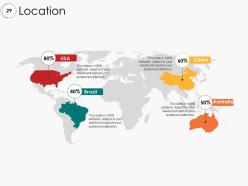
Slide 29: This is a Location slide of World map to show global presence, growth etc.
Slide 30: This is a Location slide of World map to show global presence, growth etc.
Slide 31: This is a Venn diagram image slide to show information, specifications etc.
Slide 32: This is a Lego box image slide to show information, specifications etc.
Slide 33: This is a People's silhouettes slide. Use it the way you want to show solutions etc.
Slide 34: This slide displays a Mind Map image to show behavioural segmentation or anything relative to it.
Slide 35: This is a Bulb Or Idea slide with imagery and text boxes. Showcase innovative aspects, information etc. here.
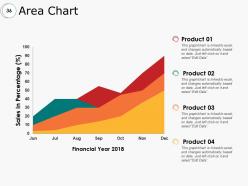
Slide 36: This is an Area Chart to present product/entity comparison, specifications etc.
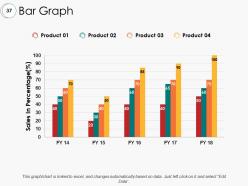
Slide 37: This is a Bar Graph slide to state product/entity comparison, specifications etc.
Slide 38: This is a Thank You slide with Address# street number, city, state, Contact Numbers, Email Address.
Employee life cycle powerpoint presentation slides with all 38 slides:
Folks enjoy being around due to our Employee Life Cycle Powerpoint Presentation Slides. They create a cordial atmosphere.




FAQs for Employee life cycle
So there are six stages in the employee lifecycle - attraction, recruitment, onboarding, development, retention, and separation. Each one hits engagement differently. Screw up onboarding? People bolt. No development opportunities? They get restless and start job hunting. Honestly, I think onboarding is where most companies blow it. You need different strategies for each stage though. Attraction is about selling your culture, onboarding creates connection, development keeps them interested. Here's what actually works: look at your current process and find where people usually check out. That's your starting point for fixes.
Honestly, most companies totally blow this - they dump everything on someone day one then wonder why people quit after three months. Build out a real 90-day plan instead of just doing the basic paperwork stuff. Get them a buddy, not just their manager checking in occasionally. Regular touchpoints work way better than cramming everything upfront. Set actual goals they can hit in those first few months so they feel like they're winning. Oh, and introduce them around to other departments early on. Map it out from their shoes - what would YOU want walking into a new place? The relationship piece is honestly what makes or breaks it.
Track different stuff for each phase. For hiring - time-to-hire and cost-per-hire work well. Onboarding needs engagement scores and training completion rates. Development phase? Look at performance ratings and whether people hit their goals. Then retention rates and internal mobility for keeping folks around. Honestly, exit interviews are super valuable but half the people don't bother doing them anyway. The real trick is making sure these numbers actually connect to business results, not just random data points. I'd start with maybe 2-3 metrics per stage that genuinely matter to what you're trying to accomplish.
Okay so here's the thing - don't just dump all your training in week one then disappear. Start with onboarding obviously, but keep it going as people grow. Skill development, leadership stuff, career programs. Most companies totally miss this during performance issues too - training can actually save people instead of losing them. Map different training to each stage of someone's time there. Short bursts work better than those marathon sessions anyway. I've seen so many places front-load everything then wonder why people leave after six months. Keep your people growing or they'll grow somewhere else.
Look, performance management sounds like corporate BS but it's actually super useful. You set expectations right when someone starts, then keep checking in regularly - not just those dreaded annual reviews. Track how they're growing, spot when they're ready to move up. Without it you're basically guessing if your people are killing it or barely hanging on. I learned this the hard way at my last job. Those ongoing conversations matter way more than formal reviews. Don't wait for problems to surprise you.
Exit interviews are seriously underrated - people will finally tell you what they really think once they're already gone. The patterns you'll see are eye-opening. Maybe your onboarding process is a mess, or managers aren't actually developing anyone. Some feedback's gonna hurt, not gonna lie, but that's usually the stuff you most need to hear. I'd map those recurring complaints back to specific parts of the employee journey. Like if everyone mentions their first week being chaotic, you know exactly where to start fixing things before you lose more good people.
Focus on the whole employee experience, not just hiring. Good onboarding is huge - sets everything up right. People need clear paths to grow and regular feedback (annual reviews are basically useless). Pay matters, but honestly? Flexibility and work-life balance can be just as important. Don't forget recognition - I've literally watched talented people walk away because they felt ignored. Here's the thing though: do stay interviews before people start mentally checking out. Way better than scrambling during exit interviews when it's already too late.
So your culture basically touches every part of an employee's time with you. Job candidates sense it right away through interviews and how you present yourself - attracts the right people or scares them off. Once they're hired, onboarding is where culture really smacks them (hopefully in a good way lol). Growth and recognition? That's all culture-driven too. Even exits are shaped by it - people either leave on good terms or burn bridges. I'd honestly look at each stage and see if your culture is actually creating the experience you want, because sometimes there's a gap you don't realize.
So BambooHR and Workday are solid for automating most of your employee stuff - applicant tracking, onboarding, performance reviews, the whole deal. Honestly saves you from hunting people down for forms constantly (which is the worst part of HR IMO). Greenhouse and Lever work great for recruiting specifically. Learning management? Cornerstone's pretty decent for training. Oh, and definitely go with an integrated system so everything talks to each other. You don't want employee data scattered across a million spreadsheets - been there, not fun.
So basically, feedback loops stop your employee stuff from being this one-and-done thing. You collect input at different stages - onboarding, reviews, exit interviews, whatever. Then you actually DO something with it. Say everyone's confused about the same part of onboarding (happens way more than you'd think). Now you can fix it before the next batch of people. The trick is closing the loop though - tell folks what changed because of their feedback. Otherwise they'll stop bothering to give it. I'd start with just one area first. Keep the surveys short or people won't fill them out.
Oh man, where do I start? Most companies rush through recruitment and end up overselling roles or skipping proper screening. Then onboarding becomes a total mess - information overload or just tossing new people in without any real support. People also forget about career development conversations and feedback (which honestly drives me crazy). Good employees get taken for granted, so they leave. Exit interviews? Half the time nobody actually listens to that feedback. You should probably map out what you're doing now and see where the gaps are.
Dude, employee advocacy is actually pretty powerful stuff. Your team shares good experiences, and it helps with hiring because candidates see real posts from actual employees. Plus people stick around longer when they feel invested enough to advocate for you. Even when someone leaves, they're way more likely to say nice things about the company. The trick? Don't make it weird and scripted. Nobody wants to post corporate-speak nonsense. Just get people excited about sharing cool projects or wins naturally. I mean, if your workplace actually rocks, people will want to talk about it anyway, right?
Start with your job postings - make them actually inclusive, not just buzzword salad. Get diverse people on interview panels too. Once people are hired, weave inclusion into onboarding and development programs. Honestly, bias training gets a bad rap but I've seen it work when done right. Make promotion processes transparent (people notice when they're not). Employee resource groups are clutch for retention - oh, and pulse surveys help you catch problems before they explode. Don't try everything at once though. Pick one area and nail it first.
Honestly, remote work makes everything way harder than people admit. Your onboarding needs to be super structured now - think detailed digital packets and virtual buddy systems since nobody can just wander over for quick questions. Online learning platforms become your best friend for development. Create clear career paths that don't depend on showing your face in meetings all the time. The culture thing? That's the real challenge. You'll need regular check-ins and pulse surveys to catch problems before people just... disappear. I'd start by looking at what you're currently doing and figuring out which parts assume everyone's in the same building.
Dude, your managers are literally make-or-break for keeping people around. They're the ones doing the hiring, showing new people the ropes, deciding who gets promoted. A crappy boss can wreck even great company policies - I've seen it happen so many times. People don't quit jobs, they quit managers, right? Your leaders control everything from feedback to growth opportunities to whether someone feels appreciated or starts job hunting. Bottom line: train your managers well because they're either keeping your best people or driving them straight out the door.
No Reviews