


Employee Rewards And Recognition Plan For Better Team Building And Maintaining Effective Team




Try Before you Buy Download Free Sample Product
 Impress Your
 Audience
 100%
100% Editable
 Save Hours
 of Time


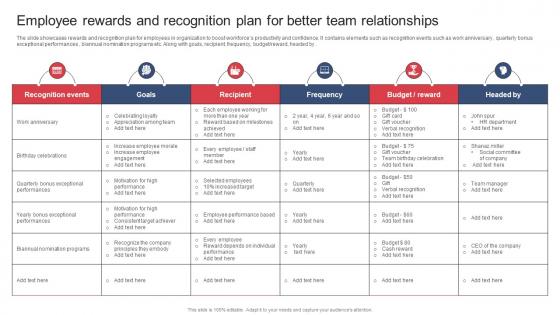
The slide showcases rewards and recognition plan for employees in organization to boost workforces productivity and confidence. It contains elements such as recognition events such as work anniversary, quarterly bonus exceptional performances, biannual nomination programs etc. Along with goals, recipient, frequency, budget reward, headed by.
People who downloaded this PowerPoint presentation also viewed the following :
Employee Rewards And Recognition Plan For Better Team Building And Maintaining Effective Team with all 6 slides:
Use our Employee Rewards And Recognition Plan For Better Team Building And Maintaining Effective Team to effectively help you save your valuable time. They are readymade to fit into any presentation structure.





FAQs for Employee Rewards And Recognition Plan For Better Team Building And
Effective employee recognition program implementation includes establishing clear criteria, creating multiple recognition channels, training managers on consistent delivery, integrating peer-to-peer nominations, and linking rewards to company values. These methods work by ensuring timely acknowledgment, personalizing recognition approaches, and maintaining program visibility across departments, with many organizations finding that regular communication and leadership modeling ultimately drive higher participation and employee engagement.
Organizations can measure the impact of rewards and recognition initiatives through employee engagement surveys, performance metrics tracking, retention rates analysis, productivity measurements, and absenteeism monitoring. These assessment methods enable companies to evaluate program effectiveness by correlating recognition frequency with improved performance outcomes, reduced turnover costs, and enhanced team collaboration, ultimately delivering measurable ROI and competitive advantage.
Company culture fundamentally drives rewards and recognition strategies by defining what behaviors, values, and achievements organizations choose to celebrate and incentivize. A collaborative culture might emphasize team-based recognition programs, while performance-driven environments focus on individual achievement awards, with many organizations finding that aligning recognition practices with cultural values enhances employee engagement and reinforces desired workplace behaviors.
Technology enhances employee recognition by enabling real-time feedback systems, automated milestone celebrations, personalized reward platforms, social recognition feeds, and comprehensive analytics tracking. Through AI-driven insights and mobile applications, organizations streamline recognition processes while creating more meaningful, timely acknowledgments that boost engagement, with many companies finding that digital recognition tools significantly increase participation rates and overall workplace satisfaction.
Creative non-monetary rewards include flexible work arrangements, professional development opportunities, public recognition programs, additional time off, and personalized thank-you notes from leadership. These approaches enhance employee satisfaction by addressing individual preferences, career growth aspirations, and work-life balance needs, with many organizations finding that such recognition strategies significantly boost retention and productivity while fostering stronger workplace culture.
Leaders ensure consistent recognition by establishing standardized criteria, implementing organization-wide recognition platforms, conducting regular calibration sessions across departments, and tracking recognition metrics to identify gaps. These systematic approaches enable equitable appreciation through transparent guidelines, cross-departmental visibility, and data-driven insights, with many organizations finding that structured recognition programs ultimately deliver improved employee satisfaction and reduced turnover across all teams.
Effective remote recognition strategies include virtual awards ceremonies, digital recognition platforms, personalized video messages, flexible work benefits, and public acknowledgment in team meetings. These approaches help bridge physical distance by creating meaningful touchpoints, enhancing employee engagement, and maintaining team cohesion, with many organizations finding that consistent virtual recognition significantly boosts remote worker satisfaction and productivity.
Feedback and communication enhance recognition programs by ensuring alignment with employee preferences, measuring program impact, and creating transparent recognition criteria. Through regular surveys, focus groups, and open dialogue channels, organizations can adapt their approaches to resonate with diverse teams, ultimately delivering higher engagement, improved retention, and stronger workplace culture across all departments.
Recognizing employees delivers significant psychological benefits including increased self-esteem, enhanced sense of purpose, reduced stress levels, improved job satisfaction, and stronger emotional connection to organizational goals. These psychological improvements streamline retention efforts, boost productivity, and create positive workplace cultures, with many organizations finding that consistent recognition programs ultimately deliver higher engagement scores and reduced turnover costs.
**INPUT**: How do different generations in the workforce respond to various types of recognition? **OUTPUT**: Different generations respond uniquely to recognition, with Baby Boomers preferring formal awards and public acknowledgment, Gen X valuing practical rewards like flexible schedules, and Millennials seeking peer recognition and development opportunities. Through tailored recognition strategies, organizations streamline engagement across age groups, enhance retention rates, and deliver stronger performance outcomes, with many companies finding that generational customization ultimately creates more cohesive and motivated teams. [Word count: 60]
Peer-to-peer recognition programs foster supportive work environments by encouraging collaboration, building trust among team members, and creating inclusive cultures where achievements are celebrated collectively. These programs enable organizations to enhance employee engagement, strengthen workplace relationships, and boost morale significantly, with many companies finding that peer recognition often carries more emotional impact than traditional top-down recognition approaches.
Organizations can tailor recognition efforts by linking rewards to specific behaviors that demonstrate core values, establishing clear criteria that support strategic objectives, and creating recognition categories aligned with business priorities like innovation, collaboration, or customer service. This strategic approach ensures recognition reinforces desired cultural behaviors while driving measurable outcomes, with many companies finding that value-based recognition significantly enhances employee engagement and organizational performance.
Common pitfalls include inconsistent application, focusing solely on monetary rewards, neglecting peer-to-peer recognition, delayed acknowledgment, and failing to align rewards with company values. These missteps often result in decreased morale and program ineffectiveness, with many organizations finding that transparent criteria, timely recognition, and diverse reward options ultimately deliver higher engagement and sustained motivation.
Recognition programs enhance employee retention and engagement by fostering emotional connection, reducing turnover costs, and creating positive workplace culture through peer acknowledgment and leadership appreciation. These initiatives deliver measurable outcomes across industries, with many organizations finding that strategic recognition approaches ultimately drive productivity, strengthen team cohesion, and maintain competitive talent acquisition advantages.
Key metrics include employee engagement scores, retention rates, performance indicators, participation rates in recognition programs, and time-to-productivity for new hires. These measurements enable organizations to track behavioral changes, identify program effectiveness across departments, and demonstrate ROI through reduced turnover costs, with many companies finding that comprehensive tracking ultimately delivers improved morale and measurable business outcomes.
-
Their professional templates are very impressive, even my manager was curious about the source. I am very grateful.
-
I really liked their customized design services. I got my desired template made by their expert team. Thank You!