


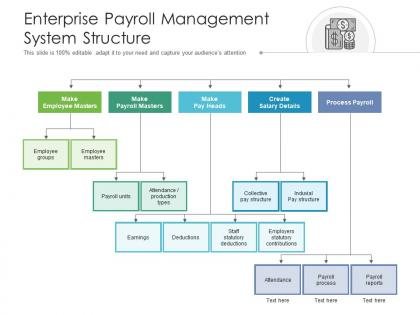
Enterprise payroll management system structure




Try Before you Buy Download Free Sample Product
 Impress Your
 Audience
 100%
100% Editable
 Save Hours
 of Time


Our Enterprise Payroll Management System Structure are topically designed to provide an attractive backdrop to any subject. Use them to look like a presentation pro.
People who downloaded this PowerPoint presentation also viewed the following :
Enterprise payroll management system structure with all 2 slides:
Use our Enterprise Payroll Management System Structure to effectively help you save your valuable time. They are readymade to fit into any presentation structure.
FAQs for Enterprise payroll
Automated tax stuff is huge - that's where things get messy fast if you don't have it. Multi-state regulations are a pain if you've got people in different places, so make sure it handles that. The audit trail thing saved my butt once when we had to show compliance records. Oh, and definitely get one that auto-updates when tax laws change because tracking that yourself is honestly the worst. Built-in reporting for W-2s and quarterly filings is clutch. Try to find something that plays nice with whatever HR system you're already using - nobody wants to do double data entry all day.
Honestly, the biggest win is just getting rid of all that manual data entry that screws everything up. You know how it is - one typo and suddenly someone's getting paid for 400 hours instead of 40. The system pulls hours straight from your time tracking, does all the tax math automatically, and catches weird stuff before it goes through. Way faster too since you're not sitting there with a calculator for hours. I'd start with time tracking integration first - that's where most of the headaches come from anyway. Your team can actually work on useful stuff instead of being glorified math robots.
Think of data analytics as your payroll crystal ball. You can spot overtime patterns, track turnover costs, and see what's driving your biggest expenses. The numbers are honestly pretty revealing once you dive in. Big companies use this stuff to plan headcount better and catch compliance problems before they blow up. Benefits negotiation gets easier too when you have solid data backing you up. I'd start by looking at your highest cost areas first - that's where you'll actually find things worth fixing. Plus it helps predict future expenses so you're not scrambling when budget season hits.
So most payroll systems connect through APIs and pre-built stuff with your HR and finance software. Employee data, time tracking, benefits - it all syncs automatically. Then payroll results go straight to accounting without you touching anything. Setup means mapping data fields between systems, but honestly it's not as bad as it sounds once IT gets involved. Workday, ADP, BambooHR - they already play nice with most finance software. Oh, and definitely check what connectors your current systems support first before you start shopping around for new payroll platforms. Saves you a headache later.
Honestly, payroll security is no joke - you'll want encrypted storage and transmission first. Set up role-based access so not everyone can see everything. Two-factor auth is a must, seriously. I've seen too many companies get wrecked by stupid password choices. Regular security audits help catch problems early. Your vendor better be SOC 2 compliant too. Don't forget the boring stuff like automated backups and audit logs tracking who accessed what. Physical security matters - lock those servers down. Oh, and kill access immediately when people quit. Maybe do quarterly security checks?
So employee self-service is basically where your workers can do their own payroll stuff without bugging HR constantly. They check pay stubs, update their info, request PTO, grab tax forms - you know, all that routine stuff. Honestly, it's a game changer for HR teams who used to spend forever answering the same questions. Your people get instant access instead of waiting around for responses. Plus HR can actually work on important projects instead of being glorified file clerks. Just make sure whatever system you pick has a portal that doesn't suck to use - some are surprisingly terrible.
Data migration is going to be your worst enemy - seriously, one tiny mistake and someone's paycheck gets screwed up. Your HR team will need tons of training too since they're so used to doing everything manually. You'll want to run both systems at the same time for a few pay periods, which honestly sucks because it doubles your work. Getting everyone on board is tricky. Map out what data you currently have first, then grab your most detail-obsessed coworkers for testing. Trust me on that last part.
So basically these systems let you run payroll across different countries without losing your mind. They handle all the currency stuff automatically and know the tax rules for each place - like your US office versus UK versus Singapore. No more juggling three different platforms (trust me, you don't want that headache). Local labor laws get applied automatically, plus it calculates deductions and spits out compliant reports for each country. Oh and it connects with local banks for payments too. Definitely find one that updates regulations in real-time because that stuff changes constantly and you'll want to stay on top of it.
Yeah, a solid payroll system makes a huge difference for keeping people happy. Nothing pisses off employees more than wrong paychecks or getting paid late - I'd be furious too honestly. Automated systems mean people actually trust they'll get their money on time, and they can grab pay stubs whenever without bugging HR. Speaking of HR, you'll get way fewer "where's my paycheck" tickets, so your team can work on better stuff. The whole transparency thing really clicks with people, especially now when everyone's job hopping left and right.
Go with a cloud-based payroll system - they scale up automatically without the headache of managing servers yourself. Variable pricing tiers are your friend here. Make sure it integrates well with your current HR and accounting tools through APIs. Most platforms these days are built for growth, but I'd still ask about employee caps and hidden fees before committing. Oh, and actually test it during the trial with different employee counts to see how it performs under heavier loads. You don't want surprises later when you're trying to process payroll for 200 people instead of 50.
Oh man, the software cost is nothing compared to everything else you'll spend. Implementation and data migration will hit your wallet hard. Training everyone takes forever and costs more than you think. Plus customization fees add up fast - honestly, vendors love nickel and diming you there. Don't even get me started on integration costs with your current systems. Get quotes that spell out EVERYTHING, then tack on 20% because stuff always goes wrong. And definitely ask what year two looks like. Some companies are sneaky about jacking up prices later.
So basically you can set up different employee types in a good payroll system - full-time, part-time, contractors, whatever you need. Each one gets its own pay rules and calculation methods. Salary bands, hourly rates, commission structures, even weird stuff like piece rates if you're into that. Honestly it's such a game changer when departments all pay differently. The system handles tax withholdings and benefit deductions automatically based on how you've classified people. My advice? Map out your current employee types first, then test everything with sample payrolls before you actually go live with it.
So the big thing right now is AI doing all the math and compliance stuff automatically - honestly saves so much headache. Real-time pay is everywhere too because people want their money right away (can't blame them). Cloud systems are pretty much standard now since they play nice with other software. Compliance tracking is brutal if you're doing it manually - regulations change constantly. Most places are adding self-service portals so employees can update their info themselves instead of bugging HR. Oh, and definitely pick something that scales up easily. You don't want to switch systems again in two years when you're dealing with multiple states or going international.
Honestly, cloud payroll is a game changer. Your data gets stored and processed automatically, plus the system updates itself so you don't have to worry about new tax laws breaking everything. Remote access was clutch during COVID - my team could run payroll from their kitchen tables if needed. It plays nice with other HR software too. Way cheaper than dealing with your own servers (trust me on that one). The scalability thing is huge if you're planning to grow. I'd skip the old-school on-premise stuff and go straight to cloud options when you're shopping around.
Look, monthly mini-audits are your best friend here - catch the small stuff before it becomes a nightmare. You'll find calculation errors, old employee info that never got updated, compliance issues that could bite you later. It's like... okay this sounds dumb but it's like changing your oil instead of waiting for your engine to explode. Quarterly deep dives are good too. Honestly, payroll errors have this annoying habit of multiplying when you're not looking. The audits also show you where your team needs more training or where your processes are wonky. Start with last week's pay period if you can.
-
Great quality product.
-
The Designed Graphic are very professional and classic.
-
Very unique and reliable designs.
-
Amazing product with appealing content and design.
-
Amazing product with appealing content and design.