

Ethical Business Practices Powerpoint Presentation Slide





Try Before you Buy Download Free Sample Product
 Impress Your
Audience
 100%
Editable
 Save Hours
of Time


Ethics are extremely important for the success of an organization. Implement ethics in your business organization with our content ready Ethical Business Practices PowerPoint Presentation Slide. Showcase the forces that shape up business ethics such as personal, organizational and external using the professionally-designed corporate social responsibility presentation deck. Incorporate ethical awareness framework PowerPoint templates to develop and evaluate the system. The professional-looking organizational ethics presentation deck has various self-explanatory PPT slides such as ethical functioning, education, action, 5 pillars, functioning, ethical leadership 4 V Model, areas of responsibility, and so on. Utilize these visually appealing business core values PPT visuals to exhibit leadership principles like respect others, show justice build community, manifest honesty, etc. Furthermore, this topic-specific CSR PowerPoint complete deck can also be used to demonstrate business responsibilities towards the general public, employees, and customers. Thus, download the ready-to-use Business Ethics Powerpoint Presentation Slides and attract the attention of your audience. Our Ethical Business Practices Powerpoint Presentation Slide encourage exchange of ideas. They enable fruitful conversation.
People who downloaded this PowerPoint presentation also viewed the following :
Content of this Powerpoint Presentation
Slide 1: This slide introduces Ethical Business Practices. State Your Company Name and begin.
Slide 2: This slide shows Business Ethics Key Drivers as- Introduction, Business Ethics Needs & Drivers, How to Shape Ethical Conduct in the Organization, Areas of Responsibility.
Slide 3: This slide presents Introduction describing- Introduction to Business Ethics, Ethical Principles for Business Executive, Core Values, Role of Individual in Organizational Effectiveness.
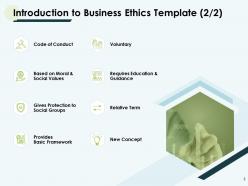
Slide 4: This slide displays Introduction to Business Ethics Template describing- Trust, Responsibility, Morality, Behavior, Reliability, Principle, Choice, and Relationship.
Slide 5: This is another template on Introduction to Business Ethics.
Slide 6: This slide represents Ethical Principles for Business Executives describing- Honesty, Accountability, Promise Keeping, Fairness, Leadership, Commitment to Excellence, Integrity, and Law Abiding.
Slide 7: This slide showcases Core Values as- Trust, Ethics, Vision, and Quality.
Slide 8: This slide shows Role of Individual in Organizational Effectiveness Template with categories as- Fulfilled Self, Inspired Thinking, and Purposeful Communication.
Slide 9: This is another template for Role of Individual in Organizational Effectiveness.
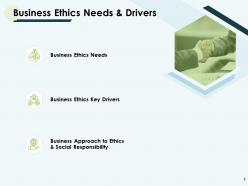
Slide 10: This slide presents Business Ethics Needs & Drivers describing in detail- Business Ethics Needs, Business Ethics Key Drivers, and Business Approach to Ethics & Social Responsibility.
Slide 11: This slide displays Business Ethics Need as- Survival of Business, Consumer Satisfaction, Protecting Consumer Rights, Creates Good Image of Business, Stop Business Malpractices, Protecting Employees, Shareholders, etc.
Slide 12: This slide represents Business Ethics Key Drivers as- Corporate Scandals, Market Place Competition, Investor Demands, Customer Pressure, Globalization.
Slide 13: This slide showcases Business Approach to Ethics & Social Responsibility.
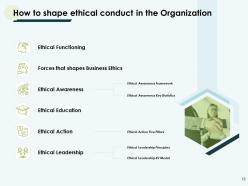
Slide 14: This slide explains How to shape ethical conduct in the Organization.
Slide 15: This slide shows Ethical Functioning in tabular form.
Slide 16: This slide displays Forces that Shapes Business Ethics as- Organizational Systems, Personal Ethics, Organizational Culture, External Stakeholders.
Slide 17: This slide presents Ethical Awareness Framework with categories as- Commit, Guide, Evaluate, Report, Reinforce, Develop.
Slide 18: This slide showcases Ethical Awareness Key Statistics with related imagery.
Slide 19: This slide shows Ethical Education with categories as- Enhancing Ethics Knowledge, Developing Ethical Sensitivity, Improving Ethical Judgement, Maintaining an ongoing Commitment to Ethical Behavior.
Slide 20: This slide presents Ethical Action describing- Honesty, Diligence, Transparency, Integrity, Fairness, Objectivity, Competence, Professionalism.
Slide 21: This slide displays Ethical Action five pillars as- Education Pillar, Reflective Pillar, Knowledge Pillar, Wellness Pillar, Restorative Pillar.
Slide 22: This slide represents Ethical functioning describing- Corporate & Social Responsibility, Fair Trade, Work Life Balance & Psychological Contract, 4P Approach : Purpose – Planet – People - Principles.
Slide 23: This slide showcases Ethical Leadership Principles describing- Respects others, Serves others, Shows Justice, Build Community, Manifests Honesty.
Slide 24: This slide shows Ethical Leadership 4V Model describing- Values, Virtue, Voice, Vision.
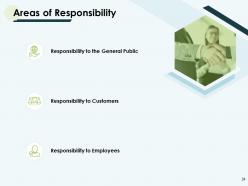
Slide 25: This slide presents Areas of Responsibility as- Responsibility to the General Public, Responsibility to Customers, Responsibility to Employees.
Slide 26: This slide displays Responsibility to the general public describing- Public Health Issues, Protecting the Environment, Recycling, Developing the Quality of the Workforce, Corporate Philanthropy, Be Responsible, Share Values & jointly Develop Community.
Slide 27: This slide represents Responsibility to Customers as- Provide the Best & Safest Products, Provide Product with Reasonable Price, After Sales services, Solving Consumers complaint, Regular Supply, Avoid Unfair Trade Practices.
Slide 28: This slide showcases Responsibility to Employees as- Appropriate Renumeration, Clean Working Atmosphere, Respect Individual Dignity, Provide Facilities, Incentives, Training to Employees.
Slide 29: This slide displays icons for Ethical Business Practices.
Slide 30: This slide reminds about 15 minutes coffee break.
Slide 31: This slide shows Clustered Bar chart with three products comparison.
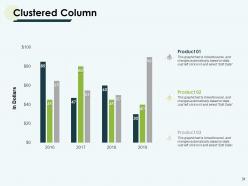
Slide 32: This slide presents Clustered Column chart with three products comparison.
Slide 33: This slide displays Stacked Bar chart comparing three products.
Slide 34: This slide is titled as Additional Slides for moving forward.
Slide 35: This is Our Mission slide with related imagery and text.
Slide 36: This is Our Team slide with names and designation.
Slide 37: This is About Us slide to show company specifications etc.
Slide 38: This slide is titled as Post it Notes. Post your important notes here.
Slide 39: This is a Puzzle slide with text boxes to show information.
Slide 40: This is a Target slide. State your targets here.
Slide 41: This is a Thank You slide with address, contact numbers and email address.
Ethical Business Practices Powerpoint Presentation Slide with all 40 slides:
Use our Ethical Business Practices Powerpoint Presentation Slide to effectively help you save your valuable time. They are readymade to fit into any presentation structure.















FAQs for Ethical Business Practices
Honestly, it's all about being transparent and actually giving a damn about people. Don't lie to customers or employees - seems obvious but you'd be surprised. Own up when you mess up instead of making excuses. These days you gotta think about environmental stuff too, which is probably overdue anyway. Following laws is the bare minimum, but real ethics means doing right even when nobody's looking. Build trust through consistency. Oh, and whatever values you set for your team? You better live them yourself first or it's all meaningless. Actions speak way louder than some poster on the wall.
Honestly, you've gotta make ethics actually mean something day-to-day, not just have it as some framed mission statement. Hire leaders who don't just talk about doing right - they actually do it. Give those people real power to make calls without running to legal every time. Train your team on situations they'll actually encounter (those generic compliance videos are useless anyway). Build ethical behavior into reviews and bonuses so people know you're serious about it. Oh, and create ways for employees to speak up about sketchy stuff without getting fired for it. Sometimes doing right costs money, but support it anyway.
Look, customers just want to know what's actually going on. Being upfront about your pricing, how things work, even when you screw up - that's what builds real trust. Nobody wants to feel like you're hiding stuff from them, you know? I've noticed companies that share info before people even ask tend to do way better. And honestly, admitting mistakes usually makes people trust you more, not less. Weird but true. Check what you're currently keeping under wraps that customers would actually care about knowing.
Honestly, start with the obvious stuff - turnover rates, customer complaints, compliance issues. Employee surveys are your best friend though, because people will tell you if your company's ethics are actually real or just BS on the website. Customer satisfaction and how people talk about your brand online says a lot too. The annoying thing is some of this stuff takes forever to show up in numbers. I'd set up regular check-ins with different groups and definitely create ways for people to report problems anonymously. That's when you'll hear what's really going down.
Dude, the legal stuff can get really messy. Civil lawsuits are probably what you'll face first - people suing for damages and all that. Criminal charges come into play if there's fraud or bribery involved (which hopefully isn't the case here). Regulatory fines can be brutal too, plus they'll make you jump through compliance hoops forever. Worst case? They revoke your business license entirely. Honestly, just document everything you do and set up some ethical guidelines now. Way better than scrambling when lawyers start calling.
Oh totally, ethics definitely help with keeping people around. Nobody wants to work somewhere that makes them feel gross about their job, you know? When companies are transparent and treat everyone fairly, people actually want to stay. It's like - would you rather tell people you work at a place you're proud of, or constantly worry your company's gonna end up in some scandal? Trust me, good employees will bounce the second they smell something fishy. My advice? Look at your workplace like you're a new hire. Would you actually want to stick around for years?
Honestly, start with leadership walking the walk - nothing torpedoes ethics faster than hypocritical managers. Set up clear codes of conduct and do regular training (yeah, I know it sounds boring but it works). Anonymous reporting helps too, since people need safe ways to speak up. Try adding ethics questions to your regular team meetings - just makes it normal conversation instead of this big scary topic. Oh, and reward people for doing the right thing, not just hitting numbers. Maybe throw in some frameworks with built-in ethics checkpoints. The whole point is weaving it into daily culture rather than just having some dusty poster nobody reads.
Look, you've gotta track this stuff like any other business goal or it just becomes wall decoration. Do quarterly reviews where you actually dig into real situations that came up - skip the boring paperwork part. Anonymous reporting is huge because people won't speak up otherwise, trust me. Your leadership team has to walk the walk though, not just talk about it in some company-wide email nobody reads. I'd also throw ethics scenarios into regular meetings so it becomes normal conversation. Most places write these policies then completely ignore them, which honestly drives me crazy.
Look, CSR and ethics are pretty much the same thing - just one's your values and the other's putting those values to work. Ethics = your moral compass. CSR = actually following through with community stuff, going green, treating workers right, whatever. Companies that split these up? They come off as total phonies, and trust me, people notice that fake corporate do-gooding instantly. I've seen way too many businesses push out feel-good initiatives that don't match what they actually stand for. Your CSR has to be real and connect to what you genuinely believe in.
Oh man, this stuff can really trip you up if you're not careful. What seems totally normal back home might be super offensive somewhere else. Take gift-giving - some places you basically have to bring something or you look rude, but other cultures will think you're trying to bribe someone. Timing's another big one. I honestly made some awkward mistakes early on because I didn't realize how differently people handle meetings and negotiations. My advice? Do your homework on local customs beforehand, and don't be shy about asking local colleagues what flies and what doesn't.
Dude, unethical stuff totally tanks your reputation - like, customers will boycott you and it takes forever to bounce back. Social media makes everything worse too, scandals just won't die. Sales drop immediately, good employees bail, and investors get spooked. Some companies are still trying to recover from mess-ups that happened years ago, which is honestly kind of sad. The whole rebuilding thing costs a fortune. Way better to just do things right from the start - fixing your reputation later is such a nightmare compared to avoiding problems in the first place.
Look, ethical practices are honestly like a cheat code these days. Customers stick with brands they actually trust, and good employees want to work somewhere that matters. When you treat suppliers fairly, they'll have your back during shortages - I've watched this play out so many times. Companies are literally winning contracts just because their sustainability game is stronger. Plus you're not scrambling when new regulations drop. My advice? Pick one thing - maybe labor practices or going greener - and really nail it first. Way better than trying to fix everything at once.
Honestly, you've gotta walk the walk first - your team will call out hypocrisy in a heartbeat. Be super clear about what's okay and what isn't, then actually stick to it when problems come up. Give people ways to report stuff anonymously (multiple options work best). Here's the thing though - celebrate the employees who ask tough ethical questions instead of making them feel like they're being difficult. Oh, and have that awkward but necessary conversation about what "doing the right thing" actually looks like in your workplace. Training's useful too, but mostly people just need to know they won't get thrown under the bus for speaking up.
So there's a bunch of ways to measure this stuff. B Corp certification is pretty comprehensive - covers governance, environmental impact, all that. GRI standards are solid for sustainability reporting too. ESG frameworks are huge with investors right now, which is honestly kind of annoying but whatever. You could also just build your own internal scorecard if those don't fit. Pick something that actually matches your industry though, not just what sounds impressive. I'd start by figuring out where you're at now first. Makes the whole process way less overwhelming.
Oh dude, start small - maybe with automated expense monitoring or supplier checks. AI can catch hiring bias, blockchain verifies if your suppliers are actually sustainable (super helpful), and basic analytics spot sketchy patterns before they blow up. The compliance stuff basically runs itself once it's set up, which honestly saved my butt during our last audit. Digital feedback tools let employees report concerns anonymously too. Data tracking for supply chains is huge right now. You'll probably want to pick just one thing first though - don't go crazy trying to automate everything at once.
-
Innovative and attractive designs.
-
Great designs, really helpful.