

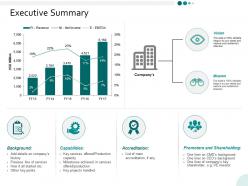
Executive summary ppt powerpoint presentation infographics deck






Try Before you Buy Download Free Sample Product
 Impress Your
 Audience
 100%
100% Editable
 Save Hours
 of Time


Achieve above average gradings with our Executive Summary Ppt Powerpoint Presentation Infographics Deck. Be considered a high caliber individual.
People who downloaded this PowerPoint presentation also viewed the following :
Executive summary ppt powerpoint presentation infographics deck with all 5 slides:
Bell the cat with our Executive Summary Ppt Powerpoint Presentation Infographics Deck. Get your audience abreast of it all.

FAQs for Executive summary ppt powerpoint
Look, execs want four main things: the problem you're solving, your solution, what they'll get out of it, and how you'll make it happen. Oh, and money stuff - budget, timeline, what you need from them. Start with whatever's most exciting first. I usually go with the biggest benefit or scariest problem. One page only - seriously, they'll toss anything longer. Think movie trailer vibes - give them enough to get hooked but don't blow the whole plot. The financial details matter way more than you'd think, so don't bury those at the end.
Yeah, length definitely matters. Too short and you're missing stuff, too long and people just... don't read it. I'd stick to 1-2 pages tops - maybe 300-800 words depending on who you're writing for. Honestly, I've watched some really smart strategies get completely ignored because they were buried in these massive 5-page "summaries." Nobody has time for that. You want it tight but still detailed enough that someone could actually make a decision from it. Oh, and test it on a coworker first - if they start skimming by the third paragraph, you've gotta cut more.
Ugh, the worst thing you can do is make it way too long - like, nobody's reading past one page. Put your main point right at the top, not buried somewhere in paragraph three. Don't just recap every section because that's what literally everyone does and it's mind-numbing. Focus on the stuff that actually matters and tell people what to do with it. Cut all the corporate speak and background nonsense. Here's the thing - most execs will only glance at your summary anyway, so those first few lines better hit hard. Make it clear what you found and why they should care.
Honestly, visuals are a game-changer for executive summaries. Charts and graphs let busy execs absorb key data in seconds rather than slogging through dense paragraphs. Nobody wants to decode walls of text anymore - especially C-suite folks who're already drowning in reports. Your document becomes way more memorable too. I always throw in infographics to break things up visually. Makes the whole thing less intimidating to open. Just don't go overboard with fancy graphics that don't actually support your points. Keep it clean and purposeful.
Your audience totally changes how you write an exec summary. C-suite folks want big picture stuff - ROI, strategic impact, that kind of thing. But if you're writing for technical people? They want the actual details and metrics. I've honestly watched people bomb presentations because they used the same summary for everyone. The language matters too - board members might need simpler explanations while industry experts want all the specifics. Before you even start writing, just ask yourself what that particular reader actually cares about. Then focus your key points around that. Makes a huge difference.
Look, the executive summary is literally make-or-break time. Decision-makers hit that section first, and honestly? Half the time it's all they'll bother reading. Executives are drowning in proposals, so you've got maybe two pages to hook them with your main points and solution. No fluff - just your strongest stuff upfront. If they're intrigued, they'll come back and grill you on specifics later (trust me on this one). But nail those opening pages and you'll get that "okay, let's talk" response instead of watching your proposal disappear into the void.
You've gotta tailor your exec summary to what each industry obsesses over. Tech people want metrics and scalability right up top - show them the innovation stuff immediately. Healthcare is completely different though, they're paranoid about risk so lead with safety and compliance first. Financial services? ROI and risk management, that's literally all they care about. What works for me is checking out industry publications beforehand to see how they actually talk. Pick up their language and mirror their priorities. Oh and frontload everything - don't bury the stuff they want to hear halfway through your summary.
Start with something that'll grab them - a crazy stat or the main problem you're solving. Short paragraphs are your friend here. Most people bail after the first few lines, so put your biggest wins right up top. Skip the fluffy corporate talk and use real numbers instead. "Boosted revenue by $2M" sounds way better than "significant growth achieved" (ugh). Stories work great if you've got one - executives eat that stuff up for some reason. Write everything in active voice, and honestly? Think of it like a movie trailer. You want them hooked and asking for more details. Don't forget to end with what you actually need from them.
So with internal people, you can get into the weedy stuff - budgets, team drama, all the nitty-gritty details since they already get your company. External folks? They just want to know what's in it for them. Skip the operational mess and focus on outcomes and money. Your internal deck can name specific people and call out real risks. But externally, keep it high-level - market potential, ROI, why they should care. Honestly, most outside investors couldn't care less about your implementation timeline. They want proof it'll work and make money. Think about what each group actually needs to say yes.
So basically you want clarity, conciseness, and completeness - hit all the key points but don't drown them in details. Lead with your main recommendation right up front. Then quickly touch on the problem, your solution, and what impact it'll have. Think of it like a movie trailer for your business doc, which sounds cheesy but actually works. Someone should be able to read just that section and totally get your whole proposal. Keep it under a page, don't go crazy with bullet points, and honestly? Every single sentence needs to earn its place. I'd test it by having a colleague read only that part - if they're confused, you're not done yet.
Look, AI tools like ChatGPT are actually pretty solid for brainstorming your key points and cleaning up awkward phrasing. Excel or Tableau will turn those boring spreadsheet numbers into charts that don't make people's eyes glaze over. Grammarly catches the stupid typos you somehow miss every time. Oh, and project management tools help track everyone's feedback - though honestly, that part can get messy fast. Don't go overboard though. Pick maybe 2-3 tools max or you'll spend more time switching between apps than actually writing. I'd start with an AI assistant plus one decent visualization tool.
Look, executives are basically drowning in emails and have maybe 3 minutes to figure out if your thing matters. So you can't mess around with fluffy language or long explanations - they'll just click delete. Start with your biggest win right up front. Make it punchy, like a news headline. Then back it up with only the facts that actually matter. I swear, every extra word works against you. Cut anything that doesn't directly prove your point. Think of it this way: if you can't explain the value in two sentences, you probably don't understand it yourself.
It's basically about your goal, right? Reports are "here's what we found" - you're sharing findings and data. Proposals flip that completely. You're selling something, so it's all "here's why you need us." I always mess up business plans though - they're weird because you're doing both? Like showing there's an opportunity AND that you can handle it. The vibe totally changes too. Reports feel neutral and analytical. Proposals get pushy (in a good way). Quick test: read just your summary. Does it match what you're actually trying to do with the whole document? That usually tells you if you're on track.
Honestly, the best trick is reading your executive summary like you've never seen it before. Does it actually make sense? I always read mine out loud - sounds weird but you'll catch clunky sentences way better. Cut any insider jargon that'd confuse someone external. Double-check your numbers match what's in the actual report because mismatched data looks super sloppy. Oh, and definitely get someone outside your team to review it. They'll spot assumptions you're making that seem obvious to you but aren't clear to anyone else. Fresh eyes are everything for these things.
So here's what actually works - start your exec summary with a real problem your audience is dealing with. Then show how your solution fixes it. Basic three-part story: problem, what you did about it, boom - results. Skip the boring bullet points (seriously, no one reads those). Instead, use actual examples or quick case studies. Show the before and after. I tried this approach last month and the difference was crazy obvious. Just don't go overboard - you're not writing some epic novel here. Structure it around how you transformed a customer's situation. Way more engaging than the usual corporate speak everyone else uses.
No Reviews