

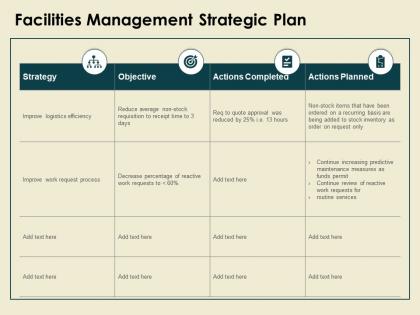
Facilities management strategic plan actions ppt powerpoint presentation outline slideshow




Try Before you Buy Download Free Sample Product
 Impress Your
 Audience
 100%
100% Editable
 Save Hours
 of Time


Our Facilities Management Strategic Plan Actions Ppt Powerpoint Presentation Outline Slideshow are apt for any function. They enhance the atmosphere of every event.
People who downloaded this PowerPoint presentation also viewed the following :
Facilities management strategic plan actions ppt powerpoint presentation outline slideshow with all 5 slides:
Function better with our Facilities Management Strategic Plan Actions Ppt Powerpoint Presentation Outline Slideshow. They allow you extra facility.




FAQs for Facilities management strategic plan actions ppt powerpoint
Key components of an effective facilities management strategy include space optimization, preventive maintenance programs, technology integration, sustainability initiatives, and comprehensive vendor management. These elements work together by reducing operational costs, enhancing workplace productivity, and improving asset longevity, with many organizations finding that strategic facilities management delivers significant competitive advantage and employee satisfaction.
A well-defined facilities management strategy enhances organizational productivity by optimizing workspace utilization, streamlining maintenance operations, and ensuring seamless technology integration. Through strategic space planning and proactive maintenance protocols, organizations reduce downtime, minimize operational disruptions, and create environments that enable employee efficiency, ultimately delivering cost savings and competitive advantage in increasingly complex business landscapes.
Technology enhances facilities management strategy through IoT sensors for real-time monitoring, predictive maintenance systems, automated HVAC controls, mobile workforce management platforms, and integrated analytics dashboards. These solutions streamline operations by reducing energy costs, preventing equipment failures, and optimizing space utilization, with many organizations finding significantly improved operational efficiency and tenant satisfaction.
Sustainability serves as a cornerstone of modern facilities management strategies, encompassing energy efficiency, waste reduction, water conservation, green building certifications, and sustainable procurement practices. These initiatives streamline operational costs, enhance corporate reputation, and ensure regulatory compliance, with many organizations finding that sustainable facilities deliver significant cost savings while attracting environmentally conscious tenants and employees.
Facilities management strategies align with corporate objectives by integrating operational efficiency, cost optimization, and employee experience enhancement into broader business goals. Through strategic space utilization, sustainability initiatives, and technology adoption, organizations streamline operations, reduce overhead costs, and improve productivity, with many companies finding that well-aligned facilities strategies deliver competitive advantage and support long-term growth objectives.
Facilities management strategy success should be measured through cost per square foot, space utilization rates, energy efficiency metrics, maintenance response times, and tenant satisfaction scores. These indicators enable organizations to track operational efficiency, resource optimization, and service quality, with many institutions finding that comprehensive metrics deliver better budget control, improved workplace experiences, and strategic facility planning advantages.
Facilities managers anticipate and manage risks through comprehensive asset assessments, predictive maintenance scheduling, emergency response planning, regulatory compliance monitoring, and vendor performance evaluation. These strategic approaches enable proactive identification of equipment failures, safety hazards, and operational disruptions, with many organizations finding that systematic risk management reduces costs, minimizes downtime, and enhances workplace safety.
Common facilities management strategy challenges include budget constraints, outdated infrastructure, regulatory compliance, space optimization, and technology integration across diverse operational requirements. These obstacles often compound in large organizations, with many institutions finding that strategic planning helps balance cost reduction with service quality, ultimately delivering streamlined operations and enhanced workplace experiences.
Stakeholder engagement significantly enhances facilities management strategy effectiveness by ensuring alignment with operational needs, securing budget approvals, and facilitating smoother implementation across departments. Through regular collaboration with employees, executives, and vendors, facilities managers can prioritize investments more strategically, reduce resistance to changes, and deliver solutions that truly support business objectives, ultimately improving workplace satisfaction and operational efficiency.
**INPUT**: What trends are shaping the future of facilities management strategies? **OUTPUT**: Key trends include IoT-enabled smart buildings, predictive maintenance technologies, sustainability initiatives, flexible workspace design, and AI-driven space optimization. These innovations streamline operations by reducing energy costs, minimizing equipment downtime, and enhancing employee experiences, with many organizations finding that strategic facility management delivers significant competitive advantages in talent retention and operational efficiency. [Word count: 56 words]
Training and development enhances facilities management strategy implementation by improving technical competencies, standardizing operational procedures, and fostering cross-departmental collaboration among staff members. Through comprehensive programs covering maintenance protocols, safety compliance, and technology utilization, organizations streamline operations, reduce downtime, and deliver superior workplace experiences, with many facilities finding that well-trained teams significantly accelerate strategic goals.
Financial considerations in facilities management strategy include capital expenditure planning, operational cost budgeting, energy efficiency investments, maintenance reserves, and technology upgrade allocations. These strategic financial elements enable organizations to optimize resource allocation, reduce long-term operational expenses, and enhance asset performance, with many institutions finding that proactive financial planning delivers measurable cost savings and improved facility utilization.
Regulatory requirements significantly shape facilities management strategies by mandating compliance standards, safety protocols, environmental controls, and accessibility measures across various sectors. Healthcare facilities must meet strict sanitation and patient safety standards, while manufacturing plants focus on OSHA requirements and environmental regulations, with financial institutions prioritizing security compliance, ultimately driving strategic investments in specialized systems and operational procedures.
Space optimization is crucial in facilities management strategy because it maximizes resource utilization, reduces operational costs, and enhances employee productivity through strategic space allocation. By analyzing occupancy patterns, implementing flexible workspace designs, and leveraging space management technologies, organizations streamline real estate expenses while improving collaboration and workflow efficiency, ultimately delivering significant cost savings and competitive advantage in an increasingly dynamic business environment.
Employee feedback can be incorporated through regular surveys, focus groups, digital feedback platforms, suggestion systems, and workplace assessments that identify pain points and preferences. These insights enable facilities managers to prioritize improvements in areas like comfort, accessibility, and workspace functionality, with many organizations finding that feedback-driven strategies ultimately deliver higher employee satisfaction, increased productivity, and better space utilization.
No Reviews