

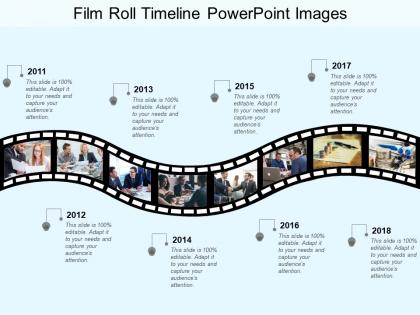
Film roll timeline powerpoint images




Try Before you Buy Download Free Sample Product
 Impress Your
 Audience
 100%
100% Editable
 Save Hours
 of Time


Our Film Roll Timeline Powerpoint Images ensure everyone pays heed. Your advice will be faithfully followed.
People who downloaded this PowerPoint presentation also viewed the following :
Film roll timeline powerpoint images with all 5 slides:
Display your ability to dish out aces with our Film Roll Timeline Powerpoint Images. You will dominate the game.



FAQs for Film roll
Warner Bros figured out this Vitaphone thing where they synced phonograph records with films, while Fox went with Movietone that recorded sound right on the film strip. Mid-1920s stuff. Honestly, you can see why the records didn't last - imagine trying to keep those perfectly in sync! "The Jazz Singer" in 1927 basically started the whole talkie craze. Everything had to change after that. New cameras, mics, theater equipment. Even actors had to learn how to actually talk on screen instead of just looking dramatic. The format war between different studios is pretty wild to read about if you're into that kind of thing.
So basically from the 1930s-50s, Hollywood studios ran everything - they owned the actors, directors, AND the theaters. MGM, Warner Bros, all of them. Make the movie, control where it plays, keep all the money. Vertical integration but like, extreme version. Sure, we got the "Golden Age" out of it, but actors had zero creative control. That's why old movies have that super polished, cookie-cutter vibe - everything was formulaic as hell. The whole thing finally got busted up in 1948 with the Paramount antitrust case. Studios had to sell their theater chains after that.
So basically the Depression and WWII totally changed movies. Studios started making big flashy musicals and comedies to distract people from being broke, but they also did grittier stuff about actual poverty. Then the war hit and boom - every studio's cranking out war films and anti-Nazi propaganda. The government was literally working with Hollywood to control the messaging, which is kinda wild when you think about it. Film noir came out of all that too, since everyone was pretty messed up psychologically after the war. It's honestly fascinating how much outside events shaped what got made.
Okay so basically indie filmmakers just said "screw it" to Hollywood's whole system. Major studios wouldn't touch stories from marginalized communities or anything too weird/risky. But then you get films like "She's Gotta Have It" and "Clerks" proving that personal, low-budget stuff could actually work. Audiences were starving for authentic stories that felt real. I mean, suddenly it wasn't just about explosions and famous actors anymore - though don't get me wrong, I still love a good blockbuster. These filmmakers showed that diverse voices matter and can make money too. Check out 90s Sundance winners if you want examples.
So editing started super basic - just cutting between shots. Then D.W. Griffith came along with cross-cutting and close-ups. The 1920s Soviet guys figured out that putting different shots together creates meaning (montage theory). French New Wave directors said "screw the rules" and threw in jump cuts everywhere. Now with digital tools, you can basically create any rhythm or crazy visual effect you want. It's wild how each breakthrough totally changed storytelling - we went from simple linear stories to these layered, complex narratives. Seriously, watch some Eisenstein next to a Marvel movie and your mind will be blown by how far we've come.
Dude, the French New Wave totally changed everything. Godard and Truffaut just said "screw the rules" and made films with tiny budgets and weird techniques - those jump cuts still look wild today. It sparked every major movement after: New German Cinema, American New Hollywood in the '70s. Personal, experimental stuff suddenly became cool and profitable. Honestly, pick any film movement from the '60s onward and you'll find New Wave influence all over it. They proved you don't need Hollywood money to revolutionize cinema.
Film festivals were huge for getting non-Western movies out there. Starting in the 50s-60s, Cannes, Venice, Berlin - they all started actively looking for diverse voices. Directors like Kurosawa and Satyajit Ray got their big breaks this way. The festivals didn't just show films though - they created hype, hooked directors up with distributors, made these movies feel legitimate to Western audiences who might've totally ignored them otherwise. I mean, so many masterpieces would've just stayed local without that push. The whole festival circuit became this pipeline for art house cinema. Oh, and if you're into this stuff, look at how Palme d'Or winners changed over the decades - it's wild how you can see the shift happening in real time.
Color film was like this massive game-changer for movies. Directors got this whole new toolkit - they could use warm colors for happy scenes, cool blues for sadness, that kind of thing. The Wizard of Oz thing where it goes from gray Kansas to technicolor Oz? Chef's kiss. Cinematographers had to basically relearn their jobs though. All these new rules about lighting and how colors looked together on camera. But honestly, audiences ate it up because everything felt so much more real and alive. You should totally watch some films from that transition period - seeing the same era in black-and-white vs color is wild.
Yeah, so film gender roles have done a complete 180 over the decades. Back in the 20s-40s, women were either helpless damsels or perfect housewives while men had to be these stoic, unbreakable heroes. Super one-dimensional stuff. Things started shifting in the 60s-70s though - female leads got way stronger and male characters could actually show emotions without everyone freaking out. Now you've got women as action stars and CEOs, men being nurturing dads or vulnerable protagonists. It's honestly refreshing compared to the old cookie-cutter formula. If you're researching this, definitely watch movies chronologically by decade - the evolution is wild and totally reflects how society changed.
Honestly, some movies just created the whole template everyone copies. *Citizen Kane* completely changed how stories could be told. *Casablanca*? That's your romantic drama blueprint right there. *The Cabinet of Dr. Caligari* basically invented horror's visual style, and *2001* made sci-fi actually thoughtful instead of just cheesy space stuff (though I'm not gonna lie, I still love the cheesy ones). You can trace *Seven Samurai* through every team-up action movie ever made. Same with *Vertigo* and psychological thrillers. Want to really get any genre? Start with whatever film basically invented it first.
Dude, CGI totally changed everything. Studios can build entire worlds now - Marvel's whole thing basically exists because of it. But audiences expect perfection now, which means budgets are insane. One bad VFX shot and people roast you online for months. It's wild how we went from basic green screen stuff in the early 2000s to these photorealistic environments. Honestly can't imagine blockbusters without it anymore. If you wanna see the evolution, just compare any early Marvel movie to like, Endgame. The difference is crazy.
So the big game-changers were definitely the Hays Code in 1930 - that thing sanitized movies for like 40 years. Then it all fell apart in the late 60s when the MPAA ratings came in. Before that, local censorship boards would literally take scissors to film reels, which is honestly insane when you think about it. The 1952 Supreme Court case Burstyn v. Wilson was massive too since it gave movies First Amendment protection. Oh, and the whole "video nasty" freakout in the UK during the 80s totally changed what people could rent at home. You'll want to dig into how these changes affected what audiences actually got to see in theaters vs at home.
Oh man, historical movies totally mess with how we remember stuff. Like, most people picture the Titanic sinking exactly how Cameron filmed it, not how it actually went down. Our brains just latch onto those dramatic scenes way better than boring textbook facts. The crazy part? People don't really separate Hollywood drama from what actually happened - it all blends together in your head. I learned this the hard way after watching Braveheart and finding out later that basically none of it was accurate lol. Definitely worth googling the real story after watching these films.
Movies are wild when you look at how they've shaped society. Early films like "Birth of a Nation" spread horrible racist ideas, but then you get something like "Do the Right Thing" decades later that actually made people talk about race in real ways. It's crazy how the medium can both reinforce stereotypes and tear them down. Marginalized communities finally getting to tell their own stories has been huge - though honestly, we still need more of that. Watch films from different time periods and you'll see how representation changes with social movements. It's like a history lesson but way more entertaining.
Honestly, it's pretty simple - just follow the tech. Magnetic tape in the '40s meant composers could finally layer sounds instead of recording everything live. The '80s brought digital sampling, which is why we got all those synth-heavy Blade Runner-type scores. Pro Tools changed everything in the '90s by making complex editing way more accessible to smaller studios. These days it's spatial audio and AI pushing things forward. Want to know what's coming next? Just peek at whatever audio tech is still stuck in research labs - that'll be mainstream in like 5-10 years.
-
Best way of representation of the topic.
-
Great designs, really helpful.