


Finding and recommendation icons for company




Try Before you Buy Download Free Sample Product
 Impress Your
 Audience
 100%
100% Editable
 Save Hours
 of Time


Our Finding And Recommendation Icons For Company are topically designed to provide an attractive backdrop to any subject. Use them to look like a presentation pro.
People who downloaded this PowerPoint presentation also viewed the following :
Content of this Powerpoint Presentation
Description:
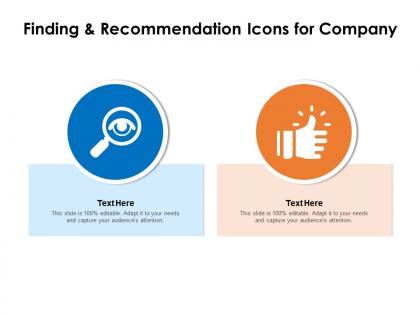
The image features a PowerPoint slide titled "Finding & Recommendation Icons for Company." The slide is divided into two sections, each with a central icon and a "Text Here" placeholder, indicating areas for customized input. On the left, there's a magnifying glass with an eye, representing the "Finding" aspect where one might detail the results of an analysis or research. On the right, there's a thumbs-up icon, symbolizing "Recommendation," where one would specify suggested actions or decisions based on the findings. The icons are set against contrasting blue and orange backgrounds, respectively, to distinguish between the two concepts visually.
Use Cases:
Industries where this slide can be effectively utilized:
1. Management Consulting:
Use: Presenting analysis and strategic advice to clients.
Presenter: Consultant.
Audience: Corporate Executives, Business Owners.
2. Market Research:
Use: Showcasing study results and marketing strategies.
Presenter: Market Research Analyst.
Audience: Marketing Teams, Brand Managers.
3. Healthcare:
Use: Reporting on clinical trials and suggesting treatment protocols.
Presenter: Medical Researcher.
Audience: Healthcare Providers, Medical Boards.
4. Financial Services:
Use: Illustrating financial audits and proposing fiscal strategies.
Presenter: Financial Auditor.
Audience: Finance Departments, Company Stakeholders.
5. Education:
Use: Offering findings from educational studies and improvement plans.
Presenter: Education Specialist.
Audience: School Administrators, Policy Makers.
6. Technology:
Use: Delivering product testing results and enhancement suggestions.
Presenter: Quality Assurance Lead.
Audience: Product Development Teams, Management.
7. Environmental Services:
Use: Discussing environmental impact assessments and recommending sustainability measures.
Presenter: Environmental Consultant.
Audience: Government Agencies, NGOs.
Finding and recommendation icons for company with all 2 slides:
Use our Finding And Recommendation Icons For Company to effectively help you save your valuable time. They are readymade to fit into any presentation structure.
FAQs for Finding and recommendation
Icons serve as visual anchors that enhance brand recognition, communicate company values, simplify complex messages, and create emotional connections with audiences. These graphic elements streamline brand communication by providing instant recognition across digital platforms, marketing materials, and customer touchpoints, with many organizations finding that consistent iconography ultimately delivers stronger brand recall and more cohesive customer experiences.
Businesses ensure icon alignment by establishing clear brand guidelines, conducting visual audits, and maintaining consistent design principles across all touchpoints. Through strategic color palettes, typography harmony, and symbolic consistency, organizations create cohesive brand experiences that reinforce their narrative, with many companies finding that aligned iconography significantly enhances brand recognition and customer trust.
**INPUT**: What design principles should be considered when creating icons for brand use? **OUTPUT**: Key design principles for brand icons include simplicity, scalability, consistency, memorability, and versatility across different contexts and media formats. These principles work together by ensuring recognition at various sizes, maintaining brand cohesion across touchpoints, and delivering distinctive visual identity, with many companies finding that well-designed icons significantly enhance customer recall and strengthen overall brand recognition. **Word count: 58 words**
Companies can assess icon effectiveness through user testing, brand recognition surveys, A/B testing across marketing materials, social media engagement analytics, and customer feedback analysis. Through these methods, organizations in retail, tech, and financial services can measure whether their icons enhance brand recall, communicate intended values, and drive user engagement, ultimately ensuring their visual identity delivers competitive advantage and stronger customer connections.
Apple's simple apple icon, Nike's swoosh, McDonald's golden arches, Twitter's bird, and Instagram's camera represent iconic branding successes that transcend language barriers. These symbols enhance brand recognition across global markets, streamline marketing materials, and create instant consumer connection, with many companies finding that memorable icons significantly boost brand recall and customer loyalty.
Cultural differences significantly impact icon interpretation through varying color meanings, symbolic associations, religious contexts, and reading patterns across different markets. Companies often adapt their iconography for global audiences, with many multinational brands finding that localized visual elements enhance customer connection and reduce misunderstandings, ultimately delivering more effective brand communication and stronger market penetration.
**INPUT**: What tools or software are recommended for designing custom branding icons? **OUTPUT**: Recommended design tools include Adobe Illustrator, Figma, Sketch, Canva Pro, and Affinity Designer, each offering vector-based capabilities essential for scalable branding assets. These platforms streamline icon creation through intuitive interfaces, extensive template libraries, and collaborative features, with many organizations finding that professional design software ultimately delivers consistent brand identity and enhanced market recognition. **Word count: 56 words**
Icons enhance user experience in digital presentations by improving visual hierarchy, reducing cognitive load, enabling faster information processing, and creating intuitive navigation pathways. Through strategic icon placement, presenters streamline complex data communication, guide audience attention more effectively, and deliver more engaging visual storytelling, with many organizations finding that well-designed iconography significantly increases audience comprehension and retention rates.
Icons enhance brand recognition by creating visual shortcuts that consumers instantly associate with specific companies, services, and values through consistent design elements, colors, and symbolic representations. These visual cues streamline brand identification across digital platforms, packaging, and marketing materials, with companies like Apple and McDonald's finding that distinctive iconography significantly accelerates consumer recall and builds stronger emotional connections.
Custom icons offer unique brand identity, precise alignment with brand guidelines, exclusive ownership, and complete creative control over design elements. Stock icons provide cost-effective solutions, faster implementation, and professional quality, but with limited customization and potential overlap with competitors, making custom icons increasingly valuable for organizations seeking distinctive brand recognition and competitive differentiation.
Businesses can incorporate icons into social media branding by using consistent visual symbols across profiles, creating branded highlight covers, developing custom iconography for post categories, and establishing recognizable visual themes. Through strategic icon placement in headers, stories, and content templates, companies streamline brand recognition, enhance visual consistency, and create memorable social experiences, ultimately delivering stronger audience engagement and competitive differentiation.
Best practices for icon usage across marketing materials include maintaining consistent style, size, and color schemes, ensuring scalability across digital and print formats, aligning with brand guidelines, and optimizing for accessibility standards. These practices streamline brand recognition by creating visual cohesion, enhancing user experience, and reinforcing brand identity, with many organizations finding that consistent icon implementation ultimately delivers stronger market presence and improved customer engagement.
Companies maintain icon consistency across platforms through standardized design guidelines, scalable vector formats, centralized asset libraries, and comprehensive brand documentation. These systems enable seamless adaptation while preserving visual identity, with many organizations finding that consistent iconography significantly enhances brand recognition, streamlines user experiences, and delivers stronger market presence across digital touchpoints.
Businesses should consider brand personality, target audience preferences, industry conventions, cultural meanings, and accessibility requirements when selecting icon color palettes. These factors work together to ensure visual consistency across platforms, emotional resonance with customers, and competitive differentiation, with many organizations finding that strategic color choices significantly enhance brand recognition and customer engagement in increasingly crowded digital marketplaces.
Icons serve as visual anchors that simplify complex narratives, guide audience attention through key story points, and create emotional connections between brand messages and viewers. In corporate presentations, financial services use chart icons to clarify data stories, while healthcare organizations employ medical symbols to reinforce patient care narratives, ultimately enhancing message retention and audience engagement.
No Reviews