


Five Step Process Of Talent Assessment




Try Before you Buy Download Free Sample Product
 Impress Your
 Audience
 100%
100% Editable
 Save Hours
 of Time


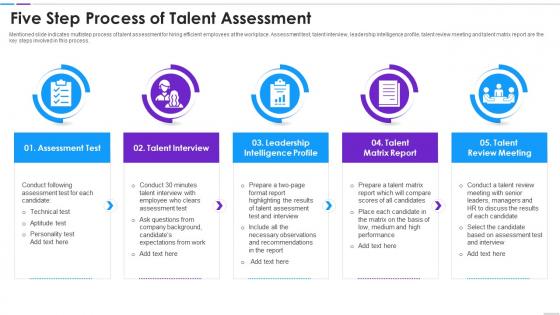
Mentioned slide indicates multistep process of talent assessment for hiring efficient employees at the workplace. Assessment test, talent interview, leadership intelligence profile, talent review meeting and talent matrix report are the key steps involved in this process.
People who downloaded this PowerPoint presentation also viewed the following :
Five Step Process Of Talent Assessment with all 6 slides:
Use our Five Step Process Of Talent Assessment to effectively help you save your valuable time. They are readymade to fit into any presentation structure.





FAQs for Five Step Process
Key competencies should include technical skills, problem-solving abilities, communication effectiveness, leadership potential, adaptability, and cultural alignment with organizational values. These assessments enable organizations to identify high-performing candidates through structured interviews, behavioral evaluations, and skills testing, ultimately delivering better hiring decisions and reduced turnover rates across diverse industries.
Organizations can effectively measure hard skills through technical assessments, certifications, portfolio reviews, and hands-on simulations, while evaluating soft skills via behavioral interviews, situational judgment tests, peer interactions, and role-playing exercises. This strategic combination enables companies to assess candidates holistically, with many finding that structured assessment frameworks in sectors like healthcare and finance ultimately deliver better hiring decisions and stronger team performance.
Technology revolutionizes talent assessment through AI-powered analytics, automated screening platforms, video interviewing tools, psychometric testing software, and predictive modeling systems. These innovations streamline recruitment processes by eliminating bias, accelerating candidate evaluation, and enhancing decision accuracy, with many organizations finding that automated assessments deliver faster hiring cycles and improved talent matching capabilities.
Personality assessments enhance recruitment by evaluating cultural fit, predicting job performance, identifying leadership potential, and reducing hiring bias through standardized metrics. These tools enable organizations to streamline candidate selection, improve team dynamics, and minimize costly hiring mistakes, with many companies finding that strategic personality testing ultimately delivers better employee retention and enhanced workplace collaboration.
Best practices for developing fair and unbiased talent assessment include using structured interviews, diverse evaluation panels, standardized scoring rubrics, blind resume reviews, and skills-based testing methods. These approaches streamline recruitment processes by minimizing unconscious bias, enhancing candidate evaluation consistency, and improving hiring accuracy, with many organizations finding that structured assessments ultimately deliver better talent outcomes and stronger workplace diversity.
Cultural fit assessments enhance team dynamics by evaluating candidates' alignment with organizational values, communication styles, and collaborative approaches alongside technical skills. These assessments help reduce workplace conflicts, improve employee retention, and strengthen team cohesion, with many companies finding that strategic cultural matching ultimately delivers more productive teams and enhanced organizational performance.
Continuous talent assessment drives employee development by identifying skill gaps, tracking progress over time, and aligning individual growth with organizational needs. This ongoing approach enables companies to provide targeted training, optimize career pathways, and retain top performers, with many organizations finding that regular assessments significantly enhance engagement while reducing turnover costs.
Gamified assessments improve candidate engagement by creating interactive, scenario-based evaluations that simulate real workplace challenges, reducing test anxiety while maintaining candidates' interest throughout longer assessment periods. These game-like elements enable recruiters to observe authentic problem-solving behaviors and decision-making patterns in realistic contexts, ultimately delivering more accurate talent predictions than traditional testing methods.
Companies should track metrics including time-to-hire, quality-of-hire scores, candidate experience ratings, assessment completion rates, and predictive validity of tools used. These measurements enable organizations to streamline recruitment processes, enhance hiring accuracy, and improve retention outcomes, with many finding that comprehensive tracking ultimately delivers competitive advantage and operational efficiency.
Tailoring talent assessments involves customizing evaluation criteria, assessment methods, and competency frameworks to match specific role requirements, responsibilities, and performance indicators. Organizations achieve this by developing role-specific behavioral interviews, technical evaluations, and situational assessments, with many companies finding that customized approaches significantly improve hiring accuracy and employee retention rates.
Ethical considerations include algorithmic bias, privacy concerns, transparency in decision-making, data security, and ensuring fair representation across diverse candidate groups. While AI enhances objectivity and streamlines hiring processes, organizations must implement robust oversight mechanisms, regular bias auditing, and clear disclosure practices, with many companies finding that ethical AI frameworks ultimately deliver more inclusive hiring outcomes and stronger employer branding.
Feedback mechanisms can be integrated through continuous performance dialogues, 360-degree evaluations, real-time coaching sessions, peer review systems, and automated assessment platforms. These approaches streamline talent development by providing immediate insights, enhancing employee engagement, and enabling data-driven decisions, with many organizations finding that integrated feedback ultimately delivers improved retention rates and accelerated skill development across teams.
Emerging trends include AI-powered behavioral analysis, real-time skills verification, virtual reality simulations, predictive analytics, and continuous performance monitoring. These technologies streamline recruitment by automating candidate screening, enhancing interview accuracy, and delivering personalized assessments, with many organizations finding that digital talent assessment reduces hiring time while improving candidate quality and cultural fit.
Organizations balance technical skills assessments with growth potential by implementing multi-faceted evaluation approaches that include aptitude testing, behavioral interviews, problem-solving scenarios, learning agility assessments, and cultural fit evaluations. Through strategic combination of current competency measurements and future-focused indicators, companies in sectors like technology and consulting identify candidates who demonstrate both immediate technical capabilities and adaptability, ultimately delivering stronger long-term talent investments.
Organizations can employ blind resume screening, diverse interview panels, standardized assessment criteria, partnerships with diverse universities and professional groups, and inclusive job descriptions that avoid biased language. These strategies streamline recruitment by expanding candidate reach, reducing unconscious bias, and enhancing decision-making quality, with many companies finding that diverse hiring practices ultimately deliver stronger innovation, better problem-solving capabilities, and improved competitive advantage.
-
Definitely a time saver! Predesigned and easy-to-use templates just helped me put together an amazing presentation.
-
Spacious slides, just right to include text. SlideTeam has also helped us focus on the most important points that need to be highlighted for our clients.