


Flag roadmap with three steps




Try Before you Buy Download Free Sample Product
 Impress Your
 Audience
 100%
100% Editable
 Save Hours
 of Time


Assess the information with our Flag Roadmap With Three Steps. Establish the degree of authenticity.
People who downloaded this PowerPoint presentation also viewed the following :
Content of this Powerpoint Presentation
Description:
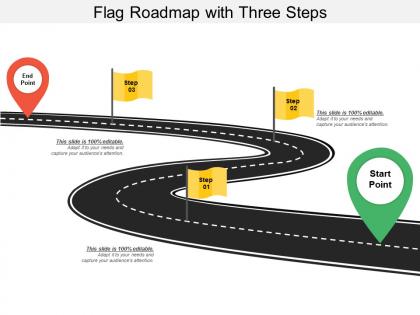
The image shows a PowerPoint slide titled "Flag Roadmap with Three Steps," depicting a metaphorical journey towards a goal or endpoint. It features a winding road with dashed lines, creating a path from a green "Start Point" to a red "End Point." Along the road, there are three flags labeled "Step 01," "Step 02," and "Step 03," which represent milestones or phases in a process. This visual metaphor can be used to describe sequential steps or progress in various projects or strategies.
Each flag on the roadmap signifies a checkpoint where specific objectives or targets are to be achieved before moving on to the next phase. The slide is marked as "100% editable," indicating that the presenter can customize the steps and descriptions to fit the specific context of their presentation.
Use Cases:
The template is versatile and can be employed in different sectors to illustrate progressions, timelines, or strategic plans:
1. Consulting:
Use: Showcasing project milestones.
Presenter: Senior Consultant.
Audience: Clients, and management teams.
2. Software Development:
Use: Illustrating phases of software release.
Presenter: Project Manager.
Audience: Development team, stakeholders.
3. Event Planning:
Use: Laying out stages of event organization.
Presenter: Event Coordinator.
Audience: Vendors, event staff.
4. Education:
Use: Mapping curriculum development stages.
Presenter: Curriculum Designer.
Audience: Educators, administrators.
5. Marketing:
Use: Demonstrating steps in a marketing campaign.
Presenter: Marketing Strategist.
Audience: Marketing team, salesforce.
6. Financial Services:
Use: Outlining financial planning or product launch.
Presenter: Financial Planner.
Audience: Clients, financial advisors.
7. Construction:
Use: Depicting construction project timeline.
Presenter: Construction Manager.
Audience: Contractors, clients.
Flag roadmap with three steps with all 5 slides:
Folks get encouraged by your good humor due to our Flag Roadmap With Three Steps. They will feel jovial.
FAQs for Flag roadmap
Honestly, start with mapping where you're at now, then figure out what "done" actually means for each rollout stage. You'll need clear timeline phases and get everyone on the same page about success metrics. Build in some buffer time because stuff always breaks when you least expect it. Have rollback plans ready - trust me on this one. Set up monitoring for each phase and nail down who makes the final calls on things. Oh, and don't forget regular check-ins with your team so nobody gets blindsided when features pop up or vanish. Draft a simple template you can reuse later.
So a flag roadmap is basically your project timeline but visual - way easier than drowning people in status emails that half the team skips anyway. You can show stakeholders exactly where things stand, what's stuck, and what's coming next. Dependencies become super obvious at a glance, which honestly saves so much back-and-forth confusion. People actually pay attention to the visual format instead of zoning out. I'd update it weekly and throw it into your regular meetings. Oh, and it keeps everyone on the same page without those awkward "wait, where are we again?" moments.
Hey! So there are a few ways to tackle this. Timeline-based planning works if you've got hard deadlines breathing down your neck. Impact-priority matrices help you figure out which flags actually matter for business goals. Stakeholder mapping is clutch - seriously, people sleep on this one but it shows you who'll freak out when things change. Some teams do story mapping or user journey stuff too, which is pretty solid. Oh, and definitely start by just... listing out what flags you have now and what they're supposed to do. Sounds basic but you'd be surprised how many teams skip that step.
First thing - make a list of all your feature flags and figure out which ones actually matter. Revenue stuff, anything user-facing, or flags that could break other systems if they mess up. Those are your priority targets. Honestly, the flags that have been sitting around forever are probably causing the most headaches. I'd sort everything by risk level and business impact, then tackle the scary ones first. Don't try to clean them all at once though - block out specific sprints just for flag removal. Makes it way less overwhelming and you'll actually get it done.
For flag roadmaps, I'd go with Gantt charts first - Asana and Monday make them pretty painless, or just use Excel if you're not trying to get fancy. Roadmunk and ProductPlan are built specifically for this kind of timeline stuff, so they look cleaner. Notion boards work surprisingly well too, honestly. I've even seen teams crush it with Airtable. Main thing is showing your rollout phases and which flags depend on others. Oh, and definitely highlight your target audiences. Whatever tool your team's already comfortable with is probably your best bet - learning new software just slows everyone down.
Honestly, base your flag roadmap on complexity more than team size. Smaller teams? Keep it basic - plan/build/release phases, fewer checkpoints. But once teams get bigger, you'll need detailed milestone tracking because coordination becomes a nightmare (learned that the hard way). Simple projects can survive with basic boolean flags. Complex ones need percentage rollouts and multiple variations. Match your flag strategy to how often you deploy and your risk tolerance. Oh, and start minimal! Don't over-engineer from the start - add complexity only when you actually hit those pain points. Way easier than trying to simplify later.
You really need to get stakeholder feedback for your flag roadmap. Trust me on this one - I've watched teams waste months building stuff nobody uses because they didn't ask around first. Talk to your users, devs, and product folks regularly. They'll tell you which flags are actually helping and which ones are just making everything messy. The feedback shows you what to turn into real features, what to kill off, and what new stuff people want. Oh, and definitely set up those regular check-ins. People will give you good intel if you actually listen to them instead of just nodding along.
Yeah totally doable! Just treat your flags like regular user stories in Agile - throw them in your sprints and track them normally. Waterfall's even easier, you just sync flag rollouts with whatever phases you already have planned. Most tools like Jira handle it fine once you get the initial setup done (took our team like a day to figure out). Start simple though - just add flag status as a field in your current tickets. Don't overthink it at first. Main thing is matching your flag timeline with release dates so you're not scrambling later. Build out fancier tracking once everyone's used to the workflow.
Don't plan too far out - learned this the hard way lol. Something always derails your timeline anyway. Get your engineers involved early since they'll spot dependencies you totally missed. Quarterly planning beats annual every time, way less overwhelming. Also avoid making roadmap calls solo in your office - your product team has intel you need. Keep things flexible and review regularly with everyone. I swear, the moment you lock in a rigid schedule is when priorities shift or some random technical debt surfaces. Review often, adjust when needed.
Honestly, you've gotta build in regular check-ins - monthly or quarterly works well. Don't plan too far ahead in detail; map out next quarter but keep everything else pretty high-level. Your stakeholders are actually super helpful here since they usually catch requirement changes before you do. Schedule these review meetings now and make them recurring. I learned this the hard way - roadmaps should evolve with your product, not trap you in old thinking. Oh, and reassess priorities whenever new data comes in or business needs shift. Trust me, this beats scrambling to catch up later.
Honestly, I'd do quarterly roadmap reviews with your team and stakeholders - book them way ahead so people actually show up. Monthly check-ins work too for urgent stuff that can't wait. Look at adoption rates, technical debt, business impact, all that good data to figure out which flags to kill or keep. A simple scoring system helps you stay objective instead of just going with gut feelings. The trick is making it routine, not scrambling when things break. I learned this the hard way - your roadmap needs to be a living thing you actually update, not something gathering dust in a Google doc somewhere.
Dude, cultural stuff will totally mess up your flag roadmap if you're not careful. Reading patterns are different everywhere - some go right-to-left, others don't. Colors mean completely different things too (red = danger vs luck depending where you are). Progress bars? Yeah, people interpret those differently too. I swear I've watched teams crash and burn because they forgot about local holidays during rollout. Build those cultural checkpoints right into your roadmap phases from day one. Don't just tack them on later. Get local people involved early or you'll regret it.
Colors actually matter way more than you'd think for feature flags. Red screams "danger" while green means "all good" - pretty basic stuff, but users react to this automatically. Blue builds trust, which is why every tech company uses it (honestly, it's getting boring at this point). Map your flag states to colors that make sense universally first. Then definitely test with your actual users since cultural stuff can trip you up. I've seen teams mess this up and confuse the hell out of everyone because their color choices sent mixed signals about what features were live or broken.
Honestly, just stick to whatever metrics you picked when you first mapped out your goals - adoption rates, performance stuff, user feedback scores. Don't go with those vague "looks good to me" feelings because we all know how that ends up. Set regular check-ins to actually look at your numbers. Hit 80% of your targets? You're golden. Below that and something needs tweaking - maybe your timeline's too aggressive or your approach isn't working. Oh, and make sure you're actually collecting the right data first. Sounds super obvious but I've definitely forgotten to set that up before shipping things.
Netflix gradually rolls out their UI changes using flag roadmaps - works pretty well for them. Spotify does something similar with their recommendation updates, and LinkedIn's probably the most famous example since they coordinate feed changes for millions without totally breaking things. Honestly, the pattern that matters most is planning the whole flag lifecycle upfront. When to enable, what percentage of users, and - this is huge - when you'll actually remove the flags. I'd start small though. Pick one feature and map out that entire journey before you flip anything on.
-
Awesome use of colors and designs in product templates.
-
I discovered this website through a google search, the services matched my needs perfectly and the pricing was very reasonable. I was thrilled with the product and the customer service. I will definitely use their slides again for my presentations and recommend them to other colleagues.