


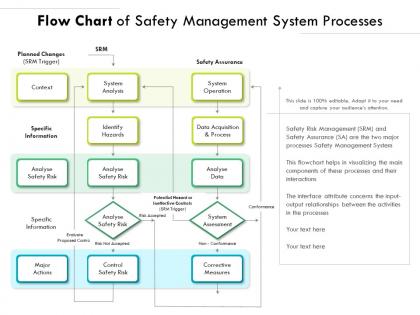
Organigramme des processus du système de gestion de la sécurité




Try Before you Buy Download Free Sample Product
 Impress Your
 Audience
 100%
100% Editable
 Save Hours
 of Time


Notre organigramme des processus du système de gestion de la sécurité est conçu de manière thématique pour offrir un arrière-plan attrayant à tout sujet. Utilisez-les pour avoir l'air d'un professionnel de la présentation.
People who downloaded this PowerPoint presentation also viewed the following :
Organigramme des processus du système de gestion de la sécurité 1. Identification des dangers et évaluation des risques 2. Mise en place de mesures de contrôle et de réduction des risques
Utilisez notre organigramme des processus du système de gestion de la sécurité pour vous aider efficacement à gagner du temps précieux. Ils sont prêts à s'intégrer dans n'importe quelle structure de présentation.
FAQs for Flow chart of safety
Okay so you need four main things: safety policy/objectives, risk management, safety assurance (audits and monitoring stuff), and safety promotion through training. Policy sets the tone from leadership. Risk management finds and controls hazards. Safety assurance checks that everything's actually working - which honestly is where most places mess up. Training keeps everyone in the loop. The trick is making sure these four pieces actually talk to each other instead of being completely separate. Start by figuring out what you've already got in place first.
Start by mapping out what could actually go wrong - hazard workshops, looking at past incidents, walking around and seeing what's sketchy. Get your frontline people involved because honestly, they spot stuff managers completely miss. Document it all in a risk register (I know, more paperwork) and tackle the scary high-probability ones first. The trick is keeping it updated when things change. Otherwise you end up with some useless binder that nobody looks at. Make it something you actually use, not just a compliance checkbox.
Honestly, training is what makes or breaks your whole SMS. People can't just wing it and hope for the best - they need to actually understand safety procedures, spot hazards, and know how to report incidents. I've watched companies with beautiful safety manuals that were totally useless because workers had no clue what their role was supposed to be. Good training gets everyone on the same page. It builds that culture where safety isn't just management's problem anymore. Figure out where your biggest knowledge gaps are first. Those should be your priority, and you'll start seeing real improvements pretty quickly.
Honestly, going digital with safety stuff is a game changer. Mobile apps are clutch - your crew can report hazards right from wherever they're working instead of waiting till later. Ditch those spreadsheets (seriously, they're the worst) and get a proper system for tracking incidents and training records. Wearable sensors are pretty cool too, they'll monitor air quality and catch when someone's getting too tired. AI can spot weird patterns in your data that you'd totally miss. I'd start with just digitizing incident reports first, then see what else makes sense for your specific situation.
Honestly, the worst part is usually getting leadership on board - they don't want to spend money or time on it. Your team will push back hard too because nobody wants more work on top of what they're already doing. Companies also make this mistake where they try rolling out everything at once instead of baby steps. Communication is usually terrible - people don't understand WHY they need to care about safety management systems. Oh, and training? Most places skimp on that completely. The kiss of death is when executives treat it like just another compliance thing to check off. My advice? Start super small, make sure bosses are actually visible about supporting it, and focus on quick wins so your skeptical coworkers see it's worth their time.
Look at both your leading and lagging metrics. Leading stuff shows what's happening proactively - training completion rates, how many hazard reports people submit, audit closures. Lagging indicators are your incident rates, severity scores, workers comp costs. Honestly, trends matter way more than individual numbers. Don't forget to survey employees about safety climate too - they'll tell you things your data won't. I'd start with maybe 3-4 metrics you can actually do something about. No point drowning in spreadsheets, right?
Honestly, it depends on your industry but there's usually overlap. Aviation stuff follows ICAO and FAA rules. Maritime has IMO regs, oil & gas does OSHA plus API guidelines. Manufacturing? ISO 45001 for safety mostly. Healthcare's kinda messy - Joint Commission standards and if you're doing medical devices, FDA gets involved too. But here's the thing - they all basically want the same stuff. Risk assessments, incident reporting, that continuous improvement cycle. I'd figure out which regs actually apply to you first, then see where they connect. Makes way more sense that way.
Here's the thing - a good safety system makes everyone feel responsible for safety stuff, not just the bosses. You want people reporting hazards without worrying they'll get in trouble for it. Track metrics that actually tell you something useful (honestly, half the data companies collect is pretty useless). Leadership needs to show they care by participating, not just sending emails about it. The whole point is switching from "oh crap, accident happened" to "let's catch this before someone gets hurt." Once people see their concerns get handled fast, they'll actually speak up more. Start with a reporting system that's truly anonymous and doesn't suck to use.
Start by picking your audit team - grab people who aren't involved in whatever areas you're checking. Review all the safety docs and incident reports first. During the actual visit, talk to workers at every level and watch what they're really doing (not just what the manual says). Make sure safety gear is accessible and working. Oh, and write everything down immediately - I always think I'll remember stuff but never do. The whole exercise is pretty pointless if you don't document it properly. Wrap up with a report that has clear priorities and deadlines that won't make everyone groan.
Honestly, most reporting systems suck because they're either too complicated or people think they'll get in trouble. Make it dead simple - QR codes, mobile apps, whatever takes under 2 minutes. Train supervisors to say "thanks for the heads up" instead of immediately hunting for someone to blame (seriously, this happens way too often). The biggest thing though? Actually tell people what happened after they report something. Even if it's just "we looked into it and here's what we found." Nobody keeps reporting when it feels like you're just talking to a wall.
Honestly, getting employees involved in safety stuff is a game changer. People actually follow rules they helped make - weird how that works, right? Your frontline folks see hazards management totally misses because they're dealing with it daily. Makes sense though. They know the job inside and out. It builds this culture where workers feel safe calling out problems instead of staying quiet. My advice? Just ask your team what safety issues they're noticing. Actually listen to what they say when you're making decisions. The buy-in you get is worth it.
Honestly, start by figuring out what safety risks your remote team actually faces - home offices can be surprisingly hazardous. You'll want to move everything digital: virtual safety meetings, video call equipment checks, online incident reporting. The culture part is harder when everyone's working from different places. Regular virtual toolbox talks help though, and those safety challenge things actually get people engaged (who knew?). Set up protocols for home ergonomics and make sure people can report near-misses from anywhere, not just the main office. Digital workflows are your friend here.
Track both leading and lagging indicators - you need the full picture. Leading ones are like safety training completion, near-miss reports, audit scores. They predict problems before they hit. Lagging indicators? That's your incident rates, injuries, lost time accidents, comp costs. Honestly, the leading stuff is way more valuable since you can actually prevent issues instead of just counting them after. Oh, and don't go crazy with data - pick maybe 3-4 from each category that actually matter for your place. You can always add more later.
Honestly, ditch the whole top-down announcement thing. You want actual conversations going both ways. Mix up your channels - toolbox talks, digital boards, just walking around and checking in with people. The tricky part? Getting workers to speak up about hazards without worrying they'll get blamed. I've seen too many places mess this up. Quick pulse surveys help you figure out if anyone's actually listening. Here's what really works though - ask your team how they want to get safety info. Sometimes the answer's totally different than what you'd expect. When people give feedback, they need to see real changes happen.
So aviation and nuclear power figured out something pretty smart - safety can't just be one department's problem. Everyone has to own it. The coolest part? They actually got people comfortable reporting close calls without worrying about getting fired. That alone is huge. Training gets major budget, they use data to spot trouble early, and mistakes become learning moments instead of blame games. Oh, and here's the kicker - track stuff like how many safety reports you're getting, not just accident numbers after the fact. Way more useful.
-
Good research work and creative work done on every template.
-
Awesomely designed templates, Easy to understand.