


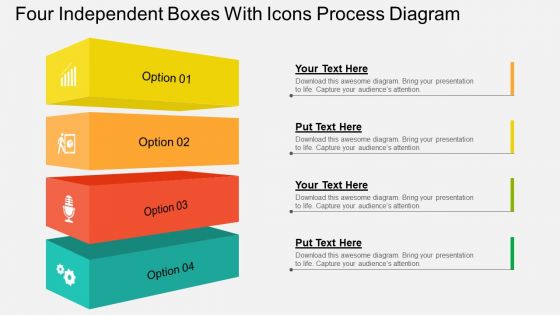
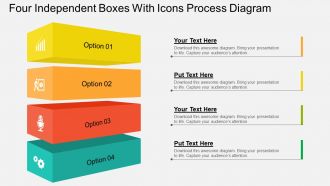
Four independent boxes with icons process diagram flat powerpoint design





Try Before you Buy Download Free Sample Product
 Impress Your
 Audience
 100%
100% Editable
 Save Hours
 of Time


Highlight any information related to your work with four independent boxes with icons PowerPoint diagram. The PPT infographic has been designed creatively for business specialists to share strategies, planning, process, procedures, and more. Whether you want to share the concepts related to business, sales, marketing and technology, finance etc. this professional presentation design makes that job easier for you. The four independent boxes PPT template can also be beneficial to show strategies, risks, achievements, milestones, challenges, tips or any other information that you want to share with your colleagues, clients or even stakeholders. The four text boxes can be easily edited, and you can change the color and other elements of the design according to your requirement. The text space can be used to write your message that you would like to communicate. To add more, this presentation diagram comes with icons that you may use as available or can edit them according to your need. Download it now and make it a part of your next presentation. Avoid harping on any aspect with our Four Independent Boxes With Icons Process Diagram Flat Powerpoint Design. They ensure every angle is covered.
People who downloaded this PowerPoint presentation also viewed the following :
Four independent boxes with icons process diagram flat powerpoint design with all 4 slides:
Expose them to excellence with our Four Independent Boxes With Icons Process Diagram Flat Powerpoint Design. Give them a feel of the best available.
FAQs for Four independent boxes with icons process diagram
You need clear start/end points, decision diamonds, process rectangles, and arrows connecting them. That's honestly the foundation - I've seen way too many confusing flowcharts that missed these basics. Add your inputs/outputs and key stakeholders too. Keep text inside each shape super short because nobody wants to decipher a novel in a tiny box. Flow should go left to right or top to bottom logically. Oh, and include timeframes if they matter for your situation. Start with these core pieces first, then only add more detail if it actually helps your audience understand better.
Honestly, process diagrams are game-changers when you're drowning in complex workflows. Your brain can only juggle so many steps at once, right? But with a visual map, suddenly you can see how everything flows together. They're perfect for getting new people up to speed - way better than dumping a wall of text on them. Plus when something's broken or moving slow, everyone can literally point to where the problem is. I swear, half the time you'll spot weird redundant steps you never noticed before. Next time you're trying to explain something messy, just draw it out first. Makes everything click faster.
So I've tried most of these at this point. Draw.io (they renamed it to diagrams.net but whatever) is completely free and honestly pretty solid - I'd start there. Microsoft Visio's what everyone uses at big companies, though it feels kinda outdated sometimes. Lucidchart's really smooth for collaboration since it's all web-based. Oh, and Miro or Figma work great too if you want something more visual/creative looking. I still use Draw.io for quick stuff since there's no paywall. But if you end up needing fancier features later, Lucidchart's worth the upgrade.
Really depends who's gonna look at it. For compliance stuff or training newbies? Go nuts with every little detail and decision point. But if it's for executives or big-picture discussions, keep it simple - like 8 major steps max. Nobody wants to stare at a flowchart that looks like a subway map. Think about daily users vs people who just need the overview. I usually start broad, then add detail only where things get messy or expensive mistakes happen. Honestly, the best test is showing it to actual users. When they start asking "okay but what if..." - that's where you need more boxes.
Honestly, they're pretty similar and people mix them up all the time. Flowcharts are more about the decision-making stuff - you know, those diamond shapes with yes/no branches? They're great when you need to map out "if this happens, then do that" logic. Process diagrams are broader. They show the whole workflow, who does what, inputs and outputs - the full picture basically. I'd go with flowcharts for decision points and logic flows. For documenting complete business processes with all the handoffs and responsibilities, process diagrams work better. Though honestly? Sometimes the terms get used interchangeably which doesn't help anyone.
Get the actual workers in a room together, not just management - they're the ones who know where everything breaks down. Have them walk through their real tasks while you map it out with them. Workshops beat individual interviews every time because people will call each other out and remember stuff they'd normally forget to mention. Honestly, half the battle is just making them feel like they're helping build it, not being interrogated. Oh, and don't forget follow-up sessions to check your draft maps. If they feel ownership over the process, they'll actually use the thing instead of letting it collect dust.
Pick a color scheme and stick with it - green for start/end, blue for processes, yellow for decisions. I learned this the hard way after making a flowchart that looked like a kindergarten art project. Red works great for bottlenecks or problem areas. Don't go crazy though, 3-4 colors tops. Also think about colorblind folks on your team - red/green combos are basically useless for them. Always throw a legend somewhere visible so people aren't playing guessing games. Trust me, consistency makes everything way more professional looking.
Yeah so keep it to like 7-10 steps tops - nobody wants to stare at some crazy complicated flowchart. Just use simple language for each box, nothing fancy. Don't try to cram every little detail in there, that's what your other docs are for. I learned this the hard way when I made one that looked like spaghetti. Stick with the same shapes and colors throughout so people aren't playing guessing games. Here's what really works though - test it on someone who's never seen the process before. If they look confused, you need to cut more stuff out. Start with just the must-have steps, then remove things instead of adding more.
Think of symbols as process diagram shorthand - way better than writing everything out. Ovals mark start/end points, rectangles show tasks, diamonds are decisions, arrows connect the flow. Pretty straightforward once you get it. The whole point is standardization so your team can glance at any diagram and instantly know what's going on. Honestly, I've seen people try to get creative with their own symbols and it just confuses everyone. Stick with the standard ones and you won't spend half your meetings explaining what that random star shape is supposed to mean.
Honestly, process diagrams are lifesavers because everyone gets the same visual roadmap. No more "wait, what happens next?" confusion during meetings. You know how Sarah and Mike always argue about who handles step 3? Yeah, that stops happening when everything's mapped out clearly. Spotting bottlenecks becomes way easier too. New people can actually see the workflow instead of piecing things together from random conversations – which is honestly exhausting for everyone involved. Trust me, next time you're explaining something complex, sketch it out first. Makes such a difference.
Honestly, the worst thing you can do is overcomplicate it. I've seen process diagrams that look like someone threw spaghetti at a wall - total nightmare. Focus on the main flow first and add your decision points clearly. Otherwise people get lost fast. Make your swim lanes obvious so everyone knows their role. Here's what really works though: test it on someone clueless about the process. If your coworker can't follow it, your stakeholders definitely won't. Start with the basic happy path, then layer in all the weird exceptions after. Way easier that way.
Okay so basically treat those diagrams like they're gonna change - because they will. Set up reviews every 3-6 months and give someone who actually uses the process daily ownership of keeping them current. Honestly, I've watched so many teams make gorgeous diagrams that turn into expensive paperweights within months. Flag affected diagrams whenever you update procedures or systems. Build the updates into your change process from day one, not as some random task later. Keep version history so you can see what changed and get sign-offs on big revisions. Oh, and set that calendar reminder today.
Process diagrams are honestly lifesavers - they show you exactly how work moves through your company. Super easy to spot where things get stuck or slow down. You'll see who's doing what at each step and where decisions are getting bottlenecked. Resource planning becomes way simpler too since you know exactly where you need more people or better tools. Before changing anything major, the diagram shows you what might break downstream. I learned this the hard way at my old job! Start with whatever process is driving you crazy right now - that's where you'll see the biggest wins.
Honestly, process diagrams are a game changer for training new people. Skip those massive procedure manuals nobody reads anyway. Instead, make flowcharts showing each step and decision point. New hires can literally walk through the diagram while doing their first tasks - it's like having a roadmap. I've watched teams cut their onboarding time in half with this approach. The visual format helps people grasp not just the what, but the why behind each step. Start with your three most common workflows and you'll cover most of what they need. Way better than info-dumping on day one.
Honestly, templates are a lifesaver because you don't have to build everything from zero each time. Most come with shapes and layouts already done for you. Real-time collaboration is huge too – way better than crowding around a whiteboard (though I kinda miss those sometimes). When your process changes, you can just update the template instead of redrawing the whole thing. Everything stays consistent across projects, which your future self will thank you for. I'd try out a few different template libraries first to see what clicks with how your team actually works.
-
Commendable slides with attractive designs. Extremely pleased with the fact that they are easy to modify. Great work!
-
Awesomely designed templates, Easy to understand.