


Framework for effective strategic thinking




Try Before you Buy Download Free Sample Product
 Impress Your
 Audience
 100%
100% Editable
 Save Hours
 of Time


You can have a good story but you should be able to tell it well to keep your audience awake. Our Framework For Effective Strategic Thinking are so design to ensure your audience is captivated by what you present.
People who downloaded this PowerPoint presentation also viewed the following :
Content of this Powerpoint Presentation
Description:
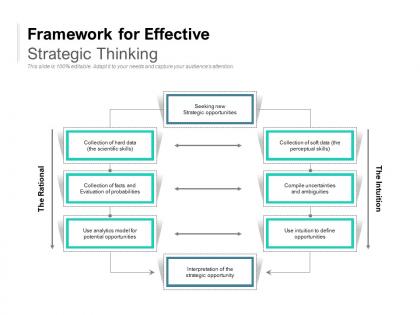
The image portrays a presentation slide entitled "Framework for Effective Strategic Thinking," designed to illustrate a conceptual approach that amalgamates rational and intuitive methodologies for the identification of strategic opportunities. This framework encourages a balanced integration of analytical, evidence-based reasoning, and perceptual, ambiguity-managing skills in the realm of strategic decision-making.
The slide is divided into two distinctive sections:
The Rational" (Left Side):
This segment primarily emphasizes the analytical and evidence-based facets of decision-making, providing a structured approach to strategic thinking.
Collection of hard data (the scientific skills): This initial step suggests the importance of gathering quantifiable and objective data as the foundational stage.
Collection of facts and Evaluation of probabilities: It underscores the significance of assessing collected data to determine the likelihood of various outcomes.
Use analytics model for potential opportunities: This point recommends the application of statistical or other analytical models to identify potential strategic opportunities.
The Intuition" (Right Side):
This counterpart underscores the value of perceptual skills and managing ambiguity in shaping strategic initiatives.
Collection of soft data (the perceptual skills): This step involves the collection of qualitative data, insights, and trends that may not be easily quantified.
Compile uncertainties and ambiguities: It emphasizes the recognition and interpretation of less clear-cut information that could influence strategic decisions.
Use intuition to define opportunities: This element encourages leveraging gut feelings or experiential knowledge to pinpoint potential strategic moves.
In the center of the slide, the phrase "Seeking new Strategic opportunities" serves as a bridge between "The Rational" and "The Intuition," highlighting the need for a harmonious synthesis of rational analysis and intuition in the pursuit of effective strategic thinking.
Use Cases:
Potential industries and scenarios where this strategic thinking framework could be effectively applied include:
1. Management Consulting:
Use: Developing comprehensive strategies for clients.
Presenter: Senior Consultant
Audience: Corporate Executives
2. Financial Services:
Use: Crafting investment strategies and portfolio management.
Presenter: Financial Analyst
Audience: Investment Clients
3. Healthcare:
Use: Improving healthcare systems and patient care strategies.
Presenter: Healthcare Administrator
Audience: Medical Staff and Hospital Management
4. Technology:
Use: Planning product development and fostering innovation.
Presenter: Chief Technology Officer
Audience: Research and Development (R&D) Team
5. Marketing and Advertising:
Use: Creating effective marketing strategies and campaigns.
Presenter: Marketing Director
Audience: Marketing and Sales Teams
6. Education:
Use: Strategic planning for educational programs and institution advancement.
Presenter: Dean or Educational Consultant
Audience: Academic Staff and Administrators
7. Public Policy:
Use: Influencing policy-making and government strategy.
Presenter: Policy Advisor
Audience: Government Officials and Departments
Framework for effective strategic thinking with all 2 slides:
Did you know that 90% of people present at a presentation would rather listen than read? Therefore you have to create powerful presentations using few words and that?s what professionally designed Framework For Effective Strategic Thinking do.
FAQs for Framework for
An effective strategic framework includes vision and mission alignment, comprehensive market analysis, clear objectives and key performance indicators, resource allocation strategies, and implementation roadmaps. These components work together by establishing direction, informing decision-making, and measuring progress, with many organizations finding that integrated frameworks streamline operations, enhance competitive positioning, and ultimately deliver sustained growth across diverse business environments.
A strategic framework aligns organizational goals with operational plans by establishing clear objectives, defining measurable outcomes, and creating systematic processes for resource allocation and performance tracking. Through cascading goal-setting methodologies, organizations streamline decision-making across departments, enhance operational efficiency, and ensure tactical initiatives directly support broader strategic priorities, ultimately delivering improved accountability and competitive advantage.
Stakeholder analysis plays a crucial role in strategic framework development by identifying key parties, assessing their influence and interests, mapping potential conflicts, and aligning strategic objectives with stakeholder expectations. Through comprehensive stakeholder mapping, organizations streamline decision-making processes, enhance buy-in across departments, and minimize implementation resistance, ultimately delivering more sustainable strategic outcomes and competitive advantage.
Organizations measure strategic framework implementation success through key performance indicators, milestone tracking, stakeholder feedback, financial metrics, and operational efficiency assessments. These measurement approaches enable companies to evaluate progress across departments, identify implementation gaps, and adjust strategies accordingly, with many businesses finding that regular quarterly reviews and data-driven dashboards ultimately deliver greater strategic alignment and competitive advantage.
Common strategic framework pitfalls include overly complex structures, lack of stakeholder input, unrealistic timelines, insufficient resource allocation, and poor communication strategies. These missteps often result from inadequate planning and limited organizational alignment, with many companies finding that frameworks fail when they prioritize theoretical perfection over practical implementation, ultimately hindering operational efficiency and strategic execution.
A strategic framework provides the structured approach and methodology for making strategic decisions and achieving long-term goals, while a business model defines how an organization creates, delivers, and captures value. Strategic frameworks guide the planning process through systematic analysis, resource allocation, and performance measurement, whereas business models focus on revenue streams, customer segments, and operational mechanics, with many organizations finding that effective frameworks ultimately inform and strengthen their underlying business model design.
Technology enhances strategic framework development through advanced analytics, real-time data visualization, collaborative planning platforms, scenario modeling tools, and automated performance tracking systems. These digital solutions streamline decision-making processes by enabling faster data analysis, improved stakeholder collaboration, and continuous strategy monitoring, with many organizations finding that technology-driven frameworks deliver more agile responses to market changes.
Strategic frameworks should be adapted by modifying core components like market analysis methods, competitive dynamics assessment, regulatory considerations, and success metrics to align with industry-specific characteristics. For example, healthcare frameworks emphasize compliance and patient outcomes, while technology frameworks prioritize innovation cycles and scalability, with many organizations finding that customized approaches deliver significantly better strategic alignment and competitive advantage.
Continuous feedback enables strategic frameworks to remain relevant and effective by identifying implementation gaps, market shifts, and performance deviations in real-time. This iterative refinement process helps organizations adapt their strategic direction, optimize resource allocation, and maintain competitive advantage, with many companies finding that regular feedback loops significantly enhance their framework's responsiveness and long-term success.
A strategic framework supports risk management by establishing clear governance structures, defining risk tolerance levels, and creating systematic assessment processes across organizational functions. Through integrated risk monitoring and response protocols, companies can proactively identify vulnerabilities, allocate resources effectively, and maintain operational continuity, ultimately delivering enhanced resilience and competitive advantage in uncertain market conditions.
Strategic planning commonly utilizes frameworks including Porter's Five Forces, SWOT analysis, balanced scorecard, scenario planning, and Blue Ocean Strategy. These models enhance decision-making by analyzing competitive landscapes, identifying organizational strengths and market opportunities, and measuring performance outcomes, with many organizations finding that strategic combinations of these approaches deliver clearer direction and sustainable competitive advantage.
Cultural considerations significantly influence strategic frameworks by shaping communication styles, decision-making processes, leadership approaches, risk tolerance levels, and stakeholder engagement methods. Organizations operating across diverse markets find that incorporating cultural insights enables more effective implementation, enhances employee buy-in, and delivers sustainable competitive advantage through culturally-aligned strategic execution and outcomes.
Integrating a new strategic framework requires stakeholder assessment, leadership alignment, phased implementation planning, employee training, and continuous monitoring systems. Organizations typically begin with pilot departments, gradually expanding across divisions while maintaining regular feedback loops and adjustment protocols, with many companies finding that structured change management and clear communication channels ultimately deliver smoother transitions and stronger adoption rates.
Visual presentation tools enhance strategic framework communication by transforming complex concepts into digestible charts, infographics, and interactive dashboards that stakeholders can quickly understand and remember. These tools streamline alignment across departments through clear timelines, process flows, and performance metrics, with many organizations finding that visual frameworks accelerate decision-making and improve strategic execution significantly.
Best practices for engaging team members include conducting collaborative workshops, establishing cross-functional working groups, implementing structured feedback sessions, creating transparent communication channels, and providing comprehensive training on strategic methodologies. These approaches streamline participation by fostering ownership, enhancing buy-in, and leveraging diverse perspectives, with many organizations finding that inclusive framework development ultimately delivers stronger strategic alignment and more effective implementation across all organizational levels.
No Reviews