

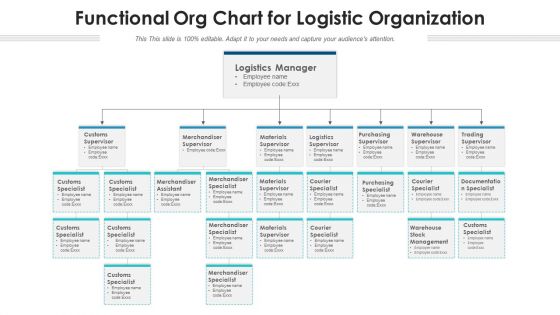
Functional org chart for logistic organization





Try Before you Buy Download Free Sample Product
 Impress Your
 Audience
 100%
100% Editable
 Save Hours
 of Time


Our Functional Org Chart For Logistic Organization are topically designed to provide an attractive backdrop to any subject. Use them to look like a presentation pro.
People who downloaded this PowerPoint presentation also viewed the following :
Functional org chart for logistic organization with all 2 slides:
Use our Functional Org Chart For Logistic Organization to effectively help you save your valuable time. They are readymade to fit into any presentation structure.
FAQs for Functional org chart
Start with your logistics director at the top, then break it down by function - transportation, warehousing, inventory, procurement. Customer service and IT support matter too (honestly, IT gets forgotten way too much). The big thing is making sure everyone knows who actually calls the shots when problems hit. I've watched teams scramble because nobody knew whose decision it was. Define authority levels clearly and don't skip the cross-functional roles. Quick test: could someone brand new look at your chart and immediately know who to bug about a shipping delay?
Honestly, mapping out your logistics org chart is a game-changer. When everyone knows their role and who to report to, decisions happen way faster. No more "wait, who handles this?" moments. Your teams actually coordinate properly instead of stepping on each other's toes. Here's what I'd do: sketch out your current setup first, then look for where things get stuck. Those handoff points between departments? That's where the magic happens – or where everything falls apart. You'll probably discover some processes are more of a mess than you thought. Focus on fixing the spots where delays actually occur.
So for your logistics org chart, definitely hit the main stuff first - procurement, inventory management, warehousing, and transportation. Someone needs to own supplier relationships and demand planning too. Oh, and don't sleep on compliance and quality control (learned that one the hard way at my last job). Data analysis is huge since you'll be drowning in useful metrics. Make sure there's clear ownership for customer service headaches around shipping delays. Honestly, reverse logistics is probably something you can add later once you get the basics down. Start simple and build from there.
Yeah so company size totally changes how you set up logistics. At small places, one poor soul handles procurement, warehousing, shipping - the whole mess basically. Medium companies finally split that up with dedicated teams under a logistics manager. Big enterprises though? They go crazy with separate departments for inbound, outbound, warehousing, transportation, sometimes even regional splits. More people = way more hierarchy and specialization. But honestly, I'd look at your actual transaction volume and complexity first, then figure out structure from there instead of just copying what similar-sized companies do.
Honestly, the worst part is trying to balance corporate control with letting regions do their own thing. Where do you even put roles like demand planning? Super confusing. Then there's the whole mess of who reports to who - warehouse to transportation or the other way around? I've seen companies flip-flop on this for months. Oh, and don't get me started on manager spans. Too many layers and nothing gets done. Here's what worked for me: map your actual processes first, then build around that instead of forcing people into whatever org chart template you found online.
So basically you'll want to embed tech people right into your logistics teams instead of keeping them separate. Add data analysts and automation folks directly to operations. Your warehouse managers? They're gonna need to learn dashboards now. Transportation people become routing optimization experts - honestly it's wild how much the roles change. The whole org chart gets flipped once you commit to this. Just make sure your structure actually supports cross-team collaboration between the tech people and operations staff. Figure out what digital tools each role needs first, then rebuild teams around those workflows.
Your org chart basically controls whether your supply chain actually works or becomes a total mess. Clear reporting lines mean procurement actually talks to warehousing, warehousing coordinates with transport - you know, like they're supposed to. Without good structure? Pure chaos. Nobody knows who does what, so you get delays and everyone pointing fingers when stuff breaks. Plus you need to see who can actually make decisions fast when problems pop up. I've seen companies waste weeks because no one knew who had approval authority. Check if your communication paths actually make sense for how you operate day-to-day.
Quarterly's probably fine for most places, but really depends on how crazy things get at your company. Growing fast or dealing with seasonal chaos? Monthly makes way more sense. I'd definitely update it whenever you hire people, shuffle roles around, or restructure departments. Oh, and when communication starts breaking down because nobody knows who reports to whom - that's a dead giveaway you've waited too long. Honestly, I've watched companies completely lose their minds over this stuff. Just set a calendar reminder and treat it like any other ops review. Your sanity will thank you later.
Get ahead of the rumors - seriously, warehouse gossip spreads faster than spilled oil! First, brief your managers so they're not caught off guard. Then send that all-hands email explaining the changes and why they're happening. Don't be vague about timelines or how jobs are affected, people freak out when they don't know if they're safe. Follow up with team meetings for questions. Oh, and update your Slack channels or whatever you use internally. Multiple ways to communicate = less confusion. Give folks time to digest it all before expecting them to be totally on board.
Honestly, color coding is a game changer for org charts - nobody wants to stare at gray boxes all day. Use different colors for departments, throw in some icons (trucks for transport, little warehouse symbols), and add arrows showing how stuff flows between teams. New hires get it so much faster. Different shapes help too - maybe bigger boxes for key roles or high-volume areas. I swear people actually pay attention when there's visual stuff to look at instead of just text everywhere. Makes spotting bottlenecks way easier, and your stakeholders won't zone out during presentations.
Honestly? Go hierarchical if you've got a complex operation that needs tight oversight - the specialized expertise at each level is clutch for logistics and risk management. Flat structures are super trendy right now and yeah, they're way faster for decisions. But they work best when things are simpler or smaller scale. Speed vs control is basically what you're choosing between. I'd probably figure out what's actually breaking in your current setup first - like, are you too slow to react or is stuff falling through cracks? That'll tell you which direction makes sense.
Try dotted-line reporting - like having someone from procurement report to their boss but also connect to the supply chain team on paper. Works pretty well from what I've seen. Short sentences mixed with longer ones that actually flow naturally when you read them. You could also do dedicated coordinator roles that bridge departments, or just pull people from different areas for specific projects. Honestly, most logistics companies need this kind of cross-team stuff constantly anyway. The main thing is getting those relationships visible on your org chart so everyone knows who they're supposed to work with and nobody's left wondering about accountability.
Track your delivery times, shipping costs, and inventory turnover - that's the obvious stuff. But honestly? Employee satisfaction matters way more than people think. High turnover usually means your org chart sucks. Also watch how fast decisions actually get made between departments. Communication breakdowns are a dead giveaway that something's broken. Customer satisfaction scores tell the real story too. Do monthly check-ins on all this. When you keep hitting the same bottlenecks, that's when you know it's time to restructure things.
Honestly, org charts are lifesavers for cutting through the "who do I even call about this?" mess. You'll know right away if something needs to go to operations, procurement, or warehouse - no more awkward back-and-forth emails. The visual setup makes it super obvious where bottlenecks might hit before they actually do. Nobody wants to be that person who accidentally delays a whole shipment because they contacted the wrong department, you know? It also helps different teams work together better since everyone can see how their piece fits. Just make sure you actually update the thing when people move around - I've seen way too many outdated charts floating around that cause more confusion than they solve.
Honestly, your leadership team is gonna make or break how your logistics structure actually works. They're the ones deciding who talks to who, what the reporting lines look like, and where decisions get made. I've watched perfectly good operations crumble because nobody thought through the org chart properly - it's wild how much that matters. Your leaders also need to figure out if you're optimizing for speed, costs, or customer happiness, then build around that. Plus they set the vibe for how warehousing, transport, and procurement teams work together. Don't let them just wing it and hope structure magically appears.
-
Excellent template with unique design.
-
Innovative and attractive designs.