


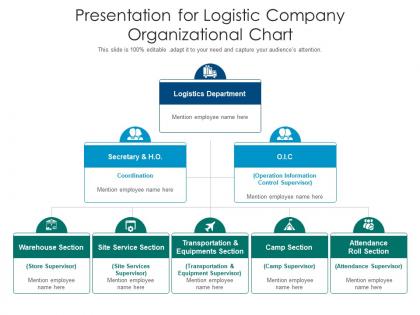
Presentation for logistic company organizational chart




Try Before you Buy Download Free Sample Product
 Impress Your
 Audience
 100%
100% Editable
 Save Hours
 of Time


Our Presentation For Logistic Company Organizational Chart are topically designed to provide an attractive backdrop to any subject. Use them to look like a presentation pro.
People who downloaded this PowerPoint presentation also viewed the following :
Presentation for logistic company organizational chart with all 2 slides:
Use our Presentation For Logistic Company Organizational Chart to effectively help you save your valuable time. They are readymade to fit into any presentation structure.

FAQs for Presentation for logistic
So you're gonna see the usual suspects: procurement, warehousing, transportation, inventory management, and distribution. Demand planning and customer service usually make it onto these charts too since they're pretty critical. Smaller companies tend to mash roles together - honestly makes sense when you don't have a huge team. The main thing is getting clear reporting lines between your inbound stuff, internal ops, and outbound delivery. Oh, and I'd definitely start by mapping what you've got now. That way you can spot the gaps or weird overlaps that need fixing.
Having a solid logistics org chart seriously cuts down on all that "who's supposed to handle this?" chaos. You'll see way better efficiency when everyone knows their lane - like who's running procurement vs warehousing vs transportation. No more finger-pointing when something goes wrong either. The communication between departments gets smoother too, which honestly makes such a difference in catching problems early. I'd start by sketching out what you have now and spotting where people are either stepping on each other's toes or where stuff just falls into a black hole. Those messy overlap areas? That's where you'll see the biggest improvements.
So logistics teams are getting completely reorganized because of all this tech stuff. Companies are hiring data analysts and automation engineers now - roles that didn't even exist before. Middle management is basically getting squeezed out since real-time data flows straight up the chain. Honestly, some of these changes happened way faster than I expected. The tricky part? You've got to balance your human talent with all the software and tech infrastructure. It's like rebuilding the plane while you're flying it, but most companies don't have a choice anymore.
Start by breaking down your main areas - procurement, warehousing, transportation, distribution. Then figure out who owns what decisions and at what dollar amounts. Someone needs to handle coordination between departments too (trust me, silos are a nightmare in logistics). Don't just throw around job titles - be super specific about actual responsibilities. When stuff hits the fan, you don't want people pointing fingers at each other. A RACI matrix sounds boring but it'll save your sanity later. Basically map out who's doing the work versus who just needs updates.
Honestly, org charts are lifesavers for figuring out who talks to who. You'll see right away if procurement goes straight to warehousing or has to run everything through operations first. Saves you from that whole "do I email my boss or just handle this myself?" thing. Plus you can spot where communication gets stuck before it becomes a headache - like when Bob from shipping somehow becomes the bottleneck for everything (there's always a Bob). Just make sure you actually update the thing when people move around. Trust me, reference it when you're planning anything cross-department.
Honestly, it's just about scale. Small businesses? One person does everything - buying, storing, shipping, you name it. Maybe they'll call themselves "Operations Manager" but they're basically wearing ten hats. Big companies though... they've got entire departments. Supply Chain Directors, Warehouse Managers, Transportation Coordinators - the works. The hierarchy gets crazy deep. Large corps even split inbound and outbound into separate teams, which seems overkill sometimes but I guess it works for them. When you're mapping this out, just figure out what functions you actually need first. Then decide if you can combine roles or need dedicated people for each thing.
Honestly, I'd tackle the big four first - transportation, warehousing, inventory, and procurement. Those are your bread and butter. Keep reporting simple because nobody wants to play telephone with shipping deadlines (learned that the hard way). Try grouping similar stuff together and cap managers at like 5-7 people max. You'll need connections between departments since logistics touches literally everything - sales, finance, the works. Oh, and don't skip the support teams like analytics. They're lifesavers. Test whatever structure you build with real workflows before going live. Trust me on that one.
Honestly, org charts are clutch for this. You'll see right away who's doing what and where you're missing people. I've seen teams with like three warehouse coordinators but nobody analyzing supply chain data - makes no sense, right? Map out what skills you actually need first, then compare that to your current setup. Doubled-up roles jump out immediately. So do the empty spots where you desperately need someone. Makes prioritizing your next hires pretty straightforward instead of just guessing what positions to post.
Pick 3-4 metrics that match your biggest headaches right now. Delivery times and cost per shipment are obvious ones. Customer satisfaction scores tell you if people actually like dealing with you (which matters more than we think). Internally, check how fast decisions get made and if people know who they report to - sounds basic but you'd be surprised. Employee satisfaction is huge too because unhappy workers = messy operations. Oh, and inventory turnover shows if stuff's just sitting around collecting dust. Honestly, fancy org charts mean nothing if your actual processes are broken.
Quarterly reviews work for most companies, but honestly it depends on what's happening with your team. Growing fast or dealing with tons of turnover? Check it monthly instead. Don't wait around if something major happens though - new key hires, reporting changes, whatever. Update it right away. The whole point is making sure new people can actually figure out who does what without playing guessing games. I'd set a calendar reminder so you don't forget about it completely (we've all been there). Treat it like changing your air filters - boring but necessary maintenance.
Ugh, role overlap is gonna be your nightmare - everyone fights over where demand planning sits since it touches like three different teams. Reporting gets super messy too because logistics has all these interconnected pieces. Honestly, forget trying to find some perfect template online because every company does supply chain completely differently (learned that the hard way). Start by mapping who actually talks to who every day - that's your real org chart right there. Don't build around how you think things should work. Follow the actual workflow instead, then structure around that.
So first I'd map out who actually needs to work together day-to-day. Then set up dotted-line reporting where people from warehousing, transportation, and inventory all report to one project lead for specific stuff. Keep their normal managers though - that's crucial. Works great for product launches or when you're overhauling processes. Honestly, I've seen companies mess this up by making it too complicated. Just focus on the temporary cross-functional connections for projects while leaving the regular reporting structure alone. Start small with one initiative and see how it goes.
Your company's vibe totally determines whether you go flat or hierarchical with your logistics setup. Collaborative places usually rock cross-functional teams instead of those annoying silos between warehousing and transport. More traditional companies? They love their clear reporting lines, but honestly that just slows everything down when you need quick decisions. Innovation-heavy spots often do matrix structures - people report to multiple bosses depending on the project, which sounds chaotic but works. My advice: figure out your actual values first, then build the org chart around how you want people to collaborate, not what looks pretty in PowerPoint.
Honestly, you really need an org chart for logistics - it's like having a map when you're lost. Shows you exactly who does what across all your regions and functions. When crap hits the fan (which happens constantly), you'll know who to call instead of playing phone tag for hours. The visibility thing is huge too - you can spot where things might get stuck and see how your warehouses, transport teams, and procurement folks actually connect. I'd start by just drawing out what you have now, then figure out where the weird gaps are. Trust me, without this you're just guessing how decisions flow between continents.
Amazon's logistics setup is pretty much the blueprint everyone copies - they split inbound, outbound, and last-mile into separate teams. Walmart does something similar but they're really good at connecting their warehouses with actual stores. FedEx keeps it simple, though honestly might be too much for smaller companies. What I've noticed from all of them? They always separate the big picture planning from day-to-day stuff. Plus they have specific people handling vendors and tracking metrics. I'd figure out what's driving you crazy first, then see which approach fixes those headaches.
-
Great quality product.
-
Graphics are very appealing to eyes.