


Future of virtual reality and augmented reality ppt powerpoint summary themes




Try Before you Buy Download Free Sample Product
 Impress Your
 Audience
 100%
100% Editable
 Save Hours
 of Time


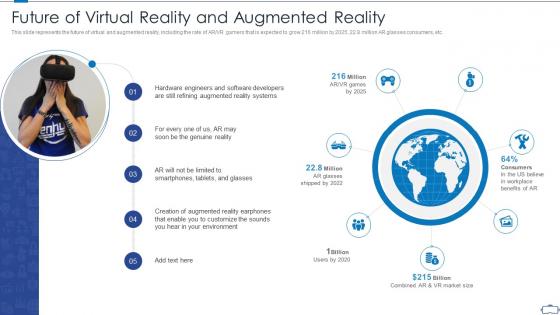
This slide represents the future of virtual and augmented reality, including the rate of AR and VR gamers that is expected to grow 216 million by 2025, 22.8 million AR glasses consumers, etc.
People who downloaded this PowerPoint presentation also viewed the following :
Future of virtual reality and augmented reality ppt powerpoint summary themes with all 6 slides:
Use our Future Of Virtual Reality And Augmented Reality Ppt Powerpoint Summary Themes to effectively help you save your valuable time. They are readymade to fit into any presentation structure.





FAQs for Future of virtual reality and augmented reality ppt
Honestly, lighter wireless headsets with way better displays are coming fast. Battery life's getting insane too. Apple's Vision Pro shows what's possible but damn, that price point. Eye and hand tracking will replace those awful controllers - thank god. Mixed reality's gonna make the VR/AR distinction pointless anyway. 5G plus edge computing fixes the lag that makes everyone sick. Oh, and if you're thinking investments? Haptic feedback companies are where it's at. Being able to actually "feel" virtual stuff changes everything. Spatial computing too - that's the real money maker.
Dude, VR and AR training is actually getting huge right now. Medical students are practicing on virtual patients, history classes are walking through ancient Rome - it's wild. The retention rates are insane too, like 75% better than regular textbooks. Flight sims have been around forever obviously, but now everyone's jumping in. Companies are using it for dangerous procedures so workers don't, you know, blow stuff up while learning. Honestly if you're in L&D and not at least looking into this, you're gonna get left behind. Your competition is definitely already testing it out.
Dude, social stuff is gonna be HUGE for VR/AR adoption. We're social animals stuck with crappy Zoom calls, right? Companies are dumping crazy money into making avatars that don't look like creepy robots and fixing that annoying delay when you're talking. The dream scenario? You'll seamlessly jump between hanging with friends IRL and in virtual spaces. Gaming, working, learning - all becomes way more natural when it feels like you're actually together. Honestly, try some social VR apps now if you haven't. You'll immediately see what's still broken and what's actually pretty cool.
Dude, AI is about to change everything for VR/AR creation. Instead of building every single asset manually, you'll just describe what you want and boom - entire worlds get generated automatically. Real-time optimization based on your hardware? Done. Characters that adapt to how each user actually behaves? Yep, that too. I'm honestly kind of jealous I didn't get into game dev earlier because this stuff is moving crazy fast. You should mess around with Blender's AI plugins or Unity's ML agents now - like, seriously don't wait. Better to learn this stuff while it's still new than play catch-up later when everyone's already using it.
Honestly, three main things worry me about VR/AR. First is privacy - these devices track your eye movements, how you physically react to stuff, way more invasive than phones. Addiction's another big one. People might get too hooked on augmented reality and lose touch with actual life, which is kinda depressing when you think about it. Then there's the manipulation aspect - companies could mess with your perception of reality pretty easily. Oh, and it might create this weird divide between people who can afford the tech and those who can't. I'd start thinking about what personal data you're actually okay with sharing before diving in.
Dude, VR and AR could totally change how remote work feels. You know those awkward Zoom calls where everyone's a floating head? Instead you'd meet in actual virtual conference rooms or work on 3D stuff together. Training sessions become way cooler with AR overlays - beats death by PowerPoint for sure. The spatial audio makes it feel like real conversations, and you can grab and move digital objects like you're all there. Honestly didn't think I'd be into this stuff, but platforms like Horizon Workrooms are pretty solid. Worth testing out!
Yeah, VR can definitely mess with you if you overdo it. Your eyes get super tired from all that refocusing, and the headaches are real. Motion sickness happens too - something about your brain getting confused when what you're seeing doesn't match how your body feels. I've noticed my neck gets sore from those clunky headsets after a while. Also you'll probably end up way less active if you're glued to virtual worlds for hours. But honestly? Most of this stuff goes away once you take breaks and adjust the headset properly.
Dude, gaming's about to get wild. VR is already letting you use your whole body as the controller - way cooler than just button mashing. Soon AR will turn your living room into like an actual game level. Yeah, the headsets are still pretty bulky and expensive right now, but that won't last. Traditional gaming on flat screens? Gonna feel ancient once this stuff gets mainstream. Meta and Apple are throwing serious money at this - they think it'll happen in the next 5-7 years or so. Way more social too, instead of gaming alone.
Start with accessibility on day one, trust me. Multiple input methods, scalable UI, audio descriptions - all that matters. Building it in early beats trying to fix it later (learned that the hard way). Your users might need voice commands, eye tracking, or regular controllers depending on their abilities. Don't forget colorblind palettes and haptic alternatives too. But here's the real thing - get actual disabled people testing your stuff. They'll spot issues you'd never think of and tell you what genuinely works in practice.
Honestly, it all comes down to what people actually want. Gen Z and millennials are pushing hard for better gaming and remote work tech - they just get digital stuff way more than older folks. But here's the thing: everyone wants that premium experience without the crazy price tag. People also want their VR/AR gear to work smoothly with whatever devices they already have. No one's dealing with clunky setups anymore. Gaming communities are where I'd look first - they're always the canaries in the coal mine for this stuff. Social media trends too. Price is still the biggest hurdle though.
Tracking's the nightmare - you need rock-solid spatial mapping or virtual stuff just floats around weirdly when you move. Latency will make people puke, even tiny delays between head movement and what they see. Lighting's another headache. Virtual objects have to match your actual room lighting or it looks fake as hell. Occlusion too - virtual things need to hide behind real furniture properly. Hardware can't be a brick on your face either, honestly. Nobody's wearing some chunky headset for hours. But seriously, nail the tracking first. I've seen demos where everything else was perfect but the tracking sucked and it ruined the whole thing. Everything breaks without solid spatial awareness.
Honestly, VR and AR are about to change everything for marketing. Customers won't just watch ads anymore - they'll walk through brand experiences or try stuff on virtually before buying. It's pretty wild. Traditional commercials are gonna look so outdated compared to letting someone test your product in their actual living room. Most companies are scrambling to catch up with how fast this tech is moving (which is kinda crazy to watch). But if you jump in early with even basic AR filters, you'll build connections that regular ads simply can't. Your customers will expect this level of interaction soon anyway.
Healthcare's where the real money is right now - VR surgical training is exploding and surgeons are using AR during actual procedures. Pretty wild stuff. Education's catching up fast though, like kids "visiting" ancient Rome or manipulating 3D organs in biology class. Don't sleep on real estate and retail either. Virtual house tours basically saved realtors during lockdowns, and now you can see how that couch looks in your living room before dropping $2k on it. Those four sectors are your best bet if you're thinking investments or job changes. Well, assuming the metaverse doesn't completely crash and burn.
VR therapy is actually pretty wild - they can put PTSD patients in controlled virtual scenarios to work through trauma safely. AR overlays calming visuals during panic attacks too. What's crazy is therapists can literally see through their patient's eyes now. Companies like AppliedVR are running FDA trials for pain management that could totally flip how we treat anxiety. Oh, and VR meditation apps are everywhere now (though honestly some are kinda gimmicky). The whole thing lets people face their fears without real-world consequences, which is huge for exposure therapy.
Honestly, it all comes down to the hardware getting way better. We need headsets that don't feel like wearing a brick on your face - lighter weight, sharper screens, batteries that actually last. The haptic stuff is going to be game-changing though. Instead of just flailing around in mid-air, you'll actually feel objects when you touch them. Wild, right? Once the tech gets good enough that you forget you're even wearing anything, that's when everyone will jump on board. I'd watch the companies dumping money into making everything smaller and wireless - they're probably onto something big.
-
Easy to edit slides with easy to understand instructions.
-
Nice and innovative design.