


Green Product Development For Clothing Brand Powerpoint Presentation Slides Ppt Template





Try Before you Buy Download Free Sample Product
 Impress Your
 Audience
 100%
100% Editable
 Save Hours
 of Time


Check out our professionally designed Green Product Development for Clothing Brand PowerPoint presentation. Green product development is a way to create sustainable and eco-friendly products. It involves environmental considerations in product designing and development processes to reduce environmental damage. Our PPT shows the current scenario for the organization. This includes transformation to green products due to an increase in customer demand, environmental issues, and technological advancement. Additionally, this PPT represents the gap assessment for the company and green product development activities. These include environmental analysis, green design principles, green framework, collaboration with stakeholders, and promotion of environmental benefits. At last, this PowerPoint presentation includes Potential green product development challenges and impact analysis. Download our 100 percent editable and customizable template, which is also compatible with Google Slides.
People who downloaded this PowerPoint presentation also viewed the following :
Content of this Powerpoint Presentation
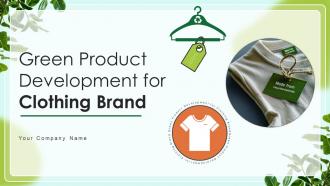
Slide 1: This slide introduces Green Product Development for Clothing Brand. State your company name and begin.
Slide 2: This slide states Agenda of the presentation.
Slide 3: This slide shows Table of Content for the presentation.
Slide 4: This slide highlights title for topics that are to be covered next in the template.
Slide 5: This slide represents graph presenting increasing customer demand for sustainable products with key reasons for the growth. It also includes elements such as sustainable material, eco-friendly dyeing, zero-waste design, etc.
Slide 6: This slide represents environmental challenges faced by the community that the company is taking into consideration while adopting green product development.
Slide 7: This slide represents latest technological advancements in clothing industry that helps open up new market opportunities for green products. It includes details regarding 3D virtual sampling, alternative textiles, and fashion on demand.
Slide 8: This slide highlights title for topics that are to be covered next in the template.
Slide 9: This slide represents a need assessment that showcases why the company is adopting green product development. It includes headers such as present state, gap analysis, and desired state for the organization.
Slide 10: This slide highlights title for topics that are to be covered next in the template.
Slide 11: This slide represents a product lifecycle framework for assessing environmental impact. It also includes LCA (lifecycle assessment) models such as cradle-to-gate, cradle-to-grave, and cradle-to-cradle.
Slide 12: This slide represents 4 phases involved in lifecycle assessment that helps understand the environmental impact of product. It includes steps such as goal & scope, life cycle inventory, impact assessment, and interpretation.
Slide 13: This slide highlights title for topics that are to be covered next in the template.
Slide 14: This slide represents sustainable design strategies that help minimize adverse impacts and promote positive contributions in the community. These strategies include waste minimization, sustainable materials, and efficient materials.
Slide 15: This slide represents eco-friendly fashion designing strategies adopted by clothing brands. It includes designing for longevity and durability, selecting adaptable design elements, etc.
Slide 16: This slide represents 3 steps of the design for environment (DfE) approach that helps check performance against environmental, health & safety objectives, and social aspects over the full life cycle. It includes steps – design, user, and end-of-life.
Slide 17: This slide highlights title for topics that are to be covered next in the template.
Slide 18: This slide represents a process for Environmental Impact Assessment (EIA) that helps evaluate the economic, environmental, and social impacts of development activities. It includes steps such as screening, analyzing the environment risk, etc.
Slide 19: This slide represents eco-friendly and ethical clothing certifications to help guide customers to choose sustainable products. It includes B corp, ecolabel by European Union, fair trade, etc.
Slide 20: This slide represents the synthesizing framework of five macro trends for the circular fashion economy. It includes consumer awareness, tech innovation, circular economy, corporate social responsibility (CSR), etc.
Slide 21: This slide represents circular fashion index model to measure fashion efforts in extending product and material life. It includes details such as primary market, secondary market, trade-in, etc.
Slide 22: This slide highlights title for topics that are to be covered next in the template.
Slide 23: This slide represents the cross-collaboration of internal stakeholders for green development. It includes the management, design, production, marketing, and sales teams.
Slide 24: This slide represents external stakeholders involved in green product development. It includes suppliers, customers, non-profit organizations, and regulatory bodies.
Slide 25: This slide represents communication plan for internal and external stakeholders. It includes details such as activities, frequency, objective, and channel for communication.
Slide 26: This slide highlights title for topics that are to be covered next in the template.
Slide 27: This slide represents effective strategies used by the company to communicate environmental.
Slide 28: This slide represents marketing channels used by brand to promote green product and its environmental benefits. It includes social media, blogs, websites, in-store event and influencers.
Slide 29: This slide highlights title for topics that are to be covered next in the template.
Slide 30: This slide represents potential challenges brand may face during green product development with solutions. It includes details regarding customer behavior, perception, regulatory compliance, and competing in niche markets.
Slide 31: This slide highlights title for topics that are to be covered next in the template.
Slide 32: This slide represents a metrics associated with green product development and innovation to measure the success rate of the project.
Slide 33: This slide contains all the icons used in this presentation.
Slide 34: This slide is titled as Additional Slides for moving forward.
Slide 35: This slide shows Pie Chart with data in percentage.
Slide 36: This slide presents Roadmap with additional textboxes.
Slide 37: This is Our Target slide. State your targets here.
Slide 38: This is a Location slide with maps to show data related with different locations.
Slide 39: This is an Idea Generation slide to state a new idea or highlight information, specifications etc.
Slide 40: This is Our Mission slide with related imagery and text.
Slide 41: This slide shows SWOT describing- Strength, Weakness, Opportunity, and Threat.
Slide 42: This slide shows Post It Notes. Post your important notes here.
Slide 43: This is a Thank You slide with address, contact numbers and email address.
Green Product Development For Clothing Brand Powerpoint Presentation Slides Ppt Template with all 51 slides:
Use our Green Product Development For Clothing Brand Powerpoint Presentation Slides Ppt Template to effectively help you save your valuable time. They are readymade to fit into any presentation structure.










-
Great combination of visuals and information. Glad I purchased your subscription.
-
The PPTs are extremely simple to modify. Thank you for providing the slides that are ready to be used. They assist me in saving a lot of time.