

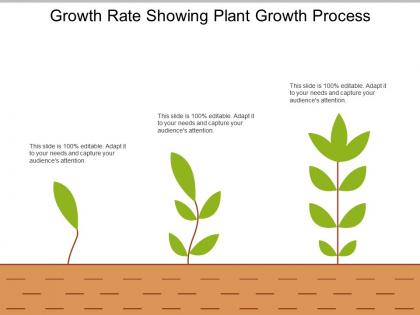
Growth rate showing plant growth process




Try Before you Buy Download Free Sample Product
 Impress Your
 Audience
 100%
100% Editable
 Save Hours
 of Time


Direct their focus with our Growth Rate Showing Plant Growth Process. Get all forces acting in harmony.
People who downloaded this PowerPoint presentation also viewed the following :
Growth rate showing plant growth process with all 5 slides:
Fight for innocence with our Growth Rate Showing Plant Growth Process. Battle attempts to criminalize events.




FAQs for Growth rate showing
Primary factors affecting plant growth rate include light intensity, temperature, water availability, soil nutrients, and atmospheric carbon dioxide levels. These environmental variables work synergistically, with controlled environments like greenhouses and hydroponic facilities optimizing these conditions to achieve faster growth cycles, higher yields, and more predictable harvests than traditional outdoor cultivation methods.
Soil quality variations significantly impact plant growth speed by affecting nutrient availability, water retention, drainage capacity, and root development conditions. Plants in nutrient-rich, well-draining soils with optimal pH levels typically demonstrate faster growth rates and stronger structural development, while poor soil conditions can reduce growth by up to 50%, ultimately determining crop yields and agricultural productivity.
Light intensity and spectrum significantly impact plant growth rates by influencing photosynthesis efficiency, stem elongation, leaf development, flowering timing, and root formation. Higher intensity blue light enhances vegetative growth and compact structure, while red light promotes flowering and fruiting, with many greenhouse operations and vertical farms finding that strategic LED spectrum combinations deliver faster crop cycles, higher yields, and ultimately greater operational efficiency.
Water availability serves as a primary limiting factor in plant growth rates, directly affecting photosynthesis, nutrient transport, cellular expansion, and metabolic processes across species. Different plants demonstrate varying water-use efficiency strategies, with drought-tolerant species like succulents maintaining slower but consistent growth, while water-dependent crops like rice and lettuce achieve rapid growth rates when adequately hydrated, ultimately determining agricultural productivity and ecosystem sustainability.
Temperature fluctuations significantly influence plant growth by affecting photosynthesis rates, enzyme activity, and cellular metabolism throughout seasonal cycles. During spring and summer, warmer temperatures accelerate metabolic processes, enabling faster nutrient uptake and enhanced protein synthesis, while cooler fall and winter conditions slow growth rates, with many agricultural operations finding that controlled greenhouse environments help maintain consistent production yields year-round.
Annual plants typically grow faster initially, completing their entire lifecycle within one year, while perennial plants invest more energy in developing extensive root systems and structural foundations for long-term survival. Though annuals like tomatoes and beans achieve rapid above-ground growth, perennials like fruit trees and asparagus ultimately deliver greater yields over multiple seasons, with many gardeners finding that strategic combinations of both plant types optimize garden productivity and resource efficiency.
Fertilizer application significantly enhances plant growth rates by providing essential nutrients like nitrogen, phosphorus, and potassium that accelerate cellular development, root expansion, and photosynthesis efficiency. Agricultural operations and greenhouse facilities find that strategic fertilization delivers faster crop maturation, increased yields, and improved plant resilience, ultimately enabling more productive growing cycles and enhanced operational profitability.
Root structures significantly influence plant growth rates through surface area for nutrient absorption, depth for water access, branching density for resource capture, and mycorrhizal associations for enhanced uptake. These structural variations enable faster-growing species like grasses and vegetables to maximize resource acquisition through fibrous systems, while slower-growing trees utilize deep taproots for stability and long-term sustainability.
Plant hormones regulate growth rates by detecting environmental changes through auxins, gibberellins, cytokinins, abscisic acid, and ethylene, which trigger cellular responses like elongation, division, and differentiation. These biochemical messengers enable plants to optimize resource allocation, adjust stem growth toward light sources, and enhance root development in nutrient-rich areas, ultimately delivering improved survival rates and reproductive success.
Competition for resources significantly reduces individual plant growth rates by limiting access to sunlight, water, nutrients, and space within plant communities. This resource scarcity forces plants to allocate energy toward competitive strategies rather than growth, with forest understory species, grassland communities, and agricultural crops demonstrating slower development, reduced biomass accumulation, and ultimately decreased reproductive success in high-density environments.
Specific plant adaptations significantly enhance growth rates in extreme environments by developing specialized root systems, modified leaf structures, and efficient water storage mechanisms. Desert succulents, alpine plants, and mangrove species demonstrate how these adaptations streamline resource utilization and minimize environmental stress, ultimately delivering competitive advantages that enable sustained growth where non-adapted species fail.
Young plants typically exhibit exponential growth rates due to rapid cell division, abundant meristematic tissue, and optimal resource allocation, while mature plants show slower, stabilized growth as energy shifts toward reproduction and maintenance. This relationship varies significantly across species, with fast-growing crops like corn and soybeans demonstrating dramatic early acceleration, while perennial trees maintain steady but reduced rates, ultimately delivering predictable yields for agricultural planning and forest management strategies.
Controlled environments optimize plant growth rates by regulating temperature, humidity, light exposure, nutrient delivery, and CO2 levels to create ideal growing conditions year-round. Through precision agriculture technologies, commercial growers and research facilities achieve faster germination, enhanced yields, and consistent crop quality while minimizing water usage and pest issues, ultimately delivering competitive advantages in food production.
Genetic modification enhances plant growth rates by optimizing photosynthesis efficiency, improving nutrient uptake mechanisms, and developing resistance to environmental stressors that typically slow development. Through targeted gene editing, agricultural enterprises streamline crop production cycles, reduce resource requirements, and increase yield predictability, with many commercial growers finding that these modifications deliver faster harvests and improved operational efficiency.
Invasive species significantly reduce native plant growth rates by competing for essential resources like sunlight, water, nutrients, and soil space, often overwhelming established vegetation through aggressive spreading mechanisms. In forest ecosystems, species like kudzu and purple loosestrife demonstrate how invasive plants can outcompete native species, ultimately reducing biodiversity and ecosystem stability while altering natural growth patterns.
No Reviews