


Harnessing AI For Achieving Environment Sustainability Ppt Powerpoint





Try Before you Buy Download Free Sample Product
 Impress Your
 Audience
 100%
100% Editable
 Save Hours
 of Time


Use our professionally designed PowerPoint presentation Harnessing AI for achieving environment sustainability, providing in-depth exploration to tackle challenges harming the environment and climate. This PPT offers technological strategies that can be implemented to optimize resource allocation, reduce climate emissions, etc. Additionally, this PPT delves into AIs role in mitigating climate change, promoting renewable energy adoption, and fostering a circular economy. Moreover, our deck includes the application of artificial intelligence to enhance ecological conservation efforts such as precision agriculture, real-time quality monitoring, energy management, etc. Use this comprehensive presentation that serves as a roadmap for leveraging AI to develop a greener future. Download our 100 percent editable and customizable template, which is also compatible with Google Slides.
People who downloaded this PowerPoint presentation also viewed the following :
Content of this Powerpoint Presentation
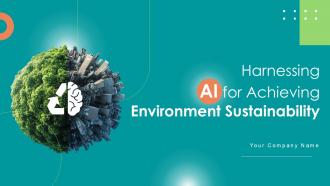
Slide 1: This slide introduces Harnessing AI for Achieving Environment Sustainability. State your company name and begin.
Slide 2: This slide states Agenda of the presentation.
Slide 3: This slide shows Table of Content for the presentation.
Slide 4: This slide highlights title for topics that are to be covered next in the template.
Slide 5: Following slide showcases impact of traditional industrial operations on environment leading high greenhouse emissions. It includes sources such as transportation, energy consumption, etc.
Slide 6: Following slide represents harmful consequences of improper waste disposal by businesses leading loss of net profits and employee productivity.
Slide 7: Following slide exhibits challenges associated with supply chain operations including inefficient transportation, unpredictable disruptions, excess inventory and wastage.
Slide 8: Following slide represents major environmental issues faced by businesses due to traditional practices followed. It includes challenges such as pollution, climate change, biodiversity loss, etc.
Slide 9: This slide highlights title for topics that are to be covered next in the template.
Slide 10: Following slide represents working process of artificial intelligence to predict environmental changes that helps to take data driven decisions for business growth.
Slide 11: Following slide represents role of integrating artificial intelligence algorithms promoting environment sustainability that minimize negative impact on business operations.
Slide 12: Following slide represents global statistics highlighting need of integrating AI to promote environmental sustainability and secure business operations.
Slide 13: Following slide represents forecasted global market size of integration AI in environment sustainability. It includes elements such as CAGR, market drivers, etc.
Slide 14: Following slide showcases global regional outlook that helps to understand market share and factors driving high adoption rate.
Slide 15: Following slide represents major trends for integrating artificial intelligence for environment sustainability that helps to optimize resource and minimize emissions.
Slide 16: Following slide represents ethical considerations in artificial intelligence (AI) development and deployment. It includes pointers such as societal impact, regulatory compliances, etc.
Slide 17: This slide highlights title for topics that are to be covered next in the template.
Slide 18: Following slide showcases key factors to consider for selection of appropriate model to ensure successful business AI initiates for environment sustainability.
Slide 19: Following slide showcases various methods that helps in refining selected model for better performance contributing to effective environmental outcomes.
Slide 20: Following slide exhibits approaches for effective model deployment to assure effective integration. It includes elements such as deployment solutions, key considerations and impact.
Slide 21: Following slide showcases workflow process for evaluating and tracking performance of AI model for effective predictive analytics for environment sustainability.
Slide 22: This slide highlights title for topics that are to be covered next in the template.
Slide 23: Following slide showcases various applications of implementing AI into environment sustainability. It includes pointers such as energy management, precision agriculture, etc.
Slide 24: This slide highlights title for topics that are to be covered next in the template.
Slide 25: Following slide showcases working approach of AI integration with energy management systems to assure proper usage and distribution of renewable source.
Slide 26: Following slide represents integration of AI algorithms for smart grid development that helps utilities to improve reliability and reduce energy waste.
Slide 27: Following slide showcases major use cases of implementing artificial intelligence to promote optimized energy consumption. It includes pointers such as renewable energy sources, energy storage, etc.
Slide 28: Following slide showcases working model of AI algorithms to predict renewable energy production to ensure efficiency and reliability. It includes pointers such as predictive model, algorithms, etc.
Slide 29: This slide highlights title for topics that are to be covered next in the template.
Slide 30: Following slide represents role of AI integration to facilitate air quality monitoring for effective predictive analytics. It includes elements such as working approach and example.
Slide 31: Following slide represents various pollution detection sensors that helps to monitor and regulate air quality assuring safety. It covers sensors such as articulate matter, gas sensors, etc.
Slide 32: Following slide represents major use cases that artificial intelligence (AI) ensure for improving air quality through consistent monitoring. It includes pointers such as smart city initiatives, waste management, etc.
Slide 33: Following slide represents applications of integrating remote sensing technique for environment monitoring and better planning. It incudes pointers such as researching tool, infrastructure management, etc.
Slide 34: This slide highlights title for topics that are to be covered next in the template.
Slide 35: Following slide showcases framework that helps to understand usage of AI technology to manage climate and environmental changes. It includes topics such as measurement, mitigation, etc.
Slide 36: Following slide exhibits steps to use and employ artificial intelligence for effective climate modeling process. It includes methods such as gather data, strengthen decision making, optimize processes, etc.
Slide 37: Following slide represents workflow process to understand use of IoT sensors and AI technology for weather monitoring that reduces risk of crop failure.
Slide 38: This slide highlights title for topics that are to be covered next in the template.
Slide 39: Following slide represents framework highlights framework to understand working process of AI algorithm for precision agriculture system.
Slide 40: Following slide showcases use of artificial intelligence (AI) technology for automated livestock monitoring. It includes pointers such as behavioral analysis, facial recognition, etc.
Slide 41: Following slide represents major use cases of integrating advanced AI technology in agriculture for better results. It includes pointers such as management purpose, market analysis, etc.
Slide 42: This slide highlights title for topics that are to be covered next in the template.
Slide 43: Following slide represents investment required by businesses to integrate AI models o ensure environment sustainability. It includes pointers such as deployment, R&D, etc.
Slide 44: This slide highlights title for topics that are to be covered next in the template.
Slide 45: Following slide represents impact of using AI technology for supply chain management and reduce possibility of disruptions. It includes pointer such as high annual savings, improved annual revenue, etc.
Slide 46: Following slide represents positive impact of using AI technology on business environment and sustainability. It includes pointers such as energy efficiency, waste reduction, pollution control, etc..
Slide 47: Following slide showcases impact f AI technology integration on global sustainable goals at environment, economy and societal level.
Slide 48: This slide highlights title for topics that are to be covered next in the template.
Slide 49: Following slide represents case study of company that implemented AI enable algorithms into its supply chain for reducing carbon emissions.
Slide 50: Following slide showcases case study of company that implemented AI based development to address business environment sustainability issues.
Slide 51: This slide contains all the icons used in this presentation.
Slide 52: This slide is titled as Additional Slides for moving forward.
Slide 53: Following slide showcases use cases for AI in supply chain management. It includes pointers such as data collection, training AI model, generating agreements, etc.
Slide 54: This is Our Goal slide. State your firm's goals here.
Slide 55: This slide shows Post It Notes. Post your important notes here.
Slide 56: This slide contains Puzzle with related icons and text.
Slide 57: This slide depicts Venn diagram with text boxes.
Slide 58: This is a Thank You slide with address, contact numbers and email address.
Harnessing AI For Achieving Environment Sustainability Ppt Powerpoint with all 66 slides:
Use our Harnessing AI For Achieving Environment Sustainability Ppt Powerpoint to effectively help you save your valuable time. They are readymade to fit into any presentation structure.










FAQs for Harnessing AI For Achieving Environment
So AI basically turns you into an environmental superhero - you get real-time tracking through satellites and sensors that catch deforestation or water issues before they spiral. Machine learning handles the heavy lifting too, like predicting crop yields to cut food waste or optimizing water distribution. The speed is honestly insane compared to what humans can process. I'd probably start with whatever resource problem is driving you crazy first, then hunt down AI tools made for that specific issue. No point trying to fix everything at once, you know?
So basically, machine learning can predict when people actually need power and adjust everything automatically. Smart grids figure out which neighborhoods are about to spike in usage. Buildings get way better at this too - their HVAC systems learn your patterns and the weather. Traffic lights are probably my favorite example though, they sync up to cut down on cars just sitting there burning gas. The more data these systems collect, the smarter they get. Honestly, if you're thinking about trying this stuff, just pick one building first. See if it actually saves money before going crazy with it.
So AI's actually changing waste management in some cool ways. Smart sorting systems can identify different plastics way better than people - like, the accuracy is wild. Route optimization cuts down fuel costs by predicting when bins are full. Recycling plants use it to catch contamination and boost recovery rates in real-time, which honestly makes a huge difference. Oh, and check out AMP Robotics if you're curious - their robotic sorting tech is pretty fascinating stuff. The whole industry's shifting toward this automated approach now.
So basically you can use predictive analytics to crunch all that climate data - temperature records, rainfall patterns, animal migration stuff. The models are getting scary good at forecasting which species will struggle and where floods or droughts will hit worst. Historical data plus current trends help you spot problems before they blow up. Honestly, I'd start by looking at your most climate-sensitive species first since they're like the canary in the coal mine. You'll see vegetation patterns shift over decades too, which is kind of fascinating but also terrifying.
Look, there are three big things to worry about here. Data privacy is huge - you might accidentally collect personal info about communities or indigenous areas without asking first. That's messy. AI models love to be biased too, especially against the exact groups who deal with environmental problems the most. Honestly, half these "green AI" projects just make people feel good without actually fixing anything. Get local people involved right away and don't be shady about what data you're grabbing or how you're making decisions.
So there's this thing called precision agriculture that's actually pretty neat - farmers use sensors and drones to figure out exactly what their crops need instead of just dumping water and fertilizer everywhere. The drones can spot sick plants or pest problems before they get bad. Machine learning helps predict when to plant based on weather patterns too. Honestly, the tech is way more advanced than I thought it'd be. You end up growing more food while using way less resources, which is great for everyone. Some farms are already doing this stuff and seeing real results.
-
I am extremely pleased with these PPT slides that we used for our event. They were easy to modify and came out great in all aspects!
-
Based on my personal experience, I would recommend other people to subscribe to SlideTeam. No one can be disappointed here!