

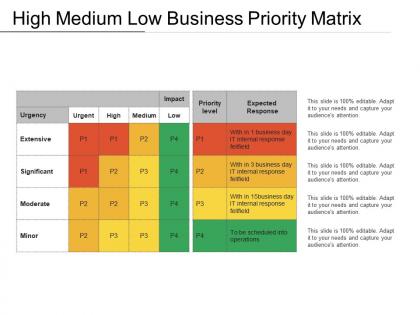
High medium low business priority matrix




Try Before you Buy Download Free Sample Product
 Impress Your
 Audience
 100%
100% Editable
 Save Hours
 of Time


Don't allow anything to hold you back with our High Medium Low Business Priority Matrix. Be able to handle inhibitions.
People who downloaded this PowerPoint presentation also viewed the following :
High medium low business priority matrix with all 5 slides:
Folks eagerly come forward to join you due to our High Medium Low Business Priority Matrix. They will accept your invitation.

FAQs for High medium low
Honestly, it just stops you from labeling everything as "urgent" - which let's be real, we all do that. You'll actually see what moves your business forward vs random busy work that feels productive. Your team gets on the same page too since everyone's using the same decision-making framework. No more chasing every shiny new project that pops up (this one's huge). Resource allocation becomes way less painful when you can literally point at the matrix and explain funding decisions. Just map your current projects onto one first - I bet you'll find some surprises there.
So you plot your tasks on a simple 2x2 grid - urgency vs importance. Game changer, honestly. High-impact stuff becomes super obvious, and you stop wasting time on random busy work. When everyone's demanding your attention (which, let's be real, is always), you can actually see what deserves resources. The tough part? You'll have to tell people their "urgent" request isn't really that critical. But it beats spreading yourself thin across everything. I literally drew one on a napkin last week when I was overwhelmed at work. Try it next time you're drowning - you'll wonder why you didn't do this sooner.
Look at four main things: impact, urgency, resources, and whether it fits your strategy. Impact = does this actually move things forward for your goals? Urgency is whether there's a real deadline or if you can push it. Be honest about your resources too - time, money, people. I've seen so many teams get pumped about big projects then crash because they're already swamped! Also check that you're not prioritizing random stuff that doesn't support your bigger picture. Try scoring each thing 1-5 to keep it simple and not overthink it.
Oh totally! They work for basically any industry - you just tweak the criteria to match what matters most. Tech companies might prioritize speed and user impact, while manufacturing focuses more on cost savings and safety stuff. The trick is figuring out what actually drives success in your space, then building your matrix around those factors. I mean, I've seen hospitals use them just as much as retail chains. Each one looks different though - that's kinda the whole point. Just start with what makes or breaks deals in your industry and go from there.
Start with your criteria - walk them through how you weighted impact vs effort before showing where everything landed. Quick wins in the top right are your best friend since they get people hyped up first. Honestly, I've learned this builds way more momentum than diving into the controversial stuff right away. Save those tough conversations about the low-priority items for later. Don't just dump the matrix on them either. Tell the actual story behind it - why this ended up here, what surprised you, that kind of thing. And definitely spell out next steps or they'll just stare at your colored dots wondering what's supposed to happen now.
Don't fall into the trap of marking everything "high priority" - I swear everyone does this! Also avoid being super vague about your criteria. Personal preferences shouldn't trump actual business impact, but it happens all the time. Get input from different people instead of doing it solo. Oh, and these matrices aren't permanent - update yours when things change. The key is being honest about what actually drives results for your business right now. I've watched too many of these turn into glorified wish lists instead of useful tools.
I'd say every quarter, but it totally depends on your field. Tech moves crazy fast so maybe monthly? More stable stuff can go quarterly or even twice a year. The main thing is don't let it sit there forever - I made that mistake once and realized half my "priorities" were completely pointless after like 8 months. Market shifts happen, new stuff comes up, you know how it is. Just set a calendar reminder and actually do it, even if it's just a quick 30-minute check. Better than scrambling later when everything's changed.
Honestly, spreadsheets are your best friend here - I use Excel or Google Sheets like 80% of the time because they're stupid simple for 2x2 matrices. If you want something prettier, Miro's really good for the visual stuff, or even just PowerPoint if you're feeling basic. Monday.com and Asana work too if your team's already living in those apps anyway. Oh, and Notion's become weirdly popular for this kind of thing lately. My advice? Just start with whatever you're already using daily. You can always get fancy later if you actually need it, but most people overthink this stuff.
Honestly, you just need to turn that qualitative stuff into numbers. Create rating scales for things like "strategic alignment" based on what leadership tells you, or score "customer impact" using support ticket patterns. I always add a "gut feeling" score too - sometimes the data misses something obvious, you know? The trick is staying consistent with how you interpret everything across different initiatives. Maybe run it by your team first to make sure you're all scoring things the same way. Once you get the hang of it, it's actually pretty straightforward.
Dude, definitely get your team involved when building that priority matrix. They know stuff you don't - like which features are actually a nightmare to build or what customers are screaming about. Can't build this thing in a vacuum and expect it to work. Your team will also fight you way less on priorities if they helped create them. Nobody likes having decisions dropped on them from above, you know? Get everyone in a room to score initiatives and argue about trade-offs. The whole thing becomes way more realistic when it's not just the leadership perspective. Also - working sessions are clutch for this kind of stuff.
Okay so basically you plot your projects on a grid - impact vs effort usually works best. Shows you immediately what's actually worth doing versus what just feels urgent. Half the time you'll be shocked seeing stuff you thought was super important land in the "meh" category. But here's the thing - it gets everyone on the same page instead of people just pushing whatever they want to work on. I swear some teams just argue in circles without this. Use it in your planning meetings to cut through all the back-and-forth. Way better than just going with your gut on everything.
So basically, priority matrices help you figure out which projects to tackle first by weighing impact against effort. Risk matrices are totally different - they're about spotting potential problems and rating them by how likely they are to happen vs how bad they'd be. One's asking "what should we do?" and the other's asking "what might bite us later?" I actually think they work pretty well together though. Pick your top priorities first, then run a risk check on those. That way you're not just chasing opportunities blindly, you know?
Yeah, totally! Just plot your projects on impact vs effort - high impact/low effort stuff goes in the "quick wins" section and you knock those out first. The high impact/high effort ones become your main focus projects. Honestly, it's one of the best ways to shut down all that "but THIS is urgent too" chaos everyone loves to create. Low impact things? Either push them way down the list or just ditch them completely. List out what you're working on, score each thing on both scales, then see where they land. Works way better than trying to keep everything in your head.
Start by figuring out what your business actually needs to accomplish - then match every project against those goals. Your priority matrix has to reflect what really matters, like revenue or customer happiness, not just look pretty on paper. I've watched so many teams build these fancy frameworks that nobody uses because they're disconnected from reality. Business priorities change constantly, so don't just set it and forget it. Update the thing regularly - what felt super urgent three months ago might be totally irrelevant now. Oh, and make sure your whole team actually uses it when deciding what to work on next.
So Google does this 70-20-10 thing - 70% on core stuff, 20% on emerging opportunities, 10% on crazy experiments. That's how they kept search going while building Gmail and Android. McKinsey loves their impact vs effort grids for client work (probably part of why their fees are insane, but whatever). Buffer does the urgent/important matrix thing too for deciding what features to build. The real trick? You've got to actually follow what your matrix says. Don't just make pretty charts that never get used. I've seen so many teams do that and it drives me nuts.
-
Use of icon with content is very relateable, informative and appealing.
-
Content of slide is easy to understand and edit.