


Hiring business plan implementation five years roadmap of organization





Try Before you Buy Download Free Sample Product
 Impress Your
 Audience
 100%
100% Editable
 Save Hours
 of Time


The success rate of business plans is hugely dependent on the plan of action, and this editable Hiring Business Plan Implementation Five Years Roadmap Of Organization rightly serves the purpose. Encapsulate all the information related to the project in a well structured manner to obtain maximum efficiency by incorporating our stunning PowerPoint theme. State the critical deliverable, steps involved, time frame, workforce allocation, and lots more in an easy to understand manner by utilizing this pre designed roadmap PowerPoint layout. You can also prioritize your tasks and discuss the problem areas with your colleagues by incorporating this tailor made PPT layout. Empower your work plan by employing this professionally designed PPT theme. Entrepreneurs can download Hiring Business Plan Implementation Five Years Roadmap Of Organization as a beneficial communication tool that facilitates in collaborating with different tasks and achieve targets.
People who downloaded this PowerPoint presentation also viewed the following :
Content of this Powerpoint Presentation
Description:
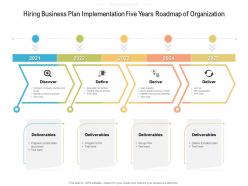
The image depicts a PowerPoint slide showcasing a five-year roadmap for the implementation of a business hiring plan. This roadmap is designed to guide the process of talent acquisition and recruitment over five years, from 2021 to 2025. Each year is associated with a specific phase of the hiring plan, accompanied by deliverables and space for additional text. Here's a detailed breakdown of the key elements on the slide:
2021 - Discover:
Description: The first phase, labeled "Discover," focuses on understanding the company's background and identifying current processes within the organization.
Deliverables: The slide mentions the creation of a document outlining the current state of the organization, and there's a prompt for adding additional text to provide further details.
2022 - Define:
Description: The second year, labeled "Define," emphasizes the evaluation of risk factors and the identification of best practices.
Deliverables: The primary deliverable for this year is the preparation of a Statement of Work (SOW), with space provided for adding specific details.
2023 - Develop (Title Missing):
Description: While the title is missing, this phase likely involves the development of key aspects related to hiring and recruitment.
Deliverables: The slide mentions the establishment of Key Result Areas (KRAs) and provides space for additional content.
2024 - Derive:
Description: In the fourth year, labeled "Derive," the plan involves conducting a gap analysis, building a detailed process model, and identifying training requirements.
Deliverables: Details of the KRA setup are expected, along with extra room for including additional information.
2025 - Deliver:
Description: The final year, labeled "Deliver," signifies the implementation phase, where the system goes live, and Key Performance Indicators (KPIs) are assessed.
Deliverables: The primary deliverable in this phase is the transition plan, and there's space provided for adding more information as needed.
The slide is designed to be fully customizable, with placeholders labeled "Text here" to allow presenters to tailor the content to their specific hiring strategies and objectives.
Use Cases:
This hiring roadmap slide can be applied across various industries and sectors where long-term talent acquisition and recruitment planning are essential. Here are some industries, use cases, presenters, and target audiences where this roadmap can be valuable:
1. Human Resources:
Use: Structuring and monitoring a multi-year recruitment strategy.
Presenter: HR Director.
Audience: HR team, C-level executives.
2. Management Consulting:
Use: Advising clients on long-term hiring strategies.
Presenter: Senior Consultant.
Audience: Client stakeholders.
3. Technology:
Use: Planning for phased talent acquisition in line with product development.
Presenter: Talent Acquisition Lead.
Audience: Hiring managers, engineering leads.
4. Healthcare:
Use: Managing the growth and hiring of clinical and administrative staff.
Presenter: Chief Administrative Officer.
Audience: Department heads, hospital board members.
5. Education:
Use: Establishing faculty and staff expansion plans for educational institutions.
Presenter: Dean of Faculty.
Audience: University administration, department chairs.
6. Retail:
Use: Strategic planning for staffing needs across multiple store openings.
Presenter: Head of Retail Operations.
Audience: Regional managers, store managers.
7. Manufacturing:
Use: Outlining workforce development in sync with manufacturing capabilities.
Presenter: Chief Operations Officer.
Audience: Plant managers, HR team.
Hiring business plan implementation five years roadmap of organization with all 2 slides:
Give your audience a fulfilling experience. They will find our Hiring Business Plan Implementation Five Years Roadmap Of Organization elevating.
FAQs for Hiring business plan implementation five years
Honestly, you need to nail down a few key things or you're gonna be scrambling later. Figure out your current team situation first, then project what headcount you'll actually need based on where the business is heading. Budget for each role realistically - and I mean actually realistic, not wishful thinking. Map out your timeline for when you need people and how you're gonna find them. The sourcing strategy part is super boring but critical - I've watched so many hiring plans crash because nobody thought through the actual recruiting process. Oh, and build in some wiggle room because priorities shift constantly.
Honestly, the trick is connecting every hire to something concrete your business actually needs to hit. Revenue goals, launching that new product, whatever. Don't just hire because you've got the budget sitting there (been guilty of this myself). Figure out which roles will genuinely make money or save costs first. Those get priority. I'd make a basic spreadsheet - sounds boring but hear me out - linking each potential hire to a real outcome. That way when someone questions why you need another person, you're not scrambling for an answer. Time everything with your actual business milestones too.
Track your speed stuff first - time-to-hire, cost-per-hire, offer acceptance rates. Quality metrics matter just as much though. New hire performance at 90 days, retention (that 6-month mark is brutal), hiring manager satisfaction. Source effectiveness too because honestly some job boards are just trash. Don't go overboard with a million metrics - pick maybe 4 or 5 you'll actually check monthly. Set up something simple so you're not drowning in spreadsheets. The data will tell you what's working and what isn't.
Start with Glassdoor and PayScale to see what people actually make. Job boards are great too - if you're seeing the same roles posted everywhere, that's your first clue hiring's gonna be rough. I practically live on LinkedIn now for checking out competitor teams and figuring out where the good people work. Recruiters are worth talking to since they'll be brutally honest about what's impossible to fill right now. Oh, and don't skip this research step - I've seen too many friends post jobs that just sit there forever because they had no idea what they were up against.
Honestly, start with fixing your candidate experience - that's where most companies totally blow it. Make your application process actually work, tell people realistic timelines, and don't ghost them after promising updates. During interviews, have real conversations instead of those weird panel setups where five people stare at you (ugh). Show them actual work they'd be doing and let them meet future teammates. Don't sugarcoat everything either - be upfront about challenges and what they can grow into. Here's the thing though: give feedback to everyone, even rejections. People remember how you treated them and will tell others.
Hire the money-makers first - sales, customer success, whoever delivers your actual product. These roles directly drive growth. I've watched startups blow cash on executive assistants while having like two salespeople total. Big mistake. Next, tackle the operational stuff that's genuinely bottlenecking you (not just annoying you). HR and finance? Outsource that initially. Way cheaper and honestly probably better than what you'd hire anyway. Work backwards from your revenue per employee goals. Short sentences help clarify priorities. Don't get distracted by roles that make life easier versus roles that make money.
Honestly, start with an applicant tracking system like Greenhouse or BambooHR - they handle all the annoying stuff like screening and follow-ups. Calendly is clutch for scheduling interviews (seriously, why are people still going back and forth on email times?). If your team uses Slack, get an ATS that integrates with it. Trello's actually pretty solid for tracking where each role is in your hiring process too. Pick one main system that doesn't blow your budget, then add other tools as you go. Way easier than trying to set up everything at once.
Honestly, you can't just slap diversity efforts onto your existing process and call it a day. First thing - audit those job descriptions for sketchy language that might turn people off. Then branch out from the usual job boards, hit up communities you haven't tapped before. I know quotas feel weird, but setting actual targets really does work. Train your interviewers on unconscious bias too. Track where diverse candidates drop off in your pipeline - that's where the real insights are. Oh, and don't expect this stuff to happen organically. It won't.
Honestly, you've gotta think like 6-12 months ahead - map out when you'll need people based on your growth plans. Network constantly, even when you don't need anyone. Universities are goldmines for this. I always stay in touch with candidates who were solid but didn't fit previous roles. Takes forever but pays off huge when you need someone fast. Your current team probably knows awesome people, so get a referral program going. Oh and keep posting on social media so people actually know you exist. The whole thing is about building relationships before you're scrambling to fill a spot.
Okay so honestly, start with multiple hiring scenarios right away - best case, worst case, and the "shit hits the fan" version. Every quarter, sit down and actually look at your numbers again. Revenue different than expected? Market doing weird stuff? Adjust accordingly. I got burned by this in 2020 when we froze all hiring, then six months later we're frantically trying to fill completely different roles. Such a mess. Keep some good candidates in your back pocket even when you're not hiring. Contract-to-hire can be a lifesaver when everything's uncertain. Trust me, future you will be grateful you planned for chaos ahead of time.
Honestly, candidate experience can make or break your whole hiring game. Bad experiences spread like wildfire - people talk, they leave Glassdoor reviews, the works. I've seen companies with decent jobs struggle to fill roles just because their interview process was a nightmare. When candidates feel respected and the process flows smoothly, you'll get better people applying and actually accepting offers. Plus your recruiting costs drop since you're not constantly starting over. My advice? Walk through your entire process like you're the one job hunting - where would you want to rage quit? Those are your problem spots to fix first.
Honestly, visual timelines are your best friend here - show those hiring milestones and budget stuff upfront because people need to see the big picture immediately. Monthly check-ins work great for updates. Here's the thing though: being honest about problems actually makes you look way more credible than acting like everything's sunshine and rainbows. Break it down by department and quarter so team leads can quickly spot what impacts them. Just make a simple dashboard or shared doc everyone can access. Oh, and actually keep it updated - I've seen too many roadmaps that just die in someone's inbox and become completely worthless.
Don't be vague with timelines and budgets - that's where most people screw up. Also, quit hunting for perfect candidates because honestly? They barely exist and you'll just have empty desks forever. Map out your must-haves vs nice-to-haves first. Build in buffer time because hiring always takes longer than you think. Oh, and factor in onboarding costs - new people aren't productive right away, which seems obvious but everyone forgets. Make sure your hiring actually matches where the business is headed, not just wishful thinking.
Honestly, start by pulling your last 6 months of hiring data - most companies don't realize how broken their process actually is until they see the numbers. Check which job boards or referral sources brought you people who are still crushing it. Time-to-fill by role is huge too. Look at your application-to-hire conversion rates and figure out where candidates bail during the process. What skills do your long-term high performers actually have in common? Don't forget diversity metrics at each stage either - that stuff matters more than ever now.
Honestly, I'd go with 30-60 day chunks for most stages. Planning and prep takes about 30 days, then 45-60 for active recruiting, plus another 30 for interviews and selection. Leadership roles? Double all of that - those positions are such a pain to fill. Always add buffer time because something will go wrong. Your top candidate might need forever to decide, or references take weeks longer than expected. I learned this the hard way! Track what actually happens vs your plan so you can get better at predicting timelines. Trust me, hiring never goes as smoothly as you think it will.
No Reviews