


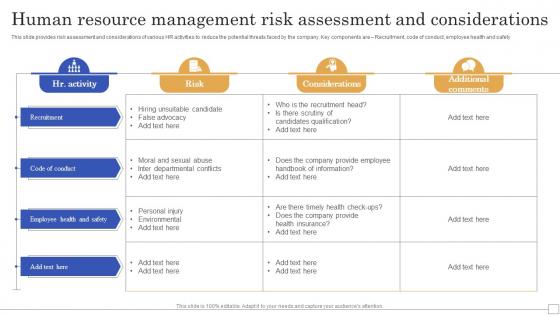
Human Resource Management Risk Assessment And Considerations




Try Before you Buy Download Free Sample Product
 Impress Your
 Audience
 100%
100% Editable
 Save Hours
 of Time


This slide provides risk assessment and considerations of various HR activities to reduce the potential threats faced by the company. Key components are Recruitment, code of conduct, employee health and safety.
People who downloaded this PowerPoint presentation also viewed the following :
Human Resource Management Risk Assessment And Considerations with all 6 slides:
Use our Human Resource Management Risk Assessment And Considerations to effectively help you save your valuable time. They are readymade to fit into any presentation structure.





FAQs for Human Resource Management Risk
Okay so basically you need four things: spotting risks, sizing them up, dealing with them, and keeping track. Start by figuring out what could go sideways in your project. Most people either way overthink this part or blow right through it - honestly drives me crazy. Once you've got your list, rate each one on how likely it is and how much damage it'd do. Then decide your game plan: dodge it completely, minimize it, pass it off to someone else, or just live with it. Oh and you can't just set it and forget it - risks change all the time so you've gotta stay on top of them. I'd say grab your biggest 5-10 risks this week and make sure someone owns each one.
Do a risk assessment first - figure out what could blow up in each part of your business. Get different departments involved because they'll spot stuff you totally missed. Honestly, the front-line people usually have the best dirt on what's actually broken day-to-day. Think about internal crap like systems crashing or people quitting, plus external stuff - market shifts, new regulations, sketchy suppliers. Rate everything by how likely it is vs how much it'd hurt. Make a simple grid so you know what needs fixing NOW versus what you can just keep an eye on.
You absolutely need stakeholders involved - they'll spot risks you'd totally miss otherwise. Finance sees budget issues operations won't catch. Customers point out service problems that aren't even on your radar. When people help create the risk plan, they actually stick to it too, which honestly makes your life so much easier. Start by figuring out your key players for each risk area. Set up regular conversations with them - doesn't have to be formal meetings or whatever. Their different perspectives are gold for catching problems early.
Honestly, automation is a game changer for risk stuff. AI can catch weird patterns way faster than humans, and compliance software tracks regulatory changes without you having to constantly monitor everything. Cloud platforms are clutch too - your team can work on risk assessments from anywhere instead of being stuck in meeting rooms forever. Predictive analytics helps you catch problems early, which is obviously way better than dealing with disasters later. I'd say start with just one automated tool for whatever your biggest headache is. Once you see how much time it saves, you'll probably want to expand it. The ROI is usually pretty obvious once you get going.
Honestly, the big ones are cyber risks - ransomware, data breaches, all that fun stuff. Supply chain issues can wreck your operations basically overnight. Market volatility messes with your finances constantly. Then there's regulatory stuff that changes faster than I can keep up with sometimes. Operational disruptions are huge too. Oh, and reputational risks - one bad incident goes viral and you're screwed. I'd probably do risk assessments every quarter since things change so fast. Each business is different though, so focus on what actually applies to yours instead of trying to cover everything.
Dude, you've gotta stay ahead of regulatory changes - they move crazy fast these days. Set up industry alerts so you're not caught off guard. Build compliance checks right into your risk assessments as standard practice. Someone needs to own this stuff, whether it's compliance or a risk manager. Document literally everything you do and your reasoning behind it. Regulators are obsessed with paper trails, trust me on that one. Oh, and run quarterly compliance reviews to spot gaps early. Way better than scrambling when problems hit.
Dude, diversifying revenue is huge - don't put all your eggs with one client. We learned that the hard way when our biggest account dropped us randomly. Cash flow forecasting is boring but necessary, and yeah, keep like 3-6 months expenses saved up. Insurance and contracts help with the crazy stuff like currency swings. Oh, and get your books audited regularly because problems hide in there. Honestly though? Start with just tracking your cash flow better. That's where you'll spot trouble before it gets ugly. Most businesses fail because they run out of money, not customers.
Dude, culture totally changes how teams think about risk. What seems fine to one group might look crazy risky or way too safe to another. Like, some cultures need everyone to agree before making big calls, while others just want quick decisions from whoever's in charge. Power dynamics are huge too - people won't push back on their boss's risk choices even when they probably should. Oh, and the whole timeline thing varies massively between cultures. Some want everything analyzed to death, others are cool with gut calls. You've got to factor this stuff into how you set up risk processes and double-check that your messaging actually makes sense to everyone.
Track both your leading and lagging indicators - stuff like incident rates, how bad the losses are, resolution times, and what you're spending on mitigation vs actual risk costs. Near-miss reports are honestly where the gold is for prevention. Don't sleep on those. Also check if your risk predictions match reality, training completion rates, and audit results. I'd stick with maybe 3-5 core metrics monthly instead of getting buried in spreadsheets. Pick the ones that actually connect to your business goals and help you make real decisions, not just nice-to-have numbers.
Think of scenario planning like those fire drills we used to hate in school, except for business stuff. Pick 3-4 realistic "what if" situations that could hit your industry - good and bad ones. Then work backwards and figure out what gaps you'd have in your current plans. Honestly, most companies skip this and regret it later. The trick is being specific enough that it's actually helpful, but not so narrow that you miss other curveballs. Start with one big uncertainty your field's dealing with right now. Map out how it could play out differently and what that'd mean for day-to-day operations. You'll spot blindspots you didn't even know existed.
So risk management is like your defense strategy - you're trying to spot problems before they smack you in the face. Resilience? That's how fast you get back up after getting knocked down (and trust me, something will knock you down eventually). Here's the thing though - they actually work together pretty well. Better risk planning means fewer nasty surprises, but you still need that bounce-back ability when things go sideways anyway. I'd start by figuring out what could really hurt your business, then build some solid recovery plans. The prep work now saves your butt later.
Honestly, most risk frameworks are way too complicated for startups. You'll waste tons of time on fancy matrices when you should just focus on the 3-5 things that could actually destroy your business. Skip the endless documentation - nobody reads that stuff anyway. Do monthly check-ins instead. What could go wrong? How likely is it? What's your backup plan? Cover the basics: money running out, key people leaving, market shifts, operational disasters. That's pretty much it. The whole point is making quick decisions, not creating paperwork that sits around collecting dust.
Honestly, most companies mess this up by only training executives then acting shocked when nobody else gives a damn about risk management. You need three things: workshops for everyone (not just the top floor), simple ways for people to actually report problems, and leaders who walk the walk. Train both the technical stuff like assessment frameworks AND how to speak up without getting your head bitten off. Oh, and celebrate the people who catch risks early - that's huge. Give teams basic tools they'll actually use, like risk registers or decision trees. Nothing fancy, just practical stuff that makes sense in their daily work.
Think of it as building a "smart risk" portfolio. Honestly, I'd set aside maybe 10-20% of your innovation budget specifically for stuff that might totally bomb - and that's okay. Companies get so paralyzed trying to make every single bet work that they kill all creativity. For the bigger swings, do staged funding so you can pull the plug early if things aren't clicking. The trick is being super clear about where you can afford to fail versus where failure would actually hurt. Map out your "safe to fail" zones first, then experiment like crazy there.
So data analytics is like having a crystal ball for spotting risks before they hit you. Look at your historical data first - what patterns show up before things went sideways? You can run scenarios to stress-test different situations too. Honestly, the coolest part is when it catches stuff you would've totally missed. Try combining different data sources since that gives you way better insights than looking at just one thing. I'd start with whatever data you already have lying around and see what jumps out at you.
-
Colors used are bright and distinctive.
-
What a stunning collection of customizable templates! Really a time-saver..