

Implementing A CRM Proposal Powerpoint Presentation Slides




Try Before you Buy Download Free Sample Product
 Impress Your
 Audience
 100%
100% Editable
 Save Hours
 of Time


For obvious reasons, a business cannot survive without a loyal fanbase. Therefore, fostering strong business relationships with clients is critical to a successful business venture. The development of customer relationship management software and framework makes this reasonably easy. Every firm with long-term goals needs a CRM strategy. This creates ample scope for CRM professionals to create value. But due to business dynamics, many CRM organizations continue to face problems in maintaining a steady flow of customers. However, SlideTeam’s latest offering- Implementing A CRM Proposal PowerPoint Presentation Slides can turn the situation on its head. Employ our PowerPoint business proposal slideshow to close more deals, and manage customer relations effectively. This proposal kicks off with a gripping cover letter. The state-of-the-art design positions your brand in the minds of the target audience. Briefly explain the CRM problems of your customers, such as outdated technology or lack of talent. Showcase a gist of your Customer Relationship Management strategy and elucidate the positive effects on the customer experience. Our business proposal PowerPoint layout assists you in virtually presenting the core aspects of CRM implementation. Walk your audience through various key steps involved in the plan of action. Elaborate on weekly and monthly project timeframe chronologically with the help of a linear diagram enlisting milestones. Portray the cost structure of CRM implementation as per various features. Represent a pricing list for common, unique, and new CRM system features. Our PowerPoint layout innovators have included a highly professional company intro. Easily personalize the details to reproduce the corporate identity of your firm, virtually. You may showcase details like firm background, vision, and the responsibilities you will undertake as a part of the deal. Introduce your clients to the key staff and members involved in the project. End the proposal with max impact by including what your past customers think about your company. Give a glimpse of your proficiency via a case study. Further, get access to an implementation agreement contact by hitting the download icon. Begin instant customization now.
People who downloaded this PowerPoint presentation also viewed the following :
Content of this Powerpoint Presentation
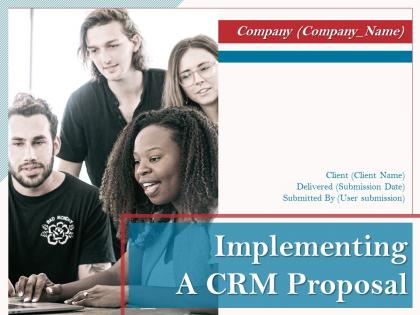
Slide 1: This slide introduces Implementing A CRM Proposal. State Company name, Client name, Submission date and User assigned.
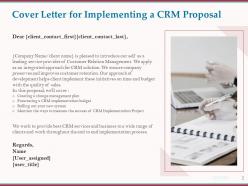
Slide 2: This slide displays Cover Letter.
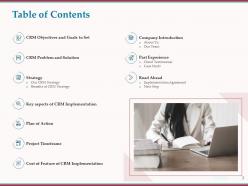
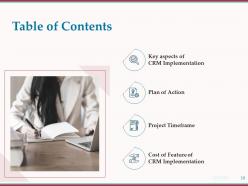
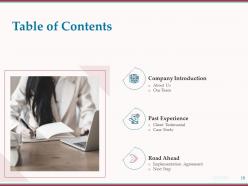
Slide 3: This slide shows Table of Content.
Slide 4: This slide shows Table of Content.
Slide 5: This slide showcases CRM Objectives and Goals To Set such as- Improved Customer Satisfaction, Improve the Efficiency of your Business, Expand you Customer Base, Enhance your Sales and Support Teams.
Slide 6: This slide depicts CRM Problem and Solution.
Slide 7: This slide displays Table of Content.
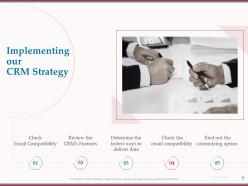
Slide 8: This slide presents describes Implementing CRM Strategy.
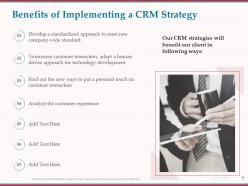
Slide 9: This slide showcases benefits of Implementing CRM.
Slide 10: This slide displays Table of Content.
Slide 11: This slide depicts Key Aspects of Implementing CRM.
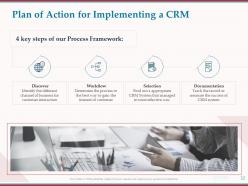
Slide 12: This slide showcases Key Steps of Our Process Framework.
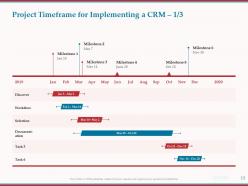
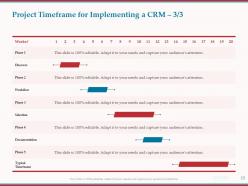
Slide 13: This slide showcases Project Timeframe.
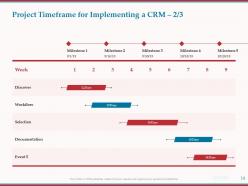
Slide 14: This slide displays Project Timeframe.
Slide 15: This slide displays Project Timeframe.
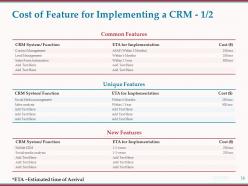
Slide 16: This slide depicts Cost of Feature of Implementing CRM.
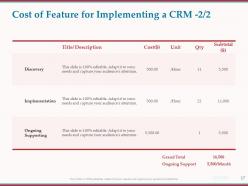
Slide 17: This slide presents Cost of Feature of Implementing CRM.
Slide 18: This slide displays Table of Content.
Slide 19: This is About Us slide to showcase Company specifications.
Slide 20: This is Our Team slide with Names and Designations.
Slide 21: This is Our Team with Names and Designations.
Slide 22: This slide presents Clients Testimonials
Slide 23: This slide represents Case Study with background, challenges & solutions, returns.
Slide 24: This slide displays Implementing CRM Agreement.
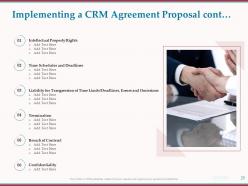
Slide 25: This slide is continued with Implementing CRM Agreement.
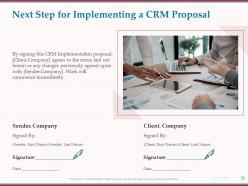
Slide 26: This slide depicts Next Step with company name, signature and date.
Slide 27: This is Contact Us slide with Address, Email address, Website and Social media accounts.
Slide 28: This is Icons Slide for Implementing CRM Proposal Template
Slide 29: This slide is titled as Additional Slides for moving forward.
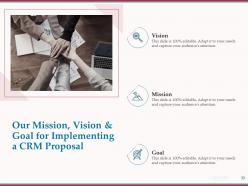
Slide 30: This slide displays Our Mission, Vision & Goal.
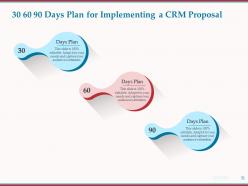
Slide 31: This is 30 60 90 Days Plan slide.
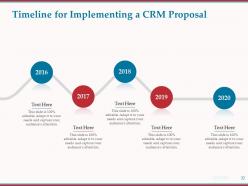
Slide 32: This slide showcases Timeline process.
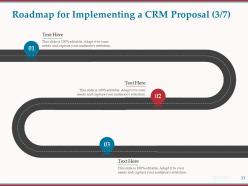
Slide 33: This slide shows Roadmap Template.
Slide 34: This slide depicts Roadmap Template.
Slide 35: This slide shows Roadmap process.
Slide 36: This slide depicts 6 step roadmap process.
Slide 37: This slide shows 7 step roadmap process.
Implementing A CRM Proposal Powerpoint Presentation Slides with all 37 slides:
Use our Implementing A CRM Proposal Powerpoint Presentation Slides to effectively help you save your valuable time. They are readymade to fit into any presentation structure.







FAQs for Implementing A CRM Proposal
Key CRM features to include are contact management, sales pipeline tracking, automated workflows, reporting analytics, and integration capabilities with existing systems. These functionalities streamline customer interactions, enhance sales forecasting, and improve data visibility, with many organizations finding that comprehensive CRM solutions ultimately deliver better customer experiences and increased operational efficiency.
Data analytics enhances CRM proposal effectiveness by providing customer segmentation insights, predictive behavior modeling, performance metrics analysis, and ROI projections that demonstrate clear business value. Through advanced analytics capabilities, organizations can showcase how the proposed CRM will deliver personalized customer experiences, optimize sales processes, and reduce acquisition costs, ultimately presenting compelling evidence of competitive advantage and measurable outcomes.
CRM proposals should outline implementation costs, software licensing fees, data migration expenses, staff training budgets, and ongoing maintenance costs. These budget considerations enable organizations to assess total cost of ownership while planning for system integration, with many businesses finding that transparent pricing across customization, support, and scalability ensures strategic resource allocation and long-term operational efficiency.
A CRM proposal aligns with client goals by demonstrating how the system addresses specific pain points, enhances customer retention, streamlines sales processes, and supports revenue growth targets. Through detailed ROI projections, workflow optimization strategies, and integration capabilities, organizations can showcase measurable outcomes like reduced response times, improved lead conversion rates, and enhanced customer satisfaction, ultimately delivering competitive advantage in increasingly demanding markets.
A CRM proposal should address data silos, inefficient lead management, poor customer communication tracking, manual processes, and lack of sales visibility. These challenges significantly impact organizations across industries, with many companies finding that streamlined customer data management, automated workflows, and integrated communication systems ultimately deliver improved conversion rates, enhanced customer relationships, and measurable revenue growth.
Demonstrate CRM ROI by presenting quantifiable metrics like customer acquisition cost reduction, sales cycle acceleration, customer retention improvements, and revenue per customer increases. Include specific projections such as 20% faster lead conversion, 15% reduction in support costs, and improved customer lifetime value calculations, with many organizations finding that documented productivity gains and enhanced customer experiences deliver measurable competitive advantages within 6-12 months.
User adoption plays a critical role in CRM proposal success, as even the most sophisticated system fails without enthusiastic employee engagement, comprehensive training programs, and seamless workflow integration. Organizations with high adoption rates typically achieve significantly better customer relationship outcomes, improved sales performance, and enhanced data quality, while those with poor adoption often see limited ROI and continued reliance on legacy processes.
Case studies and testimonials strengthen CRM proposals by providing concrete evidence of successful implementations, demonstrating measurable ROI, and addressing common client concerns through real-world validation. These proof points enable prospects to visualize outcomes in their specific industry, with many organizations finding that detailed success stories from similar sectors significantly accelerate decision-making and build stakeholder confidence.
**INPUT**: What metrics should be proposed to measure the success of the CRM implementation? **OUTPUT**: CRM success metrics should include customer acquisition cost, sales cycle length, customer retention rates, lead conversion percentages, and revenue per customer. These measurements enable organizations to track operational efficiency, sales performance, and customer satisfaction simultaneously, with many companies finding that comprehensive metric tracking delivers enhanced forecasting accuracy and strategic decision-making capabilities. *[Word count: 54]*
A CRM proposal accommodates future scalability by incorporating modular architecture, cloud-based infrastructure, flexible user licensing, and integration capabilities with emerging technologies. These strategic elements enable organizations to expand user capacity, add functionality, and integrate with new business systems as they grow, with many enterprises finding that scalable CRM solutions deliver long-term cost efficiency and competitive advantage.
**INPUT**: What training and support options should be highlighted in a CRM proposal? **OUTPUT**: CRM proposals should highlight comprehensive onboarding programs, role-specific training modules, 24/7 technical support, user certification paths, and ongoing system optimization consultations. These support frameworks streamline user adoption across departments, minimize implementation downtime, and ensure teams maximize platform capabilities, with many organizations finding that robust training ultimately delivers faster ROI and enhanced customer relationship management. [Word count: 58 words]
Customizing a CRM proposal involves analyzing the client's industry-specific workflows, compliance requirements, integration needs, and customer touchpoints to tailor functionality recommendations accordingly. Financial services might require enhanced security features and regulatory reporting, while retail focuses on omnichannel customer experiences and inventory integration, ultimately delivering targeted solutions that address sector-specific challenges and operational priorities.
Critical CRM proposal timelines include project kickoff, data migration phases, user training sessions, system testing periods, and go-live dates. These milestones streamline implementation by establishing clear expectations, enabling resource allocation, and maintaining stakeholder alignment throughout the process, with many organizations finding that well-defined timelines reduce deployment risks while accelerating user adoption.
**INPUT**: How can integrations with existing systems be presented in a CRM proposal? **OUTPUT**: Integration capabilities should be presented through detailed compatibility matrices, API documentation, data migration timelines, and system architecture diagrams that demonstrate seamless connectivity. These visual elements enable stakeholders to understand technical feasibility while showcasing how the CRM streamlines workflows, eliminates data silos, and enhances operational efficiency across departments. [Word count: 50 words]
Innovative CRM technologies include artificial intelligence for predictive analytics, chatbots for automated customer service, machine learning for personalized recommendations, blockchain for data security, and IoT integration for real-time insights. These technologies enhance functionality by streamlining customer interactions, automating routine tasks, and delivering personalized experiences, with many organizations finding that strategic technology integration ultimately drives higher customer satisfaction and competitive advantage.
-
Enough space for editing and adding your own content.