


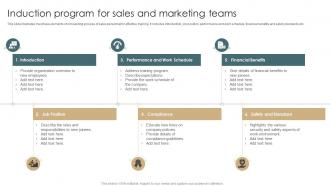
Induction Program For Sales And Marketing Teams





Try Before you Buy Download Free Sample Product
 Impress Your
 Audience
 100%
100% Editable
 Save Hours
 of Time


This slide illustrates must have elements of onboarding process of sales personnel for effective training. It includes introduction, job position, performance and work schedule, financial benefits and safety standards etc.
People who downloaded this PowerPoint presentation also viewed the following :
Induction Program For Sales And Marketing Teams with all 6 slides:
Use our Induction Program For Sales And Marketing Teams to effectively help you save your valuable time. They are readymade to fit into any presentation structure.





FAQs for Induction Program For Sales
So basically there are two parts to induction. You start with the base case - like n=1 or whatever - and prove that works. Then you do this thing where you assume it's true for some number k, and show that means it has to be true for k+1 too. Think of it like dominoes, right? First domino falls, and each one knocks down the next. That's your whole proof right there. Oh and pro tip - double check your algebra in that second part because that's where I always mess up. The setup is easy but the math gets tricky fast.
Think of it like this - inductive reasoning starts with specifics and works up to the big picture. You see a bunch of failed projects had crappy communication, so you figure communication problems tank projects. Deductive flips it: you already know "bad communication = failure" and apply that to predict your current project's doomed if the team can't talk properly. Honestly, I use inductive when I'm stumbling around trying to figure out what's even happening. Deductive's better when you've got solid frameworks to work with. The sweet spot? Combine them - spot patterns first, then test solutions based on what you found.
So induction is when you spot patterns in your observations and turn them into bigger theories - it's that bottom-up approach where specific cases become general rules. Most big scientific discoveries happened this way, which is pretty cool when you think about it. But you can't just stop there. Following up with deduction to actually test your hypothesis is where the real work begins. Otherwise you're just making educated guesses. Short version: induction forms your hypothesis, deduction proves whether it's actually right or total garbage.
Honestly, you're doing this all the time without thinking about it. Like when you see dark clouds and grab an umbrella - that's just pattern recognition from past experience. Same with avoiding that sketchy restaurant after it made you sick twice lol. Your commute route? You probably picked it based on which way usually has less traffic. Even trusting your go-to coffee place comes from inductive reasoning - they've made your drink right before, so they'll probably do it again. Though obviously nothing's guaranteed, which is why sometimes patterns break and surprise you.
Start with pattern stuff before jumping into formal proofs - way easier for kids to grasp. I love using the domino thing because they actually understand why you need both the base case AND the inductive step. Have them mess around with sequences first, let them guess what's happening, then work backwards to prove it. Arithmetic series are perfect for beginners. The trick is drilling that "assume true for k, prove for k+1" template until they don't even think about it. Honestly took me forever to figure out this approach but it works so much better than diving straight into the formal stuff.
Oh man, the biggest thing people get wrong? They think induction gives you rock-solid proof - it doesn't. You're just finding patterns and making educated guesses. Also, tons of people mix this up with deduction. One weird example won't wreck your whole argument like it would with deductive reasoning. Here you're building up probability. And honestly - I've seen this mess up so many projects - just because two things happen together doesn't mean one causes the other. Your conclusions are only as good as your sample size anyway. Treat inductive reasoning like a really strong hunch, not absolute fact.
Honestly, induction is like the secret sauce of programming once you get it. Start with your base case - empty array, whatever. Then prove if it works for size n, it'll work for n+1 too. Recursive functions are the obvious example, but it's also hiding in loop invariants and dynamic programming. I used to hate debugging recursive stuff until I started consciously identifying the base case and inductive step first. Makes everything way cleaner. It's basically just showing each step follows logically from the last one, but man does it save headaches later.
Honestly, induction's biggest problem is you can never be 100% sure about anything. Like, you could see a thousand white swans and think "okay, all swans are white" - but then boom, black swan shows up. We're also terrible at cherry-picking evidence that backs up what we already think (guilty as charged lol). Sample size matters a ton too. The trick is just being honest about these weak spots when you share your results. Stay curious and don't get too attached to your conclusions when new stuff comes along.
So basically, induction is just pattern-spotting with your business data. Track your sales, customer stuff, whatever - then look for what repeats. Like if March always sucks for sales, prep for it. I've seen people completely miss obvious seasonal trends and then wonder why they're stuck with inventory. You need decent historical data first though. Once you've got that, use those patterns to forecast demand or figure out which marketing actually moves the needle. It's educated guessing, but it works if you're consistent about tracking the same metrics over time.
So machine learning is all about induction, right? Your models look at training data, spot patterns, then make predictions on new stuff. Think of it like seeing a bunch of cats with whiskers and assuming the next one will have them too. Neural networks and decision trees work the same way - they take specific examples and create general rules. The annoying part is overfitting though, where your model gets way too attached to the training data. I always forget to check for that honestly. When you're building models, just think about what assumptions you're actually making.
Your brain is basically a pattern-seeking machine, which explains why you lean so hard on inductive reasoning. We give way too much weight to stuff that happened recently or really stuck with us (availability bias). Then confirmation bias jumps in - you'll notice evidence supporting what you already think while totally missing contradictory stuff. Honestly, mental shortcuts just feel easier than doing the hard work of proper analysis. Recent experiences end up shaping your conclusions way more than they should. Try hunting for evidence that proves you wrong before you make broad generalizations. It's annoying but actually works.
Oh this is actually pretty cool - get your team doing some creative detective work. Have them look at what's worked before, either from old projects or totally different areas, then figure out how to adapt those patterns. Like, "remember when we solved X this way? Could we tweak that approach for this new thing?" Set aside actual time during brainstorming for people to share random solutions they've seen elsewhere. Then everyone can riff on how those ideas might transfer over. It's basically pattern recognition but for problem-solving - sounds nerdy but it totally works.
So Bacon started this whole thing in the 1600s - he basically said "let's go from specific observations to big picture conclusions" and called it inductive reasoning. Mill jumped in later with his famous methods for figuring out cause and effect (honestly pretty brilliant stuff). But then Hume had to be that guy and point out we can never be 100% certain with induction, just highly probable. Mill's canons are worth checking out though - I still use them when I'm designing studies. They're surprisingly practical even now.
Yeah so Western philosophy is super into that whole "observe stuff, then make generalizations" approach - you know, like Hume questioning whether induction actually works. But Buddhist and Hindu traditions? They're more about experiential knowledge in these cyclical patterns rather than straight-line thinking. Islamic scholars like Al-Ghazali were actually pretty big on inductive methods too. Indigenous cultures worldwide use nature's patterns for practical reasoning, which honestly makes a lot of sense. The epistemological differences really matter when you're working across cultures since people approach evidence totally differently.
So basically, bias is the huge problem here. Your data sample might already be skewed, and then you're making broad conclusions that don't apply to everyone. Think hiring algorithms - they're notorious for this stuff. Medical research too. You'll also run into issues if your sample doesn't actually represent the whole population you're studying. Honestly, I see this mistake all the time. Being upfront about what you don't know helps. Also, always ask yourself: could this unfairly screw over certain groups? That's where the real ethical problems start.
-
You know what? I'm so glad I opted for this PPT design. It has been a total game-changer for me and my presentations. Thank you!
-
I want to thank SlideTeam for the work that they do, especially their customer service.