


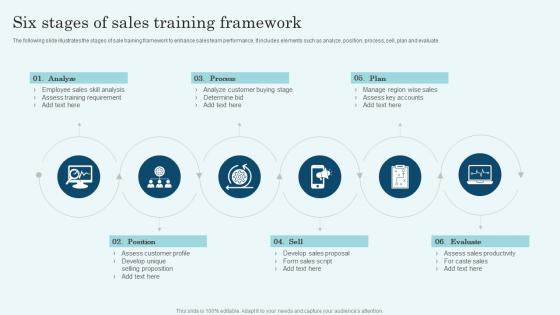
Six Stages Of Sales Training Framework




Try Before you Buy Download Free Sample Product
 Impress Your
 Audience
 100%
100% Editable
 Save Hours
 of Time


The following slide illustrates the stages of sale training framework to enhance sales team performance. It includes elements such as analyze, position, process, sell, plan and evaluate.
People who downloaded this PowerPoint presentation also viewed the following :
Six Stages Of Sales Training Framework with all 6 slides:
Use our Six Stages Of Sales Training Framework to effectively help you save your valuable time. They are readymade to fit into any presentation structure.






FAQs for Six Stages Of
So you'll want to hit four main areas: skills training like prospecting and closing, deep product knowledge sessions, some kind of sales methodology, and regular coaching. Most places totally bomb on that coaching part btw - they do this big training event then act shocked when nothing changes. Role-play actual conversations, don't just lecture about features. Make it ongoing instead of cramming everything into a week. Start by figuring out where your team's actually struggling right now, then build around those gaps. Way better than some cookie-cutter program that doesn't fit your situation.
Honestly, you've gotta tailor everything to each industry - they're all so different. Tech needs those deep product demos and handling technical pushback. Healthcare? Super relationship-heavy with crazy long decision cycles, plus all that compliance stuff. Financial services is a whole other animal - it's pure trust and knowing regulations inside out. I'd start by figuring out how each industry actually buys, then build your training around that. Get some real case studies from those sectors, do role-plays that don't suck, maybe bring in people who've actually closed those deals. That generic training everyone uses? Total waste of time.
Honestly, sales training works so much better when you treat your team like adults, not students. Ask them what problems they're actually dealing with right now - then build everything around that. Skip the theory stuff. Your reps want to see immediate value, so focus on real scenarios they face every day. Let them share war stories about what's worked or bombed. That experience sharing is gold. Make it hands-on and problem-centered instead of lecture-heavy. I'd literally start by saying "what's driving you crazy this week?" then structure the whole session around fixing those specific issues. Way more effective than generic training modules.
Honestly? Start with a CRM-integrated learning platform - that's your foundation. Mobile apps work great for bite-sized training content, and video coaching tools are solid for pitch practice. AI role-play simulations sound fancy but they actually help reps get comfortable with tough scenarios. The analytics side is where it gets interesting though - you can finally see which training modules actually move the needle on deals. Oh, and don't sleep on gamification. I was skeptical at first but it keeps people way more engaged than traditional methods. VR's becoming huge for high-stakes practice too. My advice? Pick one platform that talks to your existing CRM first, then build from there.
Honestly, start simple - pick like one or two things to track instead of going crazy with data. Test their knowledge right after training, then again in a month or two to see what actually stuck. But here's the thing - the real test is watching behavior change. Are they actually using those new techniques during calls? I'd definitely have managers do ride-alongs before and after to compare. Obviously conversion rates and deal sizes matter, but don't skip asking the reps how confident they feel. Sometimes that tells you more than the numbers do.
Honestly, just mix up how you deliver the same info. Some people are super visual - they need charts and demo videos. Others learn better by listening, so try podcasts or group discussions. Your kinesthetic learners (probably your best reps already) want hands-on practice with real prospects. Then you've got the note-takers who love case studies and written stuff. Don't overthink it - pick 2-3 formats for each topic so everyone gets it their way. I'd survey the team first to see what they actually prefer, then adjust your modules from there.
Mix up your sessions with role-playing - like practicing real objections they actually hear. I love doing breakout groups where people swap war stories and tactics they've tried. Games work great too, maybe sales competitions or point systems. Switch activities every 15-20 minutes or people totally zone out. Interactive polls are solid, and having them teach each other keeps everyone awake instead of just sitting there. Oh, and case studies where they work through actual scenarios. Here's what I'd do though - start by asking what specific problems they're dealing with right now. Gets them invested immediately.
Quarterly works for most companies, but it really depends on your space. Tech moves crazy fast so maybe monthly tweaks? More traditional industries can probably stretch it to 6 months. Watch your conversion numbers though - they'll drop when training gets outdated. Your reps will complain too when they're getting questions they weren't prepped for. That's your cue right there. Do a big refresh once a year for new tools and market changes. Honestly, just set a calendar reminder now or you'll totally forget like I always do.
Track both the activity stuff and actual results - you need both to see what's really happening. Conversion rates, deal size, sales cycle time, quota hits - that's where you'll see if training actually worked. But also watch call volume, email response rates, pipeline movement. Compare everything from before vs after, obviously. Pull reports at 30, 60, 90 days because honestly? Sometimes this stuff looks good initially then falls off a cliff. Oh and don't just look at numbers in a vacuum - context matters way more than people think.
Honestly, start simple with stuff your team deals with every day - don't throw them into crazy scenarios right away. I like pairing newbies with experienced reps so nobody feels totally exposed out there. Give feedback right after each round, like specifically what they nailed and what felt off. Mix up the variables too - angry customers one day, pricing pushback the next. Oh, and rotate who plays the prospect! People forget how much that helps with understanding the other side. The repetition is what actually builds confidence. Just don't make it a one-time training thing - schedule these regularly or people get rusty fast.
Honestly, you're gonna face pushback from your sales team first - change freaks everyone out. Leadership buy-in is huge too, without that you're dead in the water. Different managers will implement things their own way, which creates chaos. Your reps will whine about not having time for training while they're busy hitting numbers. ROI measurement is a pain since you won't see results for months. Start with the people who actually want to try it, get your leaders involved early, and create some quick wins. Oh, and maybe don't roll it out during quarter-end when everyone's losing their minds.
Just weave it into what you're already doing - don't make it this big separate thing. Spend 15 minutes each meeting having people share what worked or bombed that week. Pair up your newbies with experienced folks. My old manager used to do this and honestly? Some of our best ideas came from those random chats, not the formal training stuff. Celebrate the experiments, even the failures. Let your top performers teach occasionally - they love showing off anyway. Start small with one ritual and see what sticks. Way easier than overhauling everything at once.
Dude, feedback loops are what separate actual learning from just throwing training at people and praying something sticks. You've gotta do regular check-ins - like weekly one-on-ones where you review calls together and run through practice scenarios. That's how you catch the bad stuff early and build on what's already working. Honestly, most companies skip this part and then wonder why their training budget got wasted. Role-play sessions work great too. The whole point is adapting based on real results instead of guessing what your team needs.
Get your leaders actually involved, not just doing the kickoff speech then vanishing. Have them co-facilitate and share war stories from real deals. When they jump into role-plays and give feedback, reps actually pay attention - way more than they do with just trainers. Your managers need to keep reinforcing this stuff in their 1:1s too, or honestly it all just disappears into thin air. They should also spot which reps are struggling with what skills. The whole thing falls apart if leadership isn't visible throughout the process.
Dude, on-the-job coaching is a game changer for sales training. Like, we're talking 70-80% better results than classroom training alone. Most people forget training super fast unless they use it right away - which is honestly pretty frustrating when you think about it. But having a coach there during real calls? That's where the magic happens. They can jump in when someone's fumbling through objections or help them navigate the CRM after tough conversations. I've watched struggling reps become absolute killers once they had someone guiding those first real interactions. Try to get your coaches shadowing 3-5 calls weekly per rep.
-
This PowerPoint layout is very helpful from a business point of view, and it's visually stunning too! I'm so happy with this product because it has helped me understand and deliver great presentations.
-
Good research work and creative work done on every template.