

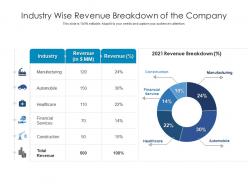
Industry wise revenue breakdown of the company





Try Before you Buy Download Free Sample Product
 Impress Your
 Audience
 100%
100% Editable
 Save Hours
 of Time


Our Industry Wise Revenue Breakdown Of The Company are topically designed to provide an attractive backdrop to any subject. Use them to look like a presentation pro.
People who downloaded this PowerPoint presentation also viewed the following :
Industry wise revenue breakdown of the company with all 2 slides:
Use our Industry Wise Revenue Breakdown Of The Company to effectively help you save your valuable time. They are readymade to fit into any presentation structure.

FAQs for Industry wise revenue breakdown
So there's software licensing and SaaS subscriptions - that's where the steady money is. Hardware sales obviously, plus cloud services are massive right now. Everyone's ditching their own servers. Digital advertising brings in crazy revenue too. Companies also sell data insights, which honestly feels kinda sketchy but whatever. Gaming makes bank from in-app purchases. Oh, and don't forget consulting services - tech companies love charging for implementation help. If you're researching a specific company, just pull their 10-K filing. They break down revenue streams there so you can see what actually pays the bills.
So B2B companies usually have way fewer customers but each one brings in serious cash - we're talking big contracts that can run for years. B2C is the total flip side. Millions of tiny purchases from regular people, but each sale is pretty small. The timing's completely different too. B2B sales take forever (like, months of back-and-forth) but you get that sweet recurring revenue. B2C is all over the place - Christmas shopping spikes, random impulse buys, that kind of chaos. Just focus on the right metrics for whichever model you're dealing with. Comparing them directly is pretty useless honestly.
Dude, regulatory changes can totally flip revenue streams upside down. New rules hit and suddenly established companies are bleeding market share to whoever can actually comply. GDPR was a perfect example - all that ad money just flowed straight to Google and Facebook since they could handle the compliance mess. The thing is, regulations never hurt everyone equally. Some segments get crushed while others thrive. Honestly, most people forget to factor this into their revenue forecasts. You should probably start watching regulatory calendars as closely as your actual revenue models - sounds boring but it'll save you from some nasty surprises.
So basically, renewable companies make money from selling equipment and installation, plus those long-term power contracts. Traditional energy? They're stuck dealing with crazy volatile fuel prices - oil and gas costs are all over the place. Renewables need way more cash upfront but then operating costs are super low. honestly, I think the predictable revenue streams from 20-30 year contracts make renewables less stressful to analyze. Traditional energy can be a goldmine when commodity prices spike, but it's also a headache. Just focus on how different their cash flows look - timing's everything.
Look, subscription pricing is basically how SaaS companies stay alive - gives you that steady monthly cash instead of hoping for random big sales. Your customers pay monthly or yearly, which makes everything more predictable. Honestly, I think it's genius because people hate canceling subscriptions they're already paying for. You'll want different pricing tiers to catch various customer types. The real trick? Watch your MRR and churn rates like a hawk. Those numbers don't lie - they'll show you if your model actually works or if you need to pivot. Way better than guessing.
Honestly, segmentation is a game-changer because you can actually customize everything for different customer types. Pricing, products, marketing - all of it. Like, you wouldn't sell to luxury buyers the same way you'd target budget shoppers, right? That's just common sense. When you really get your segments, you can squeeze more money from your big spenders while still keeping the price-conscious folks happy. Figure out which groups make you the most profit and focus there first. Then optimize for the rest. It's way better than trying to please everyone with some generic approach that doesn't really work for anybody.
So pharma companies usually spend about 15-25% of revenue on R&D, but here's the crazy part - they blow 30-40% on sales and marketing. Makes sense though since they're constantly lobbying doctors and dealing with insurance companies. Manufacturing eats up another 20-30%, then you've got admin costs and whatever's left is profit. Oh, and this totally depends on the company type. Big established pharma looks way different than some scrappy biotech that's burning cash on research. You should definitely check their 10-K filings for the real numbers.
Yeah, seasonal swings are no joke in tourism - most places see like 60-70% of their whole year's revenue packed into just 3-4 peak months. Summer's usually king, unless you're talking ski resorts which flip everything backwards obviously. Shoulder seasons can be rough though, running at maybe 20-30% capacity. Winter's typically your worst enemy unless you're somewhere warm pulling in snowbirds. Honestly, cash flow planning becomes everything - you've got to stash money during the good times. Also worth thinking about off-season offerings to keep some revenue trickling in when things get slow.
Honestly, ad revenue is all over the place depending on where you advertise. Google's still the king because people searching actually want to buy stuff - those clicks convert like crazy. Social media? Lower rates per click but you reach tons of people with display and video ads. YouTube's been crushing it lately with video ads, which makes sense since everyone's watching. Oh, and streaming services are blowing up as more people ditch cable, though they don't have as much ad space yet. My advice? Don't put all your eggs in one basket - mix it up since different platforms catch people at different stages.
Mobile commerce is absolutely dominating right now - everyone's shopping on their phones. Personalized experiences and same-day delivery are huge too. Companies making bank with subscription models and social shopping integration (you know, buying stuff straight from Instagram). AI recommendations actually don't suck anymore, which is wild. Cross-border shopping's exploding, and that whole "order online, grab in-store" thing is everywhere now. Oh, and if you're thinking investments, definitely look for mobile-first companies with rock-solid shipping networks. Those are the ones crushing it.
Location is huge for auto revenue - probably the biggest factor tbh. China's all about EVs with government backing, Europe wants luxury and green compliance stuff. The US? Still obsessed with trucks and SUVs for those fat margins, though that's changing. Latin America and Africa go for cheap, reliable cars - lower profit per car but way more volume. Your whole pricing game changes by region too. Supply chain costs, what models you even sell, how you forecast revenue - it all depends on what each market actually wants and can afford to buy.
Most healthcare places get around 75-85% of their money from insurance, with patients paying the rest directly. But it really varies by type - hospitals are super dependent on insurance, sometimes 80% or more. Meanwhile stuff like plastic surgery or those fancy concierge doctors? They flip it and rely way more on cash payments. Regular doctor offices usually sit somewhere in between. If you're looking at investing in healthcare or whatever, definitely check their specific breakdown first. The mix totally changes how predictable their income is and when they actually get paid.
When companies merge, the big players get bigger and grab more market share - pretty straightforward stuff. Your competitive landscape changes fast because suddenly there's fewer companies splitting the pie. The merged company usually ends up with better pricing power and can cut costs, so their revenue per customer goes up. Meanwhile, everyone else loses some ground. I'd focus on tracking the top 3-5 players and how their market share shifts after deals close. That's where you'll actually see the money moving around. It's wild how much these deals can reshape entire industries honestly.
Honestly, the whole fintech world is ditching transaction fees for subscription models now. Stripe's crushing it with their API approach - they built this massive platform that just prints money. Most startups are doing that "land and expand" strategy where they hook you with one thing then sell you everything else. Usage-based pricing is where it's at for B2B stuff since your revenue grows with theirs. Everyone's obsessed with recurring revenue because, let's be real, investors eat that predictable cash flow up. Oh and diversification is key - don't put all your eggs in one revenue basket, you know?
Look, consumer behavior basically controls which FMCG categories make the most money. Health-conscious shoppers boost personal care and organic food sales. Price-sensitive customers? They're all about private labels now. Brand loyalty still keeps premium stuff alive though - it's this weird back-and-forth thing. Plus impulse buying totally changed after COVID when everyone went digital (honestly, who shops in-store anymore?). You should check purchase patterns and what's in people's carts every few months. Helps you figure out where to put your money before trends shift.
-
Informative presentations that are easily editable.
-
Design layout is very impressive.
-
Very well designed and informative templates.
-
Nice and innovative design.