

Infrastructure Monitoring Powerpoint Presentation Slides





Try Before you Buy Download Free Sample Product
 Impress Your
Audience
 100%
Editable
 Save Hours
of Time


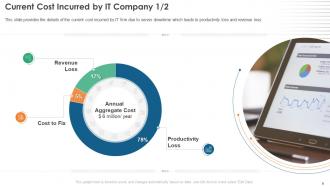
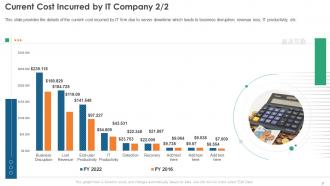
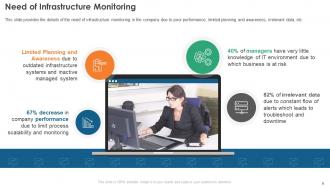
Infrastructure monitoring is the business process owned and operated by an IT organization. Check out our efficiently designed Infrastructure Monitoring template. We have evaluated the cost incurred by the company in the form of a doughnut graph and bar chart for productivity, cost to fix, revenue loss, etc. Monitoring is essential in the company due to poor performance, limited planning, awareness, irrelevant data, etc. We have focused on infrastructure managements challenges, such as the lack of powerful computing platforms, data acquisition, etc., and their solutions. This template covers the steps required for implementing IT infrastructure monitoring, such as capture, store, evaluate, interact, etc. Different types of monitoring tools and their features and services are discussed here. This slide also covers the cost and time investment needed for information technology infrastructure monitoring. Furthermore, the impact of monitoring infrastructure in the business is covered here as its future trends. Various dashboards are shared in this template which can be used for infrastructure monitoring, application server performance, etc. Get access now.
People who downloaded this PowerPoint presentation also viewed the following :
Content of this Powerpoint Presentation
Slide 1: This slide introduces Infrastructure Monitoring. State Your Company Name and begin.
Slide 2: This slide states Agenda of the presentation.
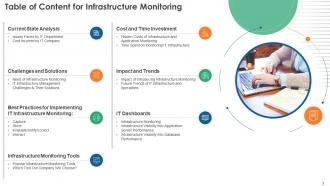
Slide 3: This slide presents Table of Content for the presentation.
Slide 4: This slide highlights title for topics that are to be covered next in the template.
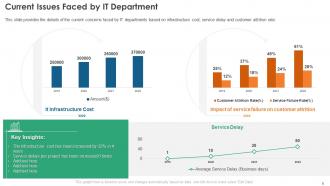
Slide 5: This slide represents Current Issues Faced by IT Department.
Slide 6: This slide displays Current Cost Incurred by IT Company.
Slide 7: This is another slide continuing Current Cost Incurred by IT Company.
Slide 8: This slide highlights title for topics that are to be covered next in the template.
Slide 9: This slide provides the details of the need of infrastructure monitoring in the company.
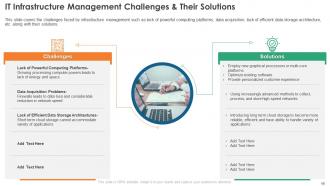
Slide 10: This slide presents IT Infrastructure Management Challenges & Their Solutions.
Slide 11: This slide highlights title for topics that are to be covered next in the template.
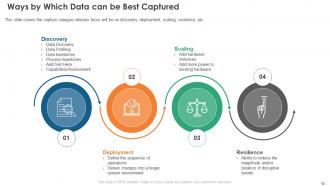
Slide 12: This slide shows Ways by Which Data can be Best Captured.
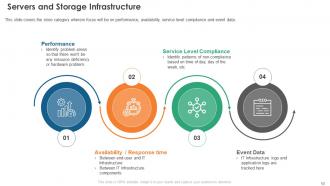
Slide 13: This slide covers the store category wherein focus will be on performance, availability, service level compliance, etc.
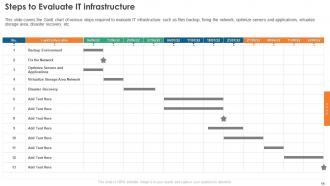
Slide 14: This slide showcases the Gantt chart of various steps required to evaluate IT infrastructure.
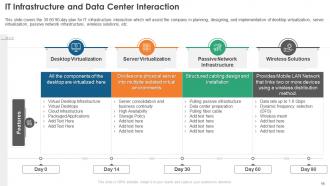
Slide 15: This slide presents IT Infrastructure and Data Center Interaction.
Slide 16: This slide highlights title for topics that are to be covered next in the template.
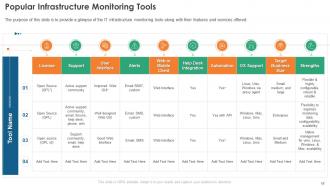
Slide 17: This slide displays Popular Infrastructure Monitoring Tools.
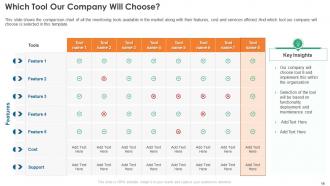
Slide 18: This slide shows the comparison chart of all the monitoring tools available in the market.
Slide 19: This slide highlights title for topics that are to be covered next in the template.
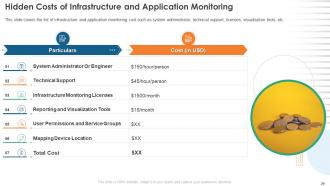
Slide 20: This slide presents Hidden Costs of Infrastructure and Application Monitoring.
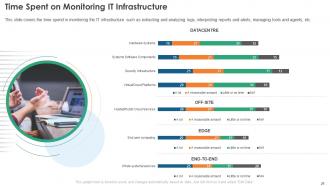
Slide 21: This slide displays Time Spent on Monitoring IT Infrastructure.
Slide 22: This slide highlights title for topics that are to be covered next in the template.
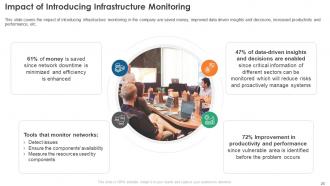
Slide 23: This slide represents Impact of Introducing Infrastructure Monitoring.
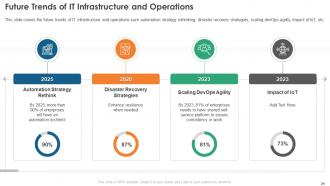
Slide 24: This slide showcases Future Trends of IT Infrastructure and Operations.
Slide 25: This slide highlights title for topics that are to be covered next in the template.
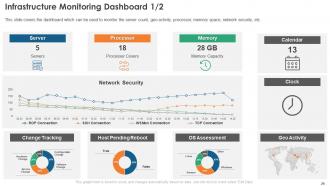
Slide 26: This slide covers the dashboard which can be used to monitor the server count, geo activity, processor, etc.
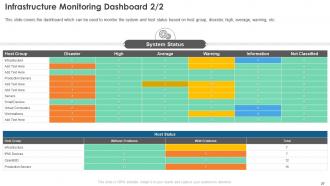
Slide 27: This is another slide continuing the dashboard which can be used to monitor the system and host status.
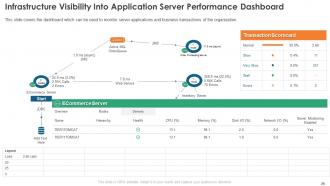
Slide 28: This slide showcases Infrastructure Visibility Into Application Server Performance Dashboard.
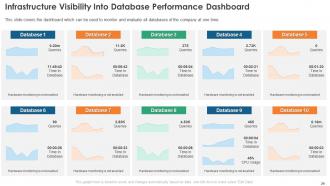
Slide 29: This slide shows Infrastructure Visibility Into Database Performance Dashboard.
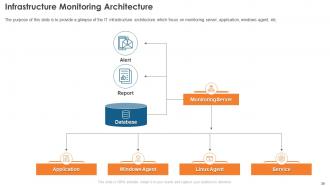
Slide 30: This slide presents Infrastructure Monitoring Architecture.
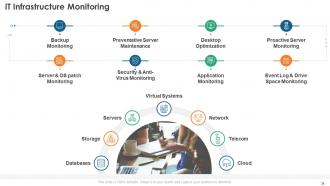
Slide 31: This slide displays IT Infrastructure Monitoring describing- Databases, Monitoring, Preventative Server Maintenance, etc.
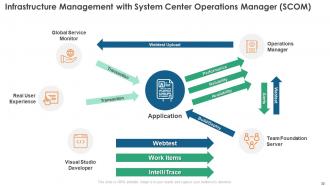
Slide 32: IThis slide represents nfrastructure Management with System Center Operations Manager (SCOM).
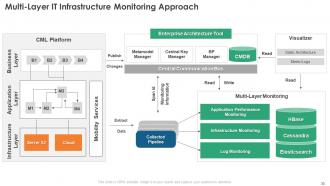
Slide 33: This slide showcases Multi-Layer IT Infrastructure Monitoring Approach.
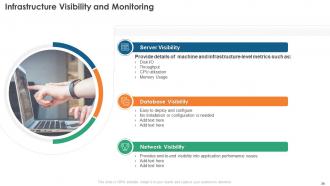
Slide 34: This slide displays Infrastructure Visibility and Monitoring.
Slide 35: This slide showcases Icons for Infrastructure Monitoring.
Slide 36: This slide is titled as Additional Slides for moving forward.
Slide 37: This slide provides 30 60 90 Days Plan with text boxes.
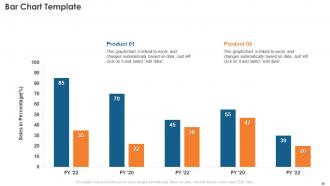
Slide 38: This slide presents Bar chart with two products comparison.
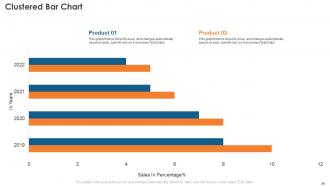
Slide 39: This slide provides Clustered Bar chart with two products comparison.
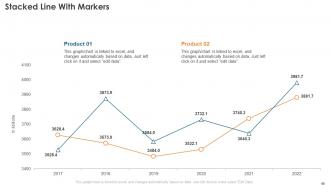
Slide 40: This slide showcases Stacked Line With Markers.
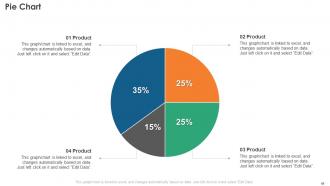
Slide 41: This slide shows Pie Chart with data in percentage.
Slide 42: This is Our Team slide with names and designation.
Slide 43: This slide shows Funnel with related icons and text.
Slide 44: This is Our Target slide. State your targets here.
Slide 45: This slide depicts Venn diagram with text boxes.
Slide 46: This slide presents Silhouettes with additional textboxes.
Slide 47: This slide showcases Magnifying Glass to highlight information, specifications, etc.
Slide 48: This slide shows Circular Diagram with additional textboxes.
Slide 49: This slide shows Post It Notes. Post your important notes here.
Slide 50: This slide contains Puzzle with related icons and text.
Slide 51: This is Our Goal slide. State your firm's goals here.
Slide 52: This slide showcases Magnifying Glass to highlight information, specifications, etc.
Slide 53: This is a Thank You slide with address, contact numbers and email address.
Infrastructure Monitoring Powerpoint Presentation Slides with all 58 slides:
Use our Infrastructure Monitoring Powerpoint Presentation Slides to effectively help you save your valuable time. They are readymade to fit into any presentation structure.








FAQs for Infrastructure Monitoring
So you'll need four main things: agents collecting data from all your systems, some centralized platform to dump all the logs, smart alerting (seriously, most people screw this up and create alert fatigue), and dashboards showing real-time stuff. Oh and automated discovery is clutch - new servers just get picked up automatically without you doing anything. Keep historical data around too for spotting trends. The alerting thing though... that's where teams always go wrong. Too much noise and people start ignoring everything. Just start with your most critical systems first, then grow from there.
So basically, cloud monitoring is all about APIs and whatever metrics the service gives you - like when you're checking EC2 instances through AWS dashboards. On-premises is totally different. You're installing agents right on the servers and can see everything - CPU temps, disk I/O, the works. Cloud providers handle that hardware stuff for you, which is honestly pretty nice. You also get auto-scaling metrics now that weren't even relevant before. The tools change too since cloud platforms have their own monitoring built right in. I'd start by figuring out which services you're actually running, then see what data each one spits out.
So you've got two main things to track - metrics and logs. Metrics are your numbers: CPU usage, memory, response times, all that graphable stuff you can set alerts on. Logs are different though - they're like your crime scene evidence when everything breaks (which it definitely will). Honestly, logs are a lifesaver because while metrics show you something's broken, logs actually tell you what the hell happened. I'd start with the key metrics for alerts first, then make sure you can actually search through your logs later when you're troubleshooting at 2am.
Honestly, start with something like Datadog or Prometheus - they're solid for pulling metrics from all your stuff in real-time. Build dashboards showing CPU, memory, disk usage, network health, the usual suspects. But here's the thing - set your alert thresholds smart so you catch problems before users start yelling at you (trust me on this one). I'd focus on your most critical systems first, then slowly add more coverage. The whole point is getting everything feeding into one central place so you're not hunting around ten different tools when things go sideways.
Honestly, the worst part is drowning in useless metrics and constant alerts. Your phone will blow up with notifications that mean nothing. Getting a clear view across different environments is brutal too - cloud stuff mixed with on-premise makes everything messy. Each team picks their favorite tools, so you're stuck juggling multiple dashboards that can't share data (super annoying). Setting the right alert thresholds? Way harder than expected. Go too tight and you'll hate your life from false alarms. Too loose and actual problems slip by. Figure out what really matters first before installing anything - trust me on this one.
So basically, you want to catch stuff before it breaks instead of finding out when angry users start calling. Monitor your CPU usage, response times, that kind of thing. Set up alerts when numbers get weird - way better than playing whack-a-mole after everything's on fire. Honestly, it's like having a smoke detector vs waiting for the fire department. Start small though, maybe just your main services first. Don't go crazy trying to monitor every little thing right away. When something looks off, you'll actually have time to fix it properly.
CPU usage, memory, disk I/O, and network throughput - those are your must-haves. Honestly, disk space monitoring saved me so many headaches too because nothing kills a Friday like running out of storage. Response times and error rates? Gold for catching issues early. Set up alerts on these first, then worry about making things pretty later. Oh, and don't overcomplicate it at the start - I've seen people build these massive dashboards that nobody actually uses. Keep it simple.
Look, automation just handles all the boring stuff you don't want to do anyway. Set up smart monitoring that knows which alerts actually matter - no more checking dashboards constantly like some kind of masochist. It'll do log rotation, catch performance issues, even fix simple problems by itself. The cool part? You can focus on interesting work while it babysits everything 24/7. Honestly, predictive maintenance alone will save your sanity since it spots trouble before you're scrambling to fix outages. My advice: start with whatever repetitive task annoys you most and automate that first.
Dude, the pattern recognition alone is worth it - AI catches stuff in your infrastructure data that would take us humans ages to spot. Early failure warnings before things actually break? Total game-changer. No more reactive scrambling when servers die at 3am. False alerts get filtered out automatically too, which honestly saves so much sanity. The system learns what's normal for your setup over time. I mean, yeah there's a learning curve, but you'll shift from constantly putting out fires to actually preventing them. Way less stress and your budget will thank you.
Honestly, just build monitoring right into your CI/CD from the start. Version control those configs with your app code - Prometheus, Datadog, New Relic all have APIs for automating dashboard and alert setup during deployments. Don't be like those teams who try adding it later and then hate their lives. Test your monitoring configs too. Oh, and make sure alerts actually matter when they fire, not just endless noise that trains everyone to ignore them. Way too many places mess this up.
So here's what's worked for me - start with data sampling since that'll give you the biggest bang for your buck right away. Instead of grabbing every single metric, use statistical sampling for the high-volume stuff. Spread your monitoring across multiple collectors too, way better than one giant system that could crap out on you. Time-series databases are clutch if you're not using one already, they handle this workload so much better. Oh and definitely set up smart alert grouping - trust me, you don't want your team getting buried in notification hell. That sampling thing though, do that first.
So basically you wanna track your current mess first - how often stuff breaks, how long fixes take, what downtime actually costs per hour. That's your starting point. Once you get monitoring tools running, measure how much faster you catch and solve problems. Honestly, the numbers usually look pretty good since one big outage you prevent can cover the whole tool cost for a year. Your team will also spend way less time putting out fires, which saves on labor costs too. Oh and document all your current "pain costs" upfront - makes it way easier to sell the investment later.
So here's what works for me - set up different alert levels where critical stuff pages people right away, but warnings can wait till morning. Alert fatigue is absolutely brutal, you don't want your team ignoring everything. Focus on business metrics that actually matter instead of random CPU thresholds. I always use multiple channels like Slack and SMS because stuff breaks. Include enough context so whoever gets woken up at 3am knows what's wrong and where to look. Oh, and test your alerts regularly - nothing worse than finding out your monitoring was broken during an actual outage.
Honestly, think of infrastructure monitoring as your compliance safety net. It automatically tracks everything - uptime, security events, who accessed what and when. Auditors eat this stuff up because it's all timestamped and organized. The cool part is catching problems before they turn into actual violations (trust me, way easier than explaining screwups later). I'd start by figuring out what metrics your compliance people actually care about. Then build your dashboards around those specific requirements. You can even automate the reports so you're not pulling all-nighters when audit season rolls around. Makes the whole process so much less stressful.
Honestly, SolarWinds and PRTG are probably your best bet if you've got the budget - they'll show you everything happening on your network in real time. PRTG's interface is pretty slick actually. Nagios works too but it's more old-school. Tight on cash? Zabbix and LibreNMS do most of the same stuff for free. I'd avoid DataDog unless you're already deep into cloud stuff since it gets pricey fast. Start by figuring out which parts of your network you actually care about monitoring first. Then just pick whatever your team won't hate using - there's nothing worse than a monitoring tool nobody checks.
-
great
-
Based on my personal experience, I would recommend other people to subscribe to SlideTeam. No one can be disappointed here!
-
Their templates are super easy to edit and use even for the one like me who is not familiar with PowerPoint. Great customer support.