

Infrastructure Project Management Powerpoint Presentation Slides




Try Before you Buy Download Free Sample Product
 Impress Your
 Audience
 100%
100% Editable
 Save Hours
 of Time


Ensure the success of your project by employing Infrastructure Project Management PowerPoint Presentation Slides. By using this engaging presentation you can describe construction project requirements and deliverables, project scope and description, client requirements for the construction project. Showcase the project cost analysis and structure details of the construction projects by incorporating project management infrastructure PPT slide design. Present the checklist for the construction project and the construction permit application process with this readily available PPT presentation. By utilizing our content-ready IT infrastructure project management you can easily elucidate the construction phases. Also, discuss the procurement stage for construction management and materials required for construction with the aid of project infrastructure PowerPoint visuals. Present information on vendor selection for construction equipment, insurance requirement for construction management, workforce requirement, etc easily with the help of our engaging PowerPointinfographics. The project management ppt presentation also explains risk analysis and helps in identifying risk mitigation strategies.
People who downloaded this PowerPoint presentation also viewed the following :
Content of this Powerpoint Presentation
Slide 1: This slide introduces Infrastructure Project Management. State your Company name and begin.
Slide 2: This slide displays Agenda of Infrastructure Project Management
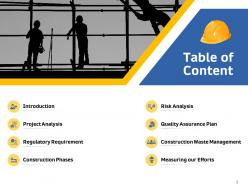
Slide 3: This slide displays Table of Content
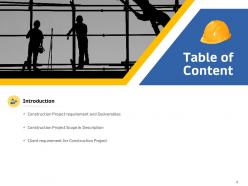
Slide 4: This slide shows Table of Content
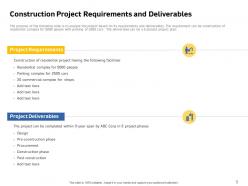
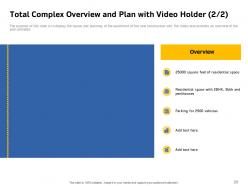
Slide 5: The purpose of the following slide is to analyze the project based on its requirements and deliverables. The requirement can be construction of residential complex for 5000 people with parking of 2500 cars . The deliverable can be a 5 phased project plan.
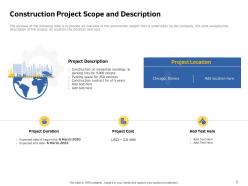
Slide 6: The purpose of the following slide is to provide an overview of the construction project that is undertaken by the company, this slide analyses the description of the project, its location, the duration and cost.
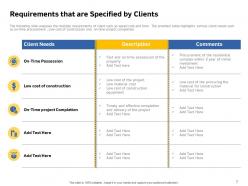
Slide 7: The following slide analyses the multiple requirements of client such as speed cost and time . The provided table highlights various client needs such as on-time procurement , Low cost of construction and on time project completion.
Slide 8: This slide displays Table of Content
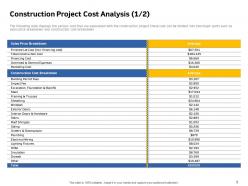
Slide 9: The following slide displays the various cost that are associated with the construction project these cost can be divided into two major parts such as sales price breakdown and construction cost breakdown
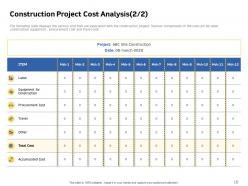
Slide 10: The following slide displays the various cost that are associated with the construction project. Various components of the cost can be labor ,construction equipment , procurement cost and travel cost.
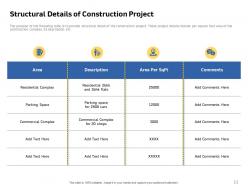
Slide 11: The purpose of the following slide is to provide structural detail of the construction project. These project details include per square feet area of the construction complex, its description etc.
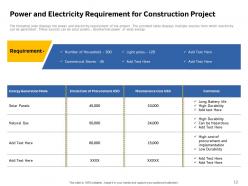
Slide 12: The following slide displays the power and electricity requirement of the project . The provided table displays multiple sources from which electricity can be generated . These sources can be solar panels , Geothermal power or wind energy.
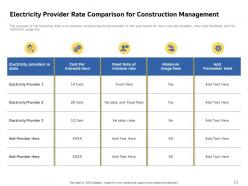
Slide 13: The purpose of the following slide is to compare multiple electricity provider in the area based on the ir cost per kilowatt , their rate flexibility and the minimum usage fee.
Slide 14: This slide displays Table of Content
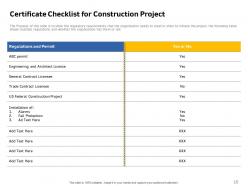
Slide 15: The Purpose of this slide is to show the regulatory requirements that the organization needs to meet in order to initiate the project, the following table shows multiple regulations and whether the organization has them or not.
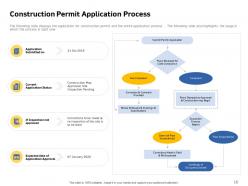
Slide 16: The following slide displays the application for construction permit and the entire application process . The following slide also highlights the stage in which the process is right now.
Slide 17: This slide shows Table of Content
Slide 18: This slide displays Layout and Design for Construction Project.
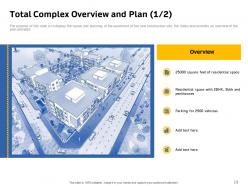
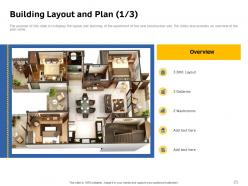
Slide 19: The purpose of this slide is to display the layout and planning of the apartment of the new construction site. The slides also provides an overview of the plan provided.
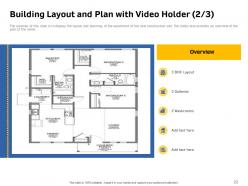
Slide 20: The purpose of this slide is to display the layout and planning of the apartment of the new construction site. The slides also provides an overview of the plan provided.
Slide 21: The purpose of this slide is to display the layout and planning of the apartment of the new construction site. The slides also provides an overview of the plan same .
Slide 22: The purpose of this slide is to display the layout and planning of the apartment of the new construction site. The slides also provides an overview of the plan of the same.
Slide 23: The purpose of this slide is to display the layout and planning of the apartment of the new construction site. The slides also provides an overview of the plan provided.
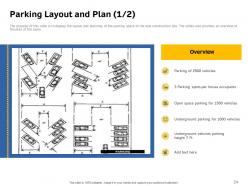
Slide 24: The purpose of this slide is to display the layout and planning of the parking space of the new construction site. The slides also provides an overview of the plan of the same
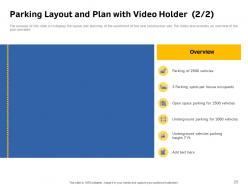
Slide 25: The purpose of this slide is to display the layout and planning of the apartment of the new construction site. The slides also provides an overview of the plan provided.
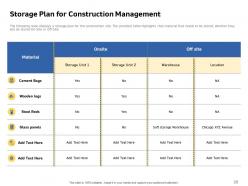
Slide 26: The following slide displays a storage plan for the construction site. The provided table highlights that material that needs to be stored, whether they will be stored On-Site or Off-Site.
Slide 27: This slide highlights Procurement Stage for Construction Management.
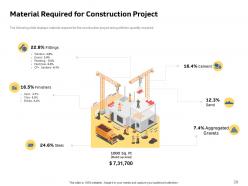
Slide 28: The following slide displays material required for the construction project along with the quantity required.
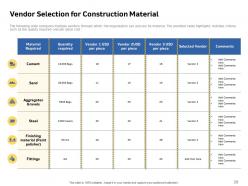
Slide 29: The following slide compares multiple vendors through which the organization can procure its material. The provided table highlights multiple criteria such as the quality required and per piece cost .
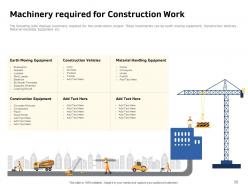
Slide 30: The following slide displays machinery required for the construction project. These machineries can be earth moving equipment, Construction Vehicles , Material Handling Equipment etc.
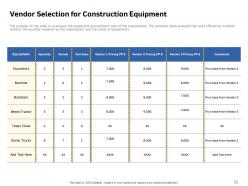
Slide 31: The purpose of this slide is to analyze the equipment procurement plan of the organization. The provided table analyzes the rates offered by multiple vendors the quantity required by the organization and the name of equipment's.
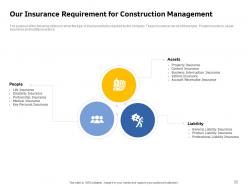
Slide 32: The purpose of the following slide is to show the type of insurance that is required by the company. These insurance can be of three type: People insurance, Asset- insurance and liability insurance.
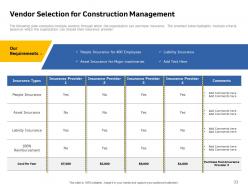
Slide 33: The following slide compares multiple vendors through which the organization can purchase insurance . The provided table highlights multiple criteria based on which the organization can choose their insurance provider.
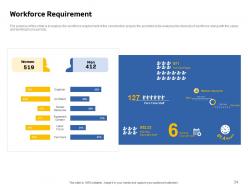
Slide 34: The purpose of this slide is to analyze the workforce requirement of the construction project, the provided slide analyses the diversity of workforce along with the salary and working hours per day.
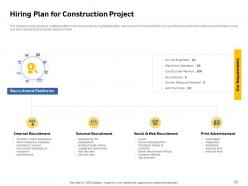
Slide 35: The following slide analysis multiple platforms for recruitment by highlighting the various forms of recruitment such as Internal recruitment, external recruitment, social and web recruitment and print advertisement
Slide 36: This slide displays Construction Phase in Construction Management.
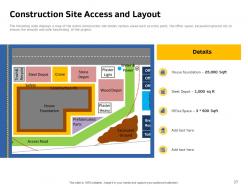
Slide 37: The following slide displays a map of the entire construction site shows various areas such as entry point, the office space, excavation ground etc to ensure the smooth and safe functioning of the project.
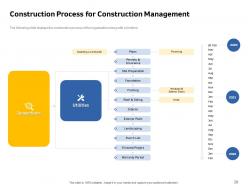
Slide 38: The following slide displays the construction process of the organization along with a timeline.
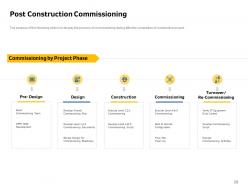
Slide 39: The purpose of the following slide is to display the process of commissioning during after the completion of construction project .
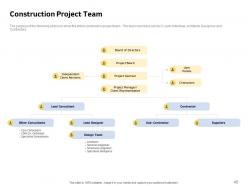
Slide 40: The purpose of the following slide is to show the entire construction project team . The team members can be C Level individual, Architects Designers and Contractors.
Slide 41: This slide shows Table of Content
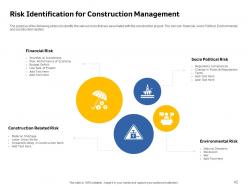
Slide 42: The purpose of the following slide is to identify the various risks that are associated with the construction project. The risk can financial, socio Political, Environmental and construction related.
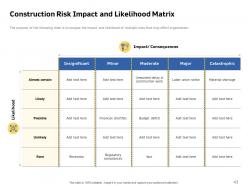
Slide 43: The purpose of the following slide is to analyze the impact and likelihood of multiple risks that may effect organization.
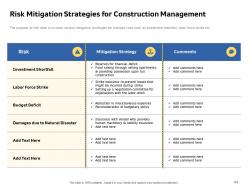
Slide 44: The purpose of this slide is to show various mitigation strategies for multiple risks such as investment shortfall, labor force strike etc.
Slide 45: This slide showcases Table of Content
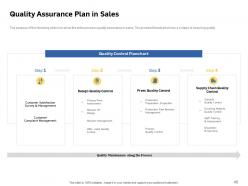
Slide 46: The purpose of the following slide is to show the entire process quality assurance in sales. The provided flowchart shows a 4 steps of ensuring quality.
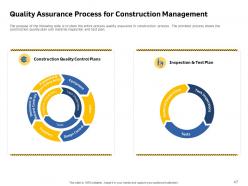
Slide 47: The purpose of the following slide is to show the entire process quality assurance in construction process . The provided process shows the construction quality plan and material inspection and test plan.
Slide 48: This slide shows Table of Content
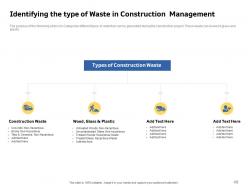
Slide 49: The purpose of the following slide is to Categorize different types of wate that can be generated during the construction project. These waste can be wood,glass and plastic.
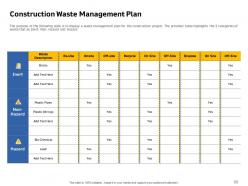
Slide 50: The purpose of the following slide is to display a waste management plan for the construction project. The provided table highlights the 3 categories of waste that ae Inert, Non- Hazard and Hazard.
Slide 51: This slide shows Table of Content
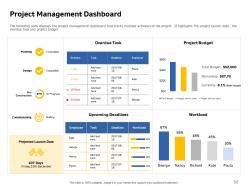
Slide 52: The following slide displays the project management dashboard that tracks multiple activates of the project . It highlights the project launch date , the overdue task and project budget.
Slide 53: This is Infrastructure Project Management Icons Slide
Slide 54: This slide is titled as Additional Slides
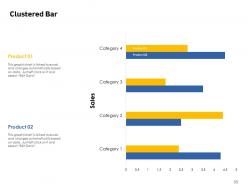
Slide 55: This slide shows Clustered Bar chart for comparison of products.
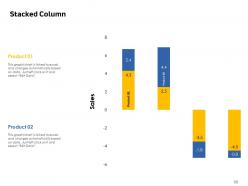
Slide 56: This slide shows Stacked Column chart.
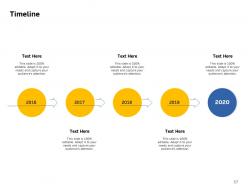
Slide 57: This slide displays Timeline process.
Slide 58: This slide shows Our Mission, Mission and Goals.
Slide 59: This slide is titled as Post It Notes
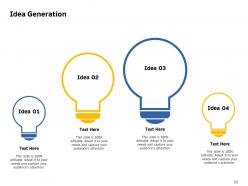
Slide 60: This is Idea Generation slide to highlight important ideas, message.
Slide 61: This slide shows Venn diagram
Slide 62: This is Thank you slide with Contact details.
Infrastructure Project Management Powerpoint Presentation Slides with all 62 slides:
Use our Infrastructure Project Management Powerpoint Presentation Slides to effectively help you save your valuable time. They are readymade to fit into any presentation structure.

FAQs for Infrastructure Project Management
Honestly, those five phases are pretty standard - initiation, planning, execution, monitoring, closure. But infrastructure projects? They're absolute monsters compared to regular stuff. Feasibility studies are crucial upfront since scope creep will destroy your budget fast. I'd spend way more time planning than feels necessary - like, seriously overdo it. Communication becomes your lifeline during execution. Keep contractors, regulators, and the community on the same page or you'll hate yourself later. Monitoring is where projects either crush it or completely fall apart, so get your KPIs sorted early. Trust me on this one.
Honestly, you gotta hit this from multiple angles. Technical stuff first - can you actually pull this off with what's available? Then crunch the financial numbers hard because that's where most projects die. Legal and regulatory bs is a nightmare but you can't ignore it - I've seen that derail entire ventures. Environmental impact studies are usually required too, plus you need to figure out if the community will hate you. The trick is being completely realistic about what could go wrong from day one. Way better to scrap something early than watch it bleed cash for months.
Look, stakeholders are basically your project's lifeline. Government agencies, community groups, contractors, end users - they all want different things and it can get pretty chaotic. But here's the thing: you need to figure out who actually has power versus who just shows up to meetings. Map that out first. Then set up regular check-ins for feedback and getting people on board. The trick is building relationships with key decision-makers way before you need them to sign off on stuff. Don't be that person scrambling for approval at the last minute - been there, not fun.
Start with a solid risk assessment when you're planning - figure out what could blow up your timeline. Weather, supply issues, regulatory stuff, you name it. Rank them by how likely they are and how badly they'd hurt. Then build actual contingency plans, not just wishful thinking. Always pad your timeline and budget because something will go wrong. Here's the thing though - most people write down risks once and never look again. Big mistake. Review them weekly in your project meetings because what seems impossible today might be knocking on your door next month. Trust me on this one.
Honestly, start with a super detailed bottom-up estimate then tack on 10-20% contingency - you're gonna need every penny of it. Break everything into phases so you can actually track where money's going. Update your forecasts monthly with real numbers, not wishful thinking. Scope creep kills more budgets than anything else, so be ruthless about catching it early. For big ticket items, do three-point estimates (best case, realistic, worst case) to get better ranges. Oh and definitely loop in procurement from the start - they actually know what stuff costs in the real world. Set alerts at 80% of each budget category so you can fix things before they're totally screwed.
Look, environmental regs are gonna add approval layers, stretch your timeline, and bump up costs. You'll deal with impact assessments, permits from like 5 different agencies, plus mitigation stuff before you can even start digging. It's annoying but honestly necessary - we've all seen what happens with pipeline disasters. My advice? Factor this into your timeline from the beginning instead of treating it as an afterthought. Start the compliance work early and budget for it properly. Oh, and don't piss off the regulatory people. Seriously, being nice to them will save you so many headaches down the road.
Dude, get Primavera P6 if you can swing it - total game changer for infrastructure work. Yeah, Microsoft Project's cheaper but P6 handles complex scheduling way better. I'd pair it with Smartsheet or Monday.com for tracking crews and equipment. Fair warning though, P6's learning curve is rough. Like, really rough at first. But seriously, once you figure it out you can't imagine doing big projects without it. Oh and build your templates right away - I learned that the hard way. Future you will be so grateful you put in the work upfront.
Look, start with a solid safety plan that hits all the regs - boring but essential. Do regular audits and those daily safety meetings (toolbox talks, whatever you want to call them). The paperwork's a pain in the ass, but trust me, you'll want it if things go sideways. Get your crew properly trained before they handle anything sketchy. Don't let deadlines make you cut corners on safety stuff. Oh, and set up anonymous reporting - workers spot things you won't. My buddy learned that the hard way. Document everything religiously.
Track four main things: does it actually work like you planned, what's the money situation (ROI, maintenance costs), how happy are users, and are you hitting safety standards. Honestly, don't sleep on stakeholder satisfaction - office politics can kill a project faster than technical issues. I'd also watch for any surprise downtime and how actual maintenance costs compare to what you budgeted. Environmental stuff is pretty much required now too. Start collecting data maybe 6-8 months after launch, then check quarterly. Seriously though, set up those dashboards early or you'll hate yourself later.
So BIM is pretty sweet - you can see everything in 3D before construction starts, which catches those annoying design conflicts early. IoT sensors track concrete curing and structural stress in real-time, honestly kind of mind-blowing how detailed the data gets. You'll spot problems way before they turn into money pits. Both reduce delays and help you make decisions based on actual facts instead of hoping for the best. My buddy started with just one small BIM pilot and was sold immediately. Definitely worth trying out.
Start with daily standups - they're clutch for keeping everyone aligned. Then add weekly deep dives where each team shares what's actually happening and where they're stuck. Visual stuff helps tons since engineers and contractors basically speak different languages (seriously, the jargon gap is real). If you've got global teams, rotate those meeting times - nobody wants to be the person always dialing in at 6am. Set up quick channels for random questions too. Oh, and don't make it all top-down - info needs to flow both ways or people just tune out. Pick one thing to try this week and see what happens.
Honestly, local culture and economics control everything about infrastructure projects. What works in Silicon Valley? Total disaster in rural Bangladesh. You've got to factor in labor practices, how communities make decisions, religious stuff, land ownership traditions - all of it. Income levels totally change your timeline and budget too. Regulatory environments are completely different depending on where you're working. Oh, and political development matters way more than people think. Do stakeholder mapping right away and build in extra time for community meetings. Trust me, it'll save you so much trouble down the road.
Oh man, stakeholder management is brutal. Everyone thinks their priorities should come first - government wants compliance boxes checked, communities don't want construction noise, contractors are chasing profit margins, environmental folks push for green everything. Honestly feels like babysitting sometimes. What works for me is figuring out early who actually matters and what they REALLY want (not what they say in meetings). Create regular check-ins so people can vent before things explode. Also, definitely set communication rules upfront or you'll spend half your time putting out fires instead of making progress.
Look, sustainability isn't optional anymore - it shapes everything from where you build to what materials you pick. Environmental assessments are mandatory now. Most clients expect LEED certification or similar green standards, which honestly makes sense given operating costs over 50+ years. Yeah, upfront expenses are steeper, but you're planning for climate resilience and way lower carbon footprints. Energy systems, waste management - it all connects. Find good sustainability consultants ASAP though. They'll help navigate permitting headaches and catch stuff you'd probably miss. Trust me on that one.
Honestly, scope creep kills these projects every single time. Boston's Big Dig? Berlin airport disaster? Same story - they kept changing what they wanted halfway through and budgets went insane. Denmark nailed their Great Belt Bridge because they figured out exactly what they wanted upfront and stuck to it. Most teams also lowball the complexity by like 30-50%, which is nuts. Planning feels boring but you'll thank yourself later. Oh, and don't let stakeholders turn your project into their personal Amazon cart - that's where everything falls apart.
-
Great product with effective design. Helped a lot in our corporate presentations. Easy to edit and stunning visuals.
-
Commendable slides with attractive designs. Extremely pleased with the fact that they are easy to modify. Great work!
-
Wonderful templates design to use in business meetings.
-
Unique design & color.