

Project Management Training It Powerpoint Presentation Slides




Try Before you Buy Download Free Sample Product
 Impress Your
 Audience
 100%
100% Editable
 Save Hours
 of Time


Project managers require an effective plan, manage, execute, and control projects to deliver successful projects in an organization. This deck is a company profile for project management courses and certifications. We have showcased an institute overview that focuses on the institutions history, mission vision, management structure, courseware, and valuable customers. Here is a professionally designed template on Project Management Training IT that will present key points on the objectives and benefits of PMP courses and different certifications offered by our company. The project management timeline and costs are covered in this PowerPoint template. Reasons for choosing our institute for project management training are discussed in this module. This learning approach will enhance the ability of the participants to work well in their companies and improve their skills and boost their knowledge. Talk to our research team to customize the project management ppt templates based on needs and book a free demo with our experienced and influential expert team. Download our 100 percent editable template and get access now.
People who downloaded this PowerPoint presentation also viewed the following :
Content of this Powerpoint Presentation
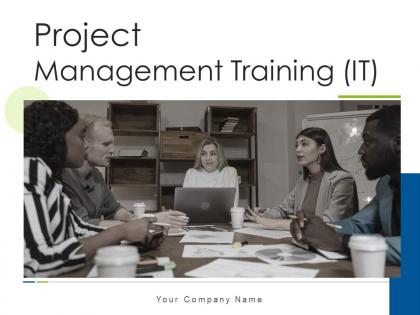
Slide 1: This slide displays the title i.e. 'Project Management Training (IT)' and your Company Name.
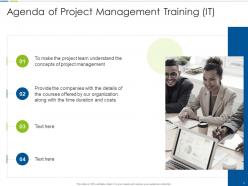
Slide 2: This slide presents the agenda for the project.
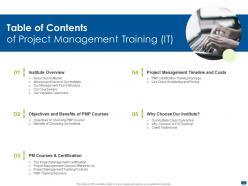
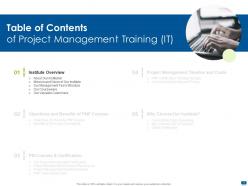
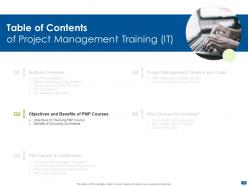
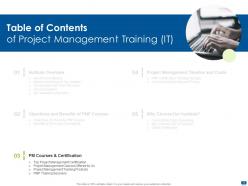
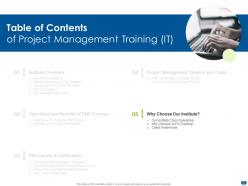
Slide 3: This slide exhibits the table of contents for the project.
Slide 4: This slide shows the title for institute overview.
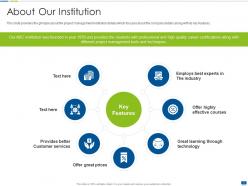
Slide 5: This slide provides the glimpse about the project management institution details which focuses about the company details along with its key features.
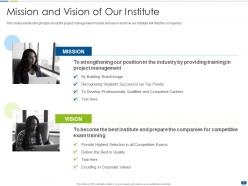
Slide 6: This slide provides the glimpse about the project management mission and vision and how our institute will help the companies.
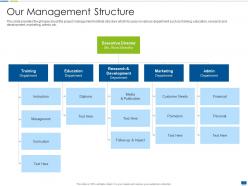
Slide 7: This slide explains project management institute structure which focuses on various department such as education, research and development, marketing, admin, etc.
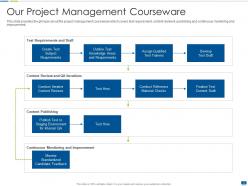
Slide 8: This slide provides the glimpse about the project management courseware which covers content review & publishing and continuous monitoring and improvement.
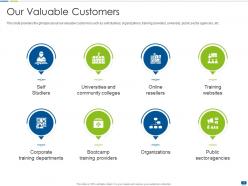
Slide 9: This slide provides the glimpse about our valuable customers such as self studiers, organizations, training providers, university, public sector agencies, etc.
Slide 10: This slide displays the title for objectives and benefits of PMP courses.
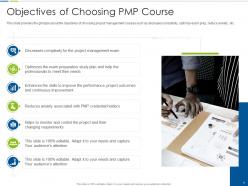
Slide 11: This slide provides the glimpse about the objectives of choosing project management courses such as decreases complexity, optimize exam prep, reduce anxiety, etc.
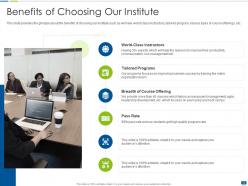
Slide 12: This slide shows benefits of choosing our institute such as we have world class instructors, tailored program, various types of course offerings, etc.
Slide 13: This slide exhibits the title for PM Courses & Certifications.
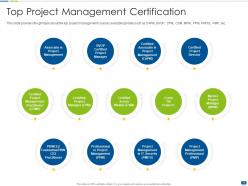
Slide 14: This slide provides the glimpse about the top project management courses available globally such as CAPM, BVOP, CPM, CSM, MPM, PPM, PMITS, PMP, tec.
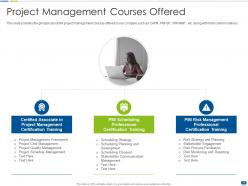
Slide 15: This slide provides the glimpse about the project management courses offered by our company such as CAPM, PMI-SP, PMI-RMP, etc. along with their content outlines.
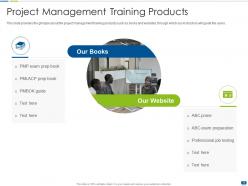
Slide 16: This slide provides the glimpse about the project management training products such as books and websites, through which our instructors will guide the users.
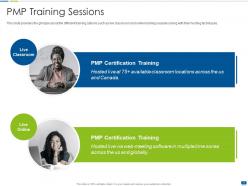
Slide 17: This slide provides the glimpse about the different training options such as live classroom and online training sessions along with their hosting techniques.
Slide 18: This slide shows the title for PM Timeline & Costs.
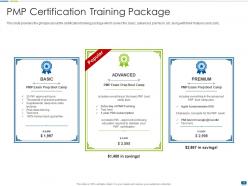
Slide 19: This slide provides the glimpse about the certification training package which covers the basic, advanced, premium, etc. along with their features and costs.
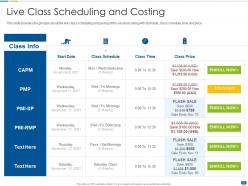
Slide 20: This slide provides the glimpse about the live class scheduling and pricing of the sessions along with start date, class schedule, time and price.
Slide 21: This slide displays the title for reasons of choosing our institute.
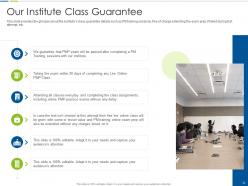
Slide 22: This slide explains institute’s class guarantee details such as PM training sessions, free of charge extending the exam prep if failed during first attempt, etc.
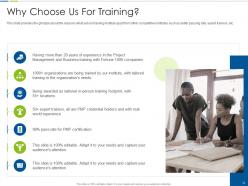
Slide 23: This slide shows reasons what set our training institute apart from other competitive institutes such as better passing rate, expert trainers, etc.
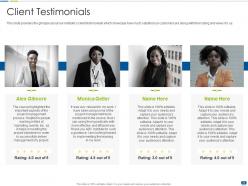
Slide 24: This slide provides the glimpse about our institute’s client testimonials which showcase how much satisfied our customers are along with their rating and views for us.
Slide 25: This is the icons slide for the project.
Slide 26: This slide displays the title for additional slides.
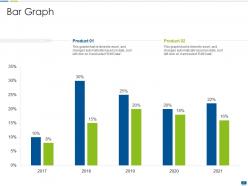
Slide 27: This slide presents the bar graphs for different products. The charts are linked to Excel.
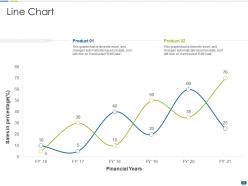
Slide 28: This slide presents the line chart for different products. The charts are linked to Excel.
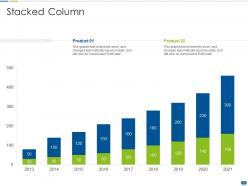
Slide 29: This slide presents the stacked column chart for different products. The charts are linked to Excel.
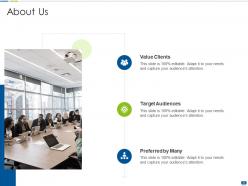
Slide 30: This slide shows about the company, target audience and its client's values.
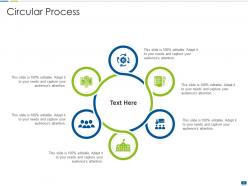
Slide 31: This slide presents the circular process of your company.
Slide 32: This slide showcases the posts related to past experiences of clients.
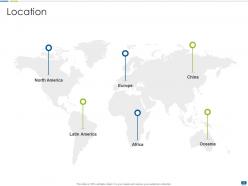
Slide 33: This slide exhibits the location of the company across the globe.
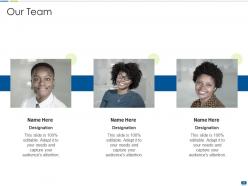
Slide 34: This slide presents details of the team members responsible for the project.
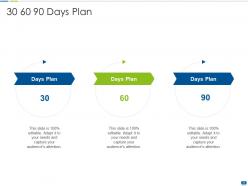
Slide 35: This slide displays the 30-60-90 days plan for your project.
Slide 36: This slide presents the goals of your company.
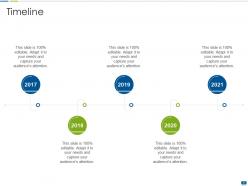
Slide 37: This slide exhibits the yearly timeline of the company.
Slide 38: This is the thank you slide and displays the contact details of the company i.e. office address, contact number, etc.
Project Management Training It Powerpoint Presentation Slides with all 38 slides:
Use our Project Management Training It Powerpoint Presentation Slides to effectively help you save your valuable time. They are readymade to fit into any presentation structure.
FAQs for Project Management Training It
Honestly, start with communication - that's where most PMs either kill it or completely fail. Time management and risk assessment matter too, but if you can't explain what's going on, you're screwed. Stakeholder management is basically keeping everyone happy while still getting work done (harder than it sounds). You'll also need leadership skills since you're managing people who don't actually report to you, which is... fun. Problem-solving's huge because fires pop up constantly. Oh, and learn Agile or Waterfall - the technical stuff matters. But seriously, nail communication first.
Honestly, PM training is a game changer for teams. Everyone finally speaks the same language instead of talking past each other constantly. People actually understand who's supposed to do what (huge relief). When something inevitably goes wrong, there's way less drama and blame games. Your team starts seeing how their work connects to everyone else's, so they collaborate before problems hit. Oh, and meetings don't suck as much when people know the process. I'd start with basic certification for your leads - don't overwhelm everyone at once.
Honestly, I'd stick with the big three: Agile, Waterfall, and hybrid stuff. Agile's everywhere now - half the companies claiming they do it are basically faking it though lol. Make sure you cover Scrum and Kanban under the Agile umbrella. Waterfall still matters for regulated industries that can't mess around. Lean and Six Sigma are solid additions if you're doing process improvement work. But here's the thing - don't just teach how each one works. Focus on when to actually use them. Different projects need different approaches, you know? Throw in some case studies where people have to pick the right method. That's where it gets real.
Honestly, tech tools are a game-changer for PM training. You can mess around with simulation software instead of sitting through boring lectures - way better for actually learning stuff. Collaboration platforms let you do real team projects, and those mobile apps are clutch for reviewing concepts when you're waiting for coffee or whatever. VR training is super impressive but still costs a fortune unfortunately. The whole point is getting your hands dirty with actual project management instead of just memorizing theory. Find programs that let you play around with these tools. You'll remember so much more and won't feel lost when you start managing real projects.
Look, certifications are basically your way of proving you know what you're doing in PM. PMP is the big one everyone recognizes, but CAPM or Agile certs work too depending on where you're at. Do they actually make you better at the job? That's debatable. But here's the thing - tons of job postings require them now, and they usually bump your salary. My cousin got his PMP last year and immediately started getting way more interview calls. If you're thinking about it, just pick whichever one matches your experience level and dive in.
Honestly, just bake the soft skills right into real project scenarios instead of treating them like separate classes. Role-playing feels super weird initially, but it actually works really well. Have them practice those brutal stakeholder conversations - you know, telling sponsors they're over budget or dealing with clients who keep changing scope. Mock conflict resolution is gold too. I'd throw in communication workshops where they rehearse the hard stuff they'll definitely encounter. The trick is tying each skill to actual PM problems they'll face later. Way better than just theory by itself.
Honestly, don't just rely on those post-training surveys - they're pretty useless if nothing changes afterward. Track the real stuff: are people actually behaving differently 30-90 days later? Better project outcomes matter way more than "great session!" feedback. I learned this the hard way - got amazing reviews once but performance stayed totally flat. Check in with both participants and their managers regularly. See what habits are actually sticking. The key thing? Tie everything back to those business goals you set up front. That's your proof it worked.
Look at your biggest project disasters first - that'll show you exactly what training you actually need. Healthcare? Focus on compliance and risk stuff. Tech companies should hit agile methods hard. Construction needs safety protocols like crazy. Honestly, most generic project management courses are mind-numbing and people forget everything immediately. Find trainers who actually get your industry - they can pull real examples that'll actually stick. Oh and definitely customize everything around your specific regulatory headaches. Makes such a difference when the scenarios feel relevant to what you're dealing with every day.
Dude, ditch the boring lectures and throw in some real case studies instead. Gamification works surprisingly well - like point systems or team challenges around hitting milestones. I'd definitely try role-playing where people swap between being the PM and those nightmare stakeholders we all know and love. VR's getting cheaper for scenario training too, though that might be overkill depending on your budget. Collaborative tools are solid for remote teams working mock projects together. Honestly, just pick one method and test it next quarter - bet your engagement scores will crush the old lecture format.
Look, the PM world changes crazy fast - new tools, methodologies, whatever. If you're not learning constantly, you'll be stuck using stuff that doesn't work anymore. I've seen this happen to people who coast. The really good PMs I know? They soak up lessons from every project, especially other people's failures (way easier than learning the hard way yourself). Each thing you pick up builds on what you already know, so your skills compound over time. Honestly, just pick one new PM concept to dig into this month and start there.
Honestly, getting people to show up is the hardest part. Everyone's already drowning in their regular work. Budget's always tight too, especially for outside trainers. You'll hit that "we've always done it this way" wall with some folks - drives me crazy but it's predictable. Leadership support makes or breaks it though. Without that, it just feels like another box-checking exercise nobody cares about. Start with whoever's actually interested first. Let those wins do the convincing for you instead of forcing it on everyone right away.
Honestly, just use Zoom or Teams for live stuff, but don't forget async options too since everyone's got crazy schedules. Break it down into like 30-minute chunks - nobody wants to sit through marathon training sessions anymore. Record everything though, trust me on that one. Miro's great for making it interactive instead of just talking at people for an hour. Oh, and if you've got people scattered across time zones (which, who doesn't these days?), you'll probably need multiple session times. Set up some kind of shared space where they can bug you with questions later. Mix of live and recorded works best - covers all the different ways people actually learn.
Honestly, I'd just focus on PMI's CEUs first - you need those anyway for renewal. LinkedIn Learning has decent PM courses you can do over lunch. ProjectManagement.com is clutch for staying updated, their case studies are way better than most formal training tbh. Your local PMI chapter probably does workshops and networking stuff too, which is gold for real-world tips. Maybe spend an hour weekly on articles or quick courses? Oh and try hitting up one in-person event every few months. That face-to-face networking really makes a difference when you're trying to level up.
Dude, case studies are seriously underrated for PM training. Your team gets to dig into real situations without any of the actual stress or fallout. What I love about them is you can pick apart the bad decisions AND figure out why someone thought it was a good idea at the time. Way better than sitting through another PowerPoint about methodology, honestly. Just make sure you're picking scenarios that actually match what your people deal with day-to-day. Then let everyone argue about what they would've done differently. Trust me, throw one into your next session for like 15 minutes and watch how much more people actually participate.
Dude, get a mentor if you can. Having someone experienced walk you through real PM situations beats any textbook by miles. They'll show you how to handle crazy stakeholders and blown deadlines - trust me, that stuff happens constantly. What really helps is hearing their actual stories from the trenches, you know? Plus they spot mistakes you'd never see coming and give you the guts to make hard decisions. Even if your program doesn't officially pair you up, find someone informally. It's honestly the fastest way to get good at this stuff.
-
I discovered this website through a google search, the services matched my needs perfectly and the pricing was very reasonable. I was thrilled with the product and the customer service. I will definitely use their slides again for my presentations and recommend them to other colleagues.
-
Illustrative design with editable content. Exceptional value for money. Highly pleased with the product.
-
Editable templates with innovative design and color combination.
-
The Designed Graphic are very professional and classic.