


Insurance Company Value Chain Mapping




Try Before you Buy Download Free Sample Product
 Impress Your
 Audience
 100%
100% Editable
 Save Hours
 of Time


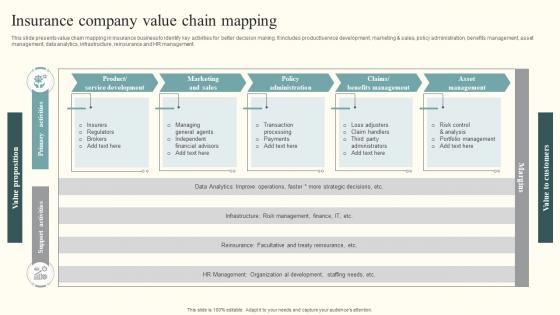
This slide presents value chain mapping in insurance business to identify key activities for better decision making. It includes product service development, marketing and sales, policy administration, benefits management, asset management, data analytics, infrastructure, reinsurance and HR management.
People who downloaded this PowerPoint presentation also viewed the following :
Insurance Company Value Chain Mapping with all 6 slides:
Use our Insurance Company Value Chain Mapping to effectively help you save your valuable time. They are readymade to fit into any presentation structure.





FAQs for Insurance Company
So there's basically five parts to how insurance companies work. First you've got product development - they figure out what to actually sell. Marketing and distribution gets those products out there through agents or whatever. Then underwriting does the risk stuff (honestly the trickiest part) - deciding who gets coverage and what they'll pay. Claims management handles when people actually need payouts. Customer service keeps everyone happy throughout. If you're trying to fix problems in the system, I'd start by figuring out which piece is most broken first. Don't try to tackle everything at once.
Look, underwriting is basically your whole operation's backbone. Get it right and everything flows smoothly - fewer claims headaches, better pricing, less chaos down the line. Data analytics help underwriters make faster decisions without sacrificing quality, which honestly makes a huge difference. But screw up the risk assessment? You're gonna deal with claim disasters and profit issues everywhere. I'd focus on automating the boring stuff first - routine decisions that bog people down. Then invest in better risk modeling tools. Trust me, it saves you so much pain later.
Dude, insurance tech is moving crazy fast right now. AI's handling risk assessment automatically, chatbots are doing customer service, and IoT devices are feeding real-time data for better pricing. The whole customer experience is getting streamlined through digital platforms. Honestly, the speed thing is huge - you can make decisions way faster and cut costs while personalizing products for each customer. My cousin works at State Farm and says they're scrambling to keep up lol. If you haven't started mapping out where this stuff fits into your operations, now's definitely the time to figure it out.
Honestly, data analytics is a game-changer for insurance. You can customize pricing and claims based on what each customer actually needs - makes them feel heard, you know? Predicting coverage before they ask, speeding up quotes so people aren't sitting around forever, catching fraud early to keep costs down. Weather alerts are huge too - nothing builds trust like a heads-up text before a storm hits. The trick is getting ahead of problems instead of playing catch-up all the time. I'd start by figuring out where your process currently sucks for customers, then see what data might fix those headaches.
Ugh, where do I even start? Data silos are the worst - your underwriting people are looking at completely different info than claims, so nobody's on the same page. Then you've got all these old systems that basically refuse to work together. Don't get me started on compliance stuff that changes depending on what state you're in. Customers want everything instantly now, but your backend is still stuck in 2015. Integration costs will make you cry. Honestly, just pick ONE thing to fix first and make sure everyone's actually on board before you try to rebuild Rome in a day.
Look, customer engagement totally changes your insurance game at every level. Product dev gets way better when people actually tell you what they want instead of guessing. Your underwriting becomes cleaner with better risk data. Sales? Way easier when customers don't think you're trying to scam them - trust me on that one. Claims processing goes so much smoother too since happy customers won't fight you on everything. Plus engaged customers stick around longer and bring their friends. Oh, and definitely track your engagement numbers at each step so you can spot where you're bleeding customers.
Honestly, it's all about customer expectations right now - everyone wants everything instantly and personalized. AI is completely changing how underwriting and claims work, which is wild to see. IoT devices are feeding insurers real-time data they could only dream of before. Traditional companies are getting destroyed by digital-first startups with slick mobile apps. Regulations keep pushing for more transparency too. The embedded insurance trend is massive - people buying coverage right at checkout when they actually need it. My advice? Find the biggest pain point in your customer experience and fix that first. Start there.
So when new regulations drop, it's basically chaos for a while. Insurers have to tweak their underwriting rules. Sales teams scramble to figure out new product guidelines. Claims people are updating their whole workflow - honestly, nobody's having fun at first. Compliance costs spike everywhere, though sometimes the new rules actually make things smoother between companies (weird, right?). The smart move? Keep an eye on what's coming down the pipeline so you're not scrambling last minute. Way better to prep your team early than get caught off guard.
Honestly, just focus on three main things: automation, integration, and data analytics. Automate the boring stuff first - claims processing, underwriting, policy renewals. The ROI is usually decent on that. Then get your systems talking to each other so data actually flows between departments instead of creating those ridiculous silos. I'd use predictive analytics to spot where things get stuck and fix resource allocation. Oh, and here's what I'd do - find the ONE process that's making everyone miserable right now and digitize that first. Makes for a good proof of concept, plus you'll actually see results people care about.
Risk management touches literally every part of insurance - it's everywhere. Underwriters use it for pricing, actuaries build those predictive models, claims teams spot fraud patterns. Marketing even thinks about risk when they're targeting customers (makes sense, you don't want to attract every terrible driver out there). The cool thing is how risk data constantly moves between all these teams. It's like this continuous feedback loop. So whenever you're working on anything, just think about how it affects the company's overall risk exposure. That mindset will serve you well.
Look, insurance companies can't do everything themselves anymore - it's just not realistic. Startups handle the tech innovation, other companies deal with all the claims headaches, and you need distribution partners to actually reach customers. Data providers give you the risk insights too. Think of it like... I don't know, everyone's got their specialty and you piece it together. The companies with the best partner networks end up with better products and can move way faster. Honestly, costs go down too when you're not trying to build everything in-house. So whenever you're looking at insurance stuff, just map out who the key players are.
Honestly, AI can help with basically everything in insurance. Claims processing is probably your best starting point - it's a pretty easy win since AI can handle simple claims automatically and catch fraudulent ones. Underwriting gets way more efficient too, spotting risk patterns that humans might overlook. Customer service bots aren't amazing yet but they're decent for basic stuff. Product development benefits from AI analyzing market gaps and pricing data. My advice? Pick one area where your data's clean and you can actually measure results. Claims is usually the safest bet to start with.
Look, claims processing is where you either win customers for life or totally screw things up. People filing claims are already stressed - car accidents, medical stuff, house damage, whatever. Fast, empathetic handling builds crazy loyalty and gets you referrals. Mess it up though? Good luck with those one-star reviews haunting you forever. Clear communication is huge, plus actually hitting your promised timelines. Honestly, most companies drop the ball here, so if you nail these basics you'll stand out. Happy claimants stick around and tell their friends - it's that simple.
So distribution channels basically control how you reach customers, and honestly everything else flows from that choice. US insurers love their agent networks - expensive but people get hand-holding. Companies like Lemon went full digital instead, which means simpler products and lower costs. Emerging markets? They're doing bancassurance or mobile since they don't have all that legacy infrastructure weighing them down. Your channel choice literally dictates your product design and cost structure, so figure out how your customers actually want to buy first, then build around that.
Look, start with your combined ratio - that's the make-or-break number showing if you're actually profitable. Then track acquisition costs versus conversion rates for distribution stuff. Loss ratios tell you if underwriting is on point. Claims processing speed matters too, plus customer satisfaction scores obviously. Honestly, customer lifetime value compared to what you spend acquiring them is huge but gets overlooked sometimes. Oh, and operational efficiency like straight-through processing rates - boring but necessary. Don't get buried in tons of metrics though. Pick maybe 3-5 that actually match what you're trying to accomplish. Way better than tracking everything and understanding nothing.
-
Illustrative design with editable content. Exceptional value for money. Highly pleased with the product.
-
I looked at their huge selection of themes and designs. They appeared to be ideal for my profession. I'm sure I'll grab a few of them.