


Integrated Facilities Management Services Powerpoint Presentation Slides




Try Before you Buy Download Free Sample Product
 Impress Your
 Audience
 100%
100% Editable
 Save Hours
 of Time


Experience our professionally designed Integrated Facilities Management Services presentation, which focuses on the crucial role of facilities management. It ensures the functionality, safety, and sustainability of properties, grounds, infrastructure, and real estate. Our Outsource Facility Management Services deck provides an overview of our FM company. It includes the organizations presence, organizational structure, and revenue breakdown. Additionally, our Facilities Management PPT explores the growth trends and SWOT analysis of the FM industry. It also highlights the importance of FM services, presents wide range of services including hard and soft FM, cleaning, building management, waste management, and security services. Additionally, our Facility Management Company module emphasizes stakeholder engagement, financial responsibility, KPIs, and facility management dashboards. Gain instant access to this invaluable resource.
People who downloaded this PowerPoint presentation also viewed the following :
Content of this Powerpoint Presentation
Slide 1: This slide introduces Integrated Facilities Management Services. Mention your Title here.
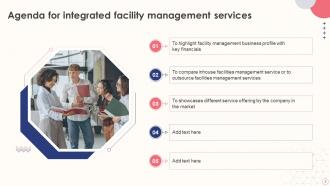
Slide 2: This slide depicts the Agenda of the presentation.
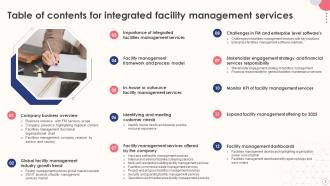
Slide 3: This slide includes the Table of contents.
Slide 4: This slide highlights the Title for the Topics to be discussed further.
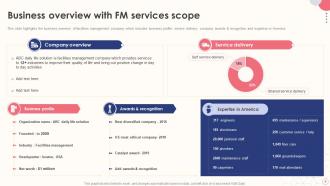
Slide 5: This slide highlights the business overview of facilities management company.
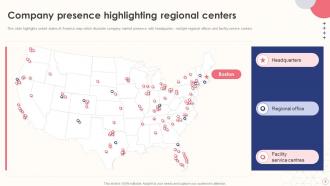
Slide 6: This slide reveals the Company presence highlighting regional centers.
Slide 7: This slide exhibits the Facilities management functional organizational chart.
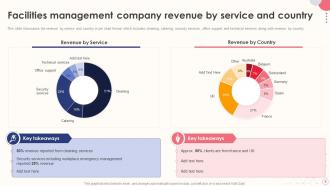
Slide 8: This slide showcases the revenue by service and country in pie chart format.
Slide 9: This slide indicates the Heading for the Contents to be covered in the upcoming template.
Slide 10: This slide highlights the facility management services market share and future growth rate in graphical format.
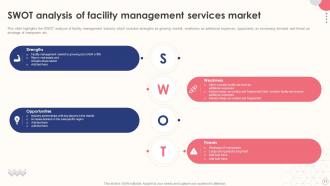
Slide 11: This slide reveals the SWOT analysis of facility management services market.
Slide 12: This slide states the Title for the Ideas to be discussed in the next template.
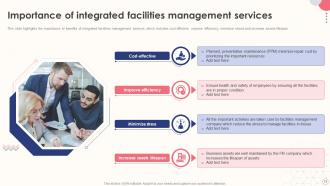
Slide 13: This slide reveals the Importance of integrated facilities management services.
Slide 14: This slide includes the Heading for the Ideas to be covered in the upcoming template.
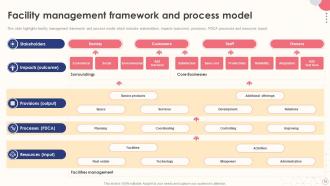
Slide 15: This slide highlights facility management framework and process model.
Slide 16: This slide contains the Title for the Contents to be discussed next.
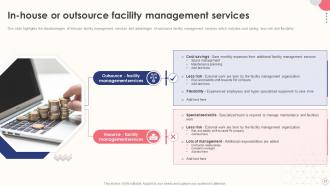
Slide 17: This slide states the disadvantages of Inhouse facility management services and advantages of outsource facility management services.
Slide 18: This slide indicates the Heading for the Topics to be covered in the upcoming template.
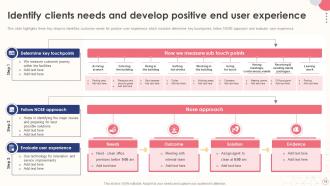
Slide 19: This slide highlights three key steps to identifies customer needs for positive user experience.
Slide 20: This slide indicates the Title for the Contents to be discussed next.
Slide 21: This slide states the different facilities management solutions or services offered by the company.
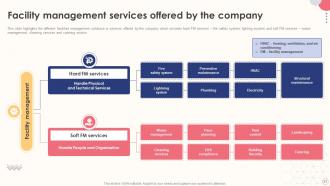
Slide 22: This slide shows the Hard and soft facility management services.
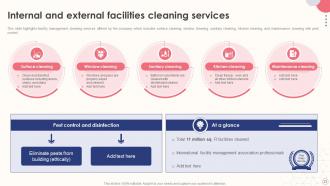
Slide 23: This slide highlights facility management cleaning services offered by the company.
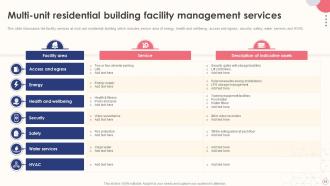
Slide 24: This slide portrays the Multi-unit residential building facility management services.
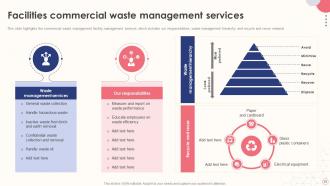
Slide 25: This slide exhibits the Facilities commercial waste management services.
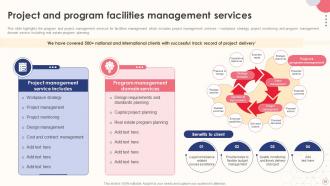
Slide 26: This slide presents the program and project management services for facilities management.
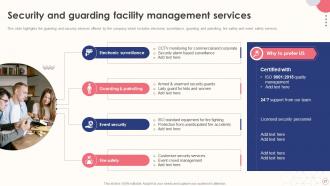
Slide 27: This slide reveals the guarding and security services offered by the company.
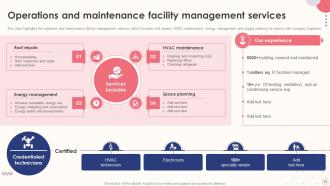
Slide 28: This slide indicates the Operations and maintenance facility management services.
Slide 29: This slide shows the Heading for the Topics to be covered further.
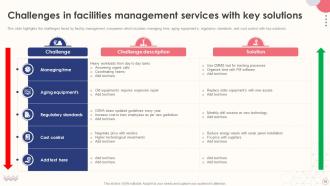
Slide 30: This slide depicts the Challenges in facilities management services with key solutions.
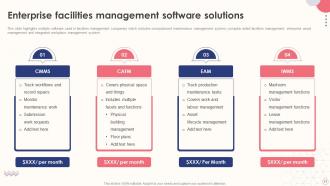
Slide 31: This slide highlights multiple software used in facilities management companies.
Slide 32: This slide portrays the Title for the Topics to be discussed next.
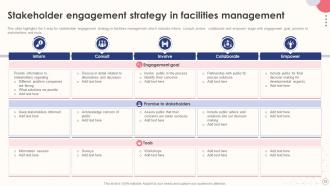
Slide 33: This slide outlines the 5 step for stakeholder engagement strategy in facilities management.
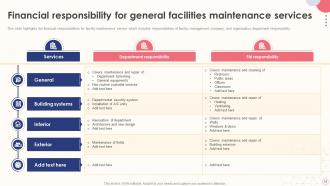
Slide 34: This slide highlights the financial responsibilities for facility maintenance.
Slide 35: This slide includes the Heading for the Contents to be covered in the upcoming template.
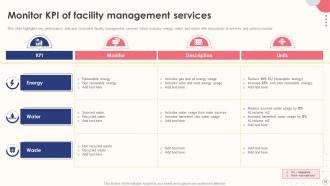
Slide 36: This slide highlights key performance indicator to monitor facility management services.
Slide 37: This slide states the Title for the Ideas to be discussed next.
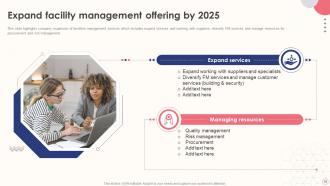
Slide 38: This slide aims to Expand working with suppliers and specialists.
Slide 39: This slide portrays the Heading for the Ideas to be covered in the upcoming template.
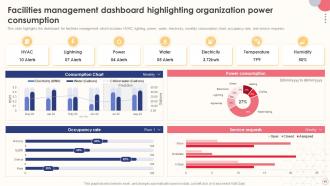
Slide 40: This slide highlights the dashboard for facilities management.
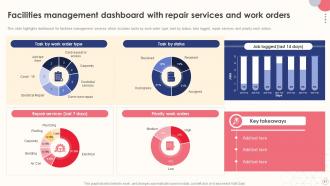
Slide 41: This slide states the Facilities management dashboard with repair services and work orders.
Slide 42: This is the Icons slide containing all the Icons used in the plan.
Slide 43: This slide is used for depicting some Additional information.
Slide 44: This slide contains the Post it notes for reminders and deadlines.
Slide 45: This is Our team slide. State your team-related information here.
Slide 46: This slide incorporates the company's mission, vision, and goals.
Slide 47: This slide elucidates the organization's Timeline.
Slide 48: This is the Puzzle slide with related imagery.
Slide 49: This slide represents the Roadmap of the company.
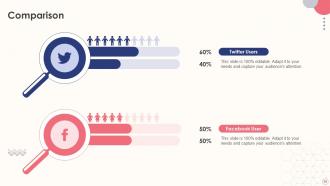
Slide 50: This slide is used for the purpose of Comparison.
Slide 51: This is the Thank you slide for acknowledgement.
Integrated Facilities Management Services Powerpoint Presentation Slides with all 56 slides:
Use our Integrated Facilities Management Services Powerpoint Presentation Slides to effectively help you save your valuable time. They are readymade to fit into any presentation structure.













FAQs for Integrated Facilities Management Services
So basically IFM bundles all your facility stuff - maintenance, cleaning, security, catering, space management. Energy and waste management usually get tossed in too, sometimes IT support. Way easier than dealing with like five different vendors honestly. One team handles everything so nothing gets forgotten or screwed up. Most packages come with reporting and compliance stuff built in. Oh and definitely figure out what services you actually need first - my old company paid for catering management when we barely had a break room lol. Makes the vendor conversations way more productive.
So basically IFM means one company handles everything - cleaning, maintenance, security, food service, all of it. Way easier than juggling like five different vendors who never talk to each other. Your team stops wasting hours playing phone tag between contractors or figuring out whose fault it is when something breaks (and trust me, there's always blame going around). The data actually flows between systems too, so you can predict issues before they happen. Best part though? Your facilities people can finally work on bigger picture stuff instead of constantly firefighting random problems that pop up daily.
Honestly, IFM is pretty brilliant for sustainability stuff. Managing everything under one roof means you can actually coordinate between systems instead of having each department do their own thing. So your HVAC scheduling works with smart lighting, waste programs align with water conservation - that kind of integration you can't get otherwise. The data tracking is where it gets really interesting though. When your FM team can see patterns across all these areas together, they'll catch inefficiencies that would totally fly under the radar before. I'd definitely ask your IFM provider about their sustainability dashboard first - see what baseline metrics they're already pulling for your building.
Dude, tech is what makes IFM actually work these days. IoT sensors track your HVAC and occupancy stuff, CMMS handles maintenance schedules, and dashboards show you everything in real time. Without it, coordinating cleaning, security, and space management would be a nightmare - honestly can't picture going back. The predictive analytics part is huge too, saves you from those expensive emergency repairs. My advice? Figure out what's driving you crazy operationally first, then find solutions that'll actually play nice with whatever systems you've already got running.
So data analytics basically gives you superpowers for facility management. Your HVAC systems? You'll know they're about to crap out weeks before it happens. No more surprise breakdowns or wild guessing games. You can track how people actually use spaces, cut energy waste, and find ways to save money you didn't even know existed. It's honestly pretty cool once you see it working. My advice - pick one thing you already have decent data on and start there. Prove it works, then expand. Way easier than trying to do everything at once.
Oh man, the change resistance is brutal - every department thinks they know best and nobody wants to adjust their workflow. Data silos are another nightmare since facilities, IT, and ops barely talk to each other. Budget's always tight too, especially for new tech platforms. Honestly though? Start with small pilot programs instead of going big right away. Get some quick wins under your belt first - that momentum really helps when you're trying to convince the skeptics. Once you have stakeholder buy-in, the system integration becomes way more manageable.
IFM makes a massive difference for employee happiness - basically everything just works better. Your IT, security, and facilities teams actually talk to each other, so problems get fixed way faster. Trust me, nothing tanks morale like waiting three weeks for someone to fix the AC or dealing with printers that hate everyone. When all these services are coordinated, people don't waste time on annoying workplace stuff. They can focus on their actual jobs instead of playing maintenance request roulette. The whole office vibe improves because employees feel like the company's got their back. It's honestly one of those behind-the-scenes things that makes a huge impact.
Track cost per square foot, energy spend, and work order response times - those are your core metrics. Employee satisfaction is honestly the most telling one though, because people complain fast when stuff's broken. Also watch asset uptime and how much of your preventive maintenance you're actually completing (spoiler: it's probably less than you think). Space utilization rates matter too if you're trying to optimize footprint. Don't go crazy with like 15 different metrics or you'll drown in spreadsheets. Pick 5-6 max and set up a monthly dashboard to see trends over time.
So basically IFM puts all your facility stuff under one roof - one system, one provider handling everything. Instead of scrambling to fix things when they break, you get predictive maintenance that actually prevents problems. Way cheaper in the long run. Buying in bulk through one provider gets you better deals on supplies and repairs too. Honestly, the best part is having all your data consolidated so you can actually see patterns and avoid scheduling disasters. No more overlapping work or missing maintenance windows. I'd start by looking at your current vendor contracts - bet you'll find tons of redundancy you can cut.
Honestly, I'd look at three main things. Check their track record first - get actual case studies from companies your size and call those references yourself. Their tech matters too since you'll be stuck with their systems every day. Make sure it plays nice with what you already have and gives you real-time data. The staffing thing is huge though - some companies oversell then dump junior people on your account. Find out exactly who's running your facilities day-to-day. Visit their other sites if you can swing it.
So IFM is basically your backup for staying compliant - it puts all your regulatory stuff in one place instead of having it scattered everywhere. You'll get automatic reminders for inspections and permit renewals, which honestly saves so much headache. The workflows are pretty solid too, nothing gets forgotten. What I really like is having everything from fire safety to environmental regs on one dashboard. Makes audits way easier since it logs everything automatically. I'd start by figuring out what compliance tasks you have now, then see which ones IFM can handle first.
So IFM and asset management work hand in hand, but they handle different pieces. Asset management is all the big picture stuff - what to buy, sell, how your portfolio's performing financially. IFM deals with the nitty-gritty operations that keep your buildings actually functional day-to-day. Here's how I think about it: asset managers make the strategic calls, while IFM prevents everything from breaking down once you own it. The cool part is your operational data from IFM should feed back into those bigger investment decisions. Just don't track metrics for the sake of it - focus on what actually matters for your strategy.
Honestly, weekly check-ins with IT, HR, and operations are a game-changer - those "quick syncs" prevent so many fires later. Get your facilities team on Slack or Teams where everyone can actually see what's happening in real-time. Your IFM people need to understand other departments' priorities, not just their maintenance stuff. I'd start by figuring out who needs what info and when. Oh, and transparency is huge here - people get way less frustrated when they know how facilities work affects their day. Collaborative platforms really do make everything smoother.
So IFM basically lets you control all your energy stuff from one place - HVAC, lights, equipment, the whole deal. Instead of juggling everything separately, you can see what's happening across all your facilities in real time. Makes spotting waste super obvious. The predictive maintenance thing is honestly a game changer because your systems actually run better when they're not falling apart. Plus coordinating with vendors on green initiatives becomes way less of a headache. My advice? Start by connecting your energy monitoring systems first. That's where you'll see the biggest wins right off the bat.
Okay so predictive maintenance with AI is everywhere now - your HVAC basically tells you when it's about to die. IoT sensors are in everything too. All the building systems talk to each other automatically which is pretty cool. Sustainability stuff isn't optional anymore, thank god. There's this whole shift toward making employees actually comfortable instead of just cutting costs. Oh and everything's mobile now since who wants to use a desktop for facility management? Honestly I'd look for vendors doing integrated platforms rather than buying like five different systems that don't play nice together.
-
Wonderful ideas and visuals. I'm really pleased with the templates, which are unique and up to date.
-
“Thank you to the SlideTeam. Your presentations look really skillful and have made my life so much easier.”