


Office Space And Facility Management Services Powerpoint Presentation Slides




Try Before you Buy Download Free Sample Product
 Impress Your
 Audience
 100%
100% Editable
 Save Hours
 of Time


Facilities management focuses on the services that support the functionality, safety, and sustainability of property, grounds, infrastructure, and real estate. Check out our professionally designed Office Space and Facility Management Services PowerPoint presentation. At first, this module covers the FM company overview, which includes company presence, organization chart, company revenue by services, and country. Additionally, our Facilities Management PPT includes FM industry growth trends with FM market SWOT analysis. The In-house Facility Management Services deck also includes the importance of FM services, FM framework, and In-house or outsourced facility management services. Moreover, it mentions the companys FM services, including hard and soft FM services, cleaning services, building management services, commercial waste management services, and security and guarding FM services with operational and maintenance services. At last, this Facility Management Company deck focuses on the stakeholder engagement strategy with financial responsibility for general facilities maintenance services, KPIs of FM services, and facility management dashboards. Get access to this powerful template now.
People who downloaded this PowerPoint presentation also viewed the following :
Content of this Powerpoint Presentation
Slide 1: This slide introduces Office Spaces and Facility Management Service. State your company name and begin.
Slide 2: This slide states Agenda of the presentation.
Slide 3: This slide shows Table of Content for the presentation.
Slide 4: This slide highlights title for topics that are to be covered next in the template.
Slide 5: This slide presents Business overview with FM services scope.
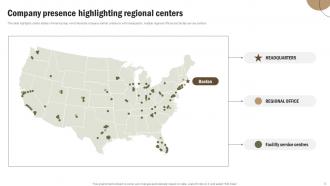
Slide 6: This slide displays Company presence highlighting regional centers.
Slide 7: This slide represents Facilities management functional organizational chart.
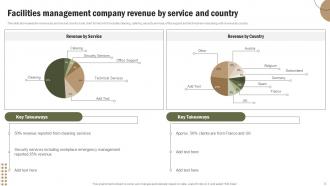
Slide 8: This slide showcases Facilities management company revenue by service and country.
Slide 9: This slide highlights title for topics that are to be covered next in the template.
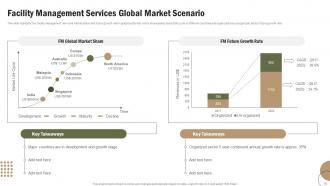
Slide 10: This slide shows Facility Management Services Global Market Scenario.
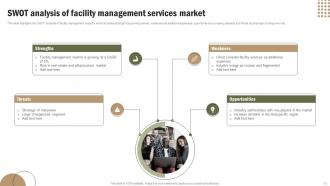
Slide 11: This slide presents SWOT analysis of facility management services market.
Slide 12: This slide highlights title for topics that are to be covered next in the template.
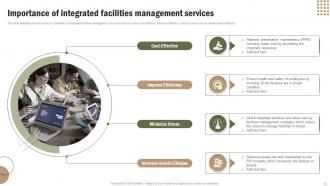
Slide 13: This slide displays Importance of integrated facilities management services.
Slide 14: This slide highlights title for topics that are to be covered next in the template.
Slide 15: This slide represents Facility management framework and process model.
Slide 16: This slide highlights title for topics that are to be covered next in the template.
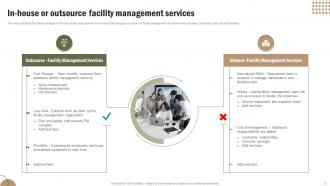
Slide 17: This slide showcases In-house or outsource facility management services.
Slide 18: This slide highlights title for topics that are to be covered next in the template.
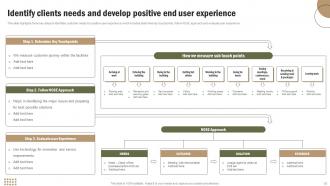
Slide 19: This slide shows Identify clients needs and develop positive end user experience.
Slide 20: This slide highlights title for topics that are to be covered next in the template.
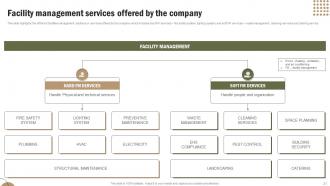
Slide 21: This slide presents Facility management services offered by the company.
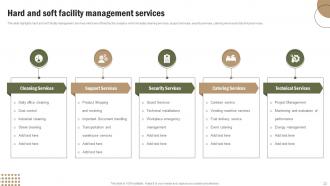
Slide 22: This slide displays Hard and soft facility management services.
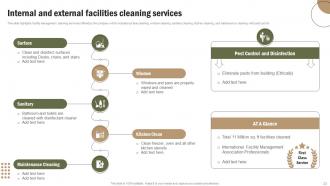
Slide 23: This slide represents Internal and external facilities cleaning services.
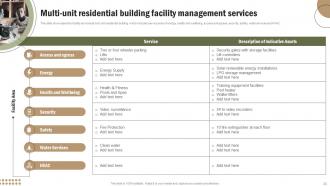
Slide 24: This slide showcases Multi-unit residential building facility management services.
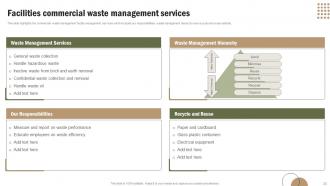
Slide 25: This slide shows Facilities commercial waste management services.
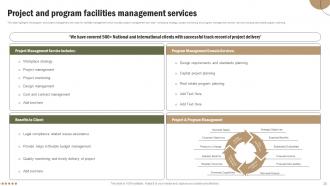
Slide 26: This slide presents Project and program facilities management services.
Slide 27: This slide displays Security and guarding facility management services.
Slide 28: This slide represents Operations and maintenance facility management services.
Slide 29: This slide highlights title for topics that are to be covered next in the template.
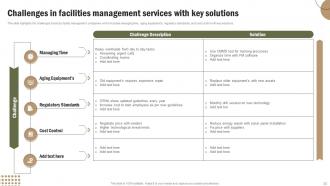
Slide 30: This slide showcases Challenges in facilities management services with key solutions.
Slide 31: This slide shows Enterprise facilities management software solutions.
Slide 32: This slide highlights title for topics that are to be covered next in the template.
Slide 33: This slide presents Stakeholder engagement strategy in facilities management.
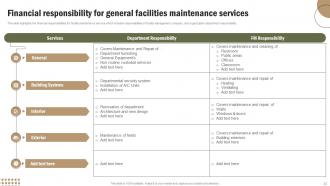
Slide 34: This slide displays Financial responsibility for general facilities maintenance services.
Slide 35: This slide highlights title for topics that are to be covered next in the template.
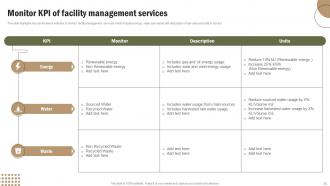
Slide 36: This slide represents Monitor KPI of facility management services.
Slide 37: This slide highlights title for topics that are to be covered next in the template.
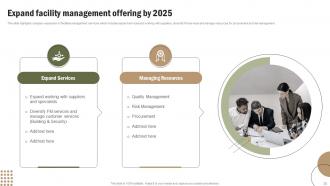
Slide 38: This slide showcases Expand facility management offering by 2025.
Slide 39: This slide highlights title for topics that are to be covered next in the template.
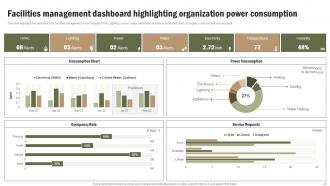
Slide 40: This slide shows Facilities management dashboard highlighting organization power consumption.
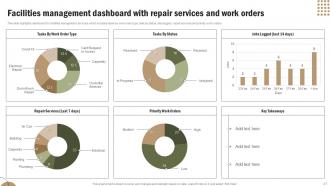
Slide 41: This slide presents Facilities management dashboard with repair services and work orders.
Slide 42: This slide contains all the icons used in this presentation.
Slide 43: This slide is titled as Additional Slides for moving forward.
Slide 44: This is Our Mission slide with related imagery and text.
Slide 45: This is About Us slide to show company specifications etc.
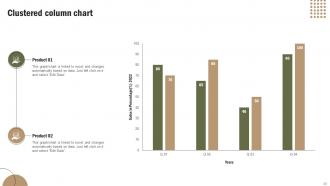
Slide 46: This slide provides Clustered Column chart with two products comparison.
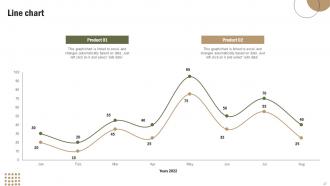
Slide 47: This slide describes Line chart with two products comparison.
Slide 48: This slide contains Puzzle with related icons and text.
Slide 49: This slide depicts Venn diagram with text boxes.
Slide 50: This slide shows Post It Notes. Post your important notes here.
Slide 51: This is Our Goal slide. State your firm's goals here.
Slide 52: This is a Thank You slide with address, contact numbers and email address.
Office Space And Facility Management Services Powerpoint Presentation Slides with all 57 slides:
Use our Office Space And Facility Management Services Powerpoint Presentation Slides to effectively help you save your valuable time. They are readymade to fit into any presentation structure.

























FAQs for Office Space And Facility Management Services
Honestly, start by asking your team where they actually like working - you'll be surprised how wrong your guesses are. Make spaces flexible with modular furniture that moves around easily. Mix it up with quiet spots, collaboration areas, and somewhere people can just hang out. Good lighting and decent chairs aren't negotiable (learned that one the hard way). Track which spaces get used and which don't. Survey people regularly about what's bugging them. The whole "open office for everyone" thing is dead anyway. Focus on adapting as your team changes rather than creating some perfect permanent setup.
Dude, start with room booking software - you'll see results right away. Occupancy sensors are pretty cool too, they show which areas actually get used vs. sitting empty all day. The data visualizations are honestly addictive once you start seeing real patterns. Your people can reserve desks through apps instead of wandering around looking lost. Space management tools track peak times and traffic flow. I thought our break room was super popular but turns out barely anyone goes there after 2pm - who knew? Use the data to redesign layouts or convert dead zones into something useful. One simple tool first though, don't go overboard.
Oh totally get your team's input on this! They're stuck in that space 8 hours a day so they'll know exactly what's driving them crazy. Skip the generic surveys though - ask specific stuff like "where do you actually go when you need to focus?" Anonymous feedback works way better since people won't sugarcoat things. Ask about noise levels, whether the collaboration areas actually work, if there's enough quiet spots. I swear half these office designs are done by people who've never worked in a cubicle. But here's the thing - you've gotta actually DO something with their feedback or they'll be even more frustrated than before.
Track your current space usage for a week first - you'll be surprised how much goes unused. Hot-desking is where it's at though, letting people grab whatever desk is free instead of assigned spots. Modular furniture you can move around easily makes a huge difference too. Oh and get a decent booking system for conference rooms and those little focus pods (people hate wandering around looking for space). We tried this at my last job and honestly the modular setup was trickier than expected, but worth it. Just don't overthink it - start small and see what actually works for your team.
Oh man, this is way trickier than most people think! Japanese offices need to respect hierarchy - can't just throw everyone into open layouts. Meanwhile Scandinavian workers expect everything super egalitarian. Germans are obsessed with privacy (seriously, they need those closed doors). You've got religious considerations too, like prayer spaces. Even colors can be touchy depending on culture. Honestly, your best move is surveying employees in each region first. Then find local designers who actually get the cultural stuff - they'll save you from major mistakes. Skip the one-size-fits-all approach completely.
Honestly, just get a shared calendar going first - double-booked rooms are the worst drama you'll deal with. Quick cleaning routine between users is clutch too. Post some basic rules about noise and food (people get weird about crumbs lol). Someone needs to do occasional check-ins, even if you rotate who does it. The booking system thing is probably most important though - trust me on that one. Oh and make the guidelines super simple, not some long document nobody reads. Get this stuff sorted early and you won't be constantly putting out fires later.
Dude, office space makes such a huge difference! Poor lighting and weird temperatures will kill everyone's mood instantly. I swear I've worked in places that felt like actual caves - productivity was nonexistent. You want comfortable temps, decent lighting, plus quiet spots for focused work and areas where people can collaborate. Your team will be way more engaged when the environment doesn't suck. Oh, and actually ask them what's bugging them about their current setup. Most managers skip that step but it's honestly the easiest way to figure out what needs fixing first.
So you'll want to measure space utilization rates and cost per square foot per employee first. Track occupancy patterns too - trust me, you're probably using way less space than you realize. Employee satisfaction surveys about their workspace are huge, plus collaboration frequency and other productivity stuff. Oh, and don't sleep on operational costs like utilities, cleaning, maintenance per area. The real trick is being consistent with data collection over months so you can actually spot trends. Then you can make smart calls about downsizing or reconfiguring spaces instead of just guessing.
Dude, remote work totally changes your space needs - like you can slash 30-50% of your square footage since way fewer people show up daily. Hot-desking becomes the norm instead of everyone having their own desk. I swear, the amount of empty desks when half your team's at home is crazy! You'll want more meeting rooms and phone booths though, less individual workstations. Oh and definitely track who's actually coming in for a few months first - don't just guess. The occupancy data will probably shock you before you make any big real estate moves.
Oh man, the noise thing will drive you crazy first - nobody can focus and forget about taking private calls. Plus everyone fights over desk space constantly. Temperature's always wrong for half the office too. Different people work totally differently, so good luck making introverts happy while the chatty ones collaborate everywhere. And don't get me started on keeping shared spaces clean when it's "everyone's job." Honestly? Set up quiet zones ASAP and some kind of booking system for meeting rooms. Trust me on this one.
Start with LED bulbs - easiest change and you'll see savings right away. Hot-desking is huge for cutting down your footprint, plus smart power strips and motion sensors work way better than I expected. HVAC optimization based on who's actually there makes a difference too. When you're doing furniture refreshes, go sustainable if the budget allows. Oh and definitely track your energy usage so you can tell what's actually working vs what's just feels-good stuff. Waste reduction should be part of every space decision you make. Honestly the tracking part is probably more important than people think.
Dude, offices are getting crazy these days! Everything's modular now - desks on wheels, walls that fold up. No more assigned seating either. Instead you've got different zones for deep work, team stuff, and random chats. Plants are literally everywhere (they call it "biophilic design" but it's just... plants lol). Standing desks are standard now. Some companies even have nap pods and meditation rooms - honestly didn't think I'd see the day. Before you redesign anything though, ask your team what they actually want. Don't just wing it.
Survey your team first - are they heads-down focused or constantly meeting? I'd go roughly 60-70% individual workspace, 30-40% collaborative stuff, but honestly your team's style matters more than some magic ratio. Create actual zones instead of mixing everything together. Quiet desks should be far from the collaborative chaos (maybe throw in glass partitions if sound's an issue). Both spaces need to actually work - not just random bean bags that look "innovative." Oh, and don't overthink it initially. Try something for a few months, see what people gravitate toward, then tweak from there.
Honestly, your office is like your brand walking around in physical form. Visitors and employees get who you are just by looking at the space. Think about it - startups have those ping pong tables for a reason, while law firms go full mahogany boardroom vibes. The layout you pick either backs up the culture you want or totally kills it. Open spaces scream collaboration, quiet corners say "we value focus time." I'd start with figuring out what behaviors you actually want to see happening, then work backwards. The colors and setup should make people feel whatever supports your goals.
Start talking to everyone way earlier - like 3-6 months out, seriously. Nobody wants to find out their desk is moving next week. Get them involved in planning by asking what they actually need. I learned this the hard way once. Make a timeline so people aren't constantly asking "when's this happening?" Regular check-ins are huge for addressing concerns before they blow up. Be honest about why you're making changes - people can smell BS from a mile away. Don't just inform them, make them feel heard. Set up feedback during the move so you can pivot if something's not working.
-
No second thoughts when I’m looking for excellent templates. SlideTeam is definitely my go-to website for well-designed slides.
-
SlideTeam is a great place for PPT templates. They have many templates on a single topic. It has made my life a lot easier.