


Internal control process for financial reporting




Try Before you Buy Download Free Sample Product
 Impress Your
 Audience
 100%
100% Editable
 Save Hours
 of Time


Acquaint folks with iconic individuals through our Internal Control Process For Financial Reporting. Delve on their exemplary contributions to humanity.
People who downloaded this PowerPoint presentation also viewed the following :
Content of this Powerpoint Presentation
Descrription:
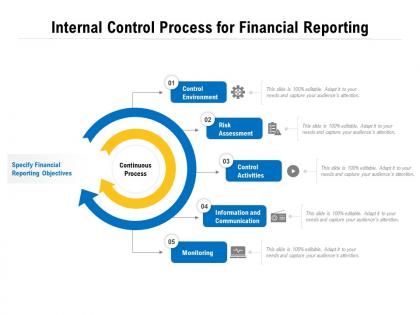
The image is of a PowerPoint slide titled "Internal Control Process for Financial Reporting," which outlines a five-step cyclical process designed to ensure accuracy and reliability in financial reporting. Each step of the process is represented by a segment of a circular arrow, emphasizing the continuous and iterative nature of internal controls. The five segments are labeled:
1. Control Environment:
This foundational step involves establishing an environment that promotes internal control, including the integrity, ethical values, and competence of the company's people. It is often considered the most critical element as it sets the tone for the organization.
2. Risk Assessment:
The company must identify and analyze risks to achieve its objectives, which forms the basis for determining how the risks should be managed.
3. Control Activities:
These are the policies and procedures that help ensure management directives are carried out. They help ensure necessary actions are taken to address risks to the achievement of the entity's objectives.
4. Information and Communication:
Relevant information must be identified, captured, and communicated in a form and timeframe that enables people to carry out their responsibilities. Effective communication must occur in a broader sense, flowing down, across, and up the organization.
5. Monitoring:
The entire process must be monitored, and modifications made as necessary. Monitoring is accomplished through ongoing management activities, separate evaluations, or a combination of the two.
Each step has a space for adding text, as indicated by "Text here," suggesting that the slide is customizable for specific internal control processes.
Use Cases:
This internal control process is crucial in various industries for ensuring that financial reporting is accurate, reliable, and compliant with regulations:
1. Banking:
Use: Ensuring accurate reporting of financial transactions and compliance with banking regulations.
Presenter: Chief Financial Officer
Audience: Finance team, regulatory compliance officers
2. Manufacturing:
Use: Monitoring the costs of production and inventory control.
Presenter: Finance Manager
Audience: Management team, internal auditors
3. Healthcare:
Use: Maintaining patient billing integrity and regulatory financial reporting.
Presenter: Healthcare Administrator
Audience: Billing department, compliance staff
4. Retail:
Use: Overseeing financial transactions, inventory reporting, and loss prevention.
Presenter: Internal Controls Director
Audience: Store managers, finance department
5. Education:
Use: Managing funding, expenses, and financial aid by educational standards.
Presenter: Director of Finance
Audience: School board, department heads
6. Technology:
Use: Safeguarding against financial risks related to intellectual property and R&D investments.
Presenter: Risk Manager
Audience: R&D team, investors
7. Non-Profit:
Use: Ensuring donations, grants, and expenditures are reported correctly.
Presenter: Compliance Officer
Audience: Donors, grant managers
Internal control process for financial reporting with all 2 slides:
Delve on exemplary contributions to humanity with our Internal Control Process For Financial Reporting. Acquaint folks with iconic individuals.

FAQs for Internal control process
OK so there are five main things to look at: control environment, risk assessment, control activities, information/communication, and monitoring. Control environment is where I'd start - it's basically whether your leadership actually gives a damn about having good controls. If they don't care, you're screwed from the get-go. Risk assessment helps you figure out your biggest problem areas. Then you've got your actual control activities - the policies and procedures that catch issues before they blow up. Information needs to flow between departments properly, and you'll want to monitor how everything's performing. Honestly, just evaluate that control environment first and you'll know pretty quickly what you're dealing with.
Start with mapping out your main processes and figure out where stuff could break down. I always think about it like this - pretend you're trying to mess with your own system, where would you attack it? Look at risks that happen naturally plus what's left over after your current safeguards kick in. Then rank everything by how likely it is and how bad the damage would be. Risk matrices help tons here - you can see what needs fixing now vs. what you can just keep an eye on. Don't just go with your gut though, be methodical about the whole thing.
So internal controls are basically your safety net for catching financial screw-ups before they become real problems. You want different people handling different parts of transactions - like one person records stuff, another approves it. Prevents both honest mistakes and sketchy behavior. Regular reconciliations help too, though honestly they're kind of a pain. But your books stay clean and auditors won't give you grief later. It's like having guardrails on your finances - won't stop every issue but catches most of the big ones before they mess up your statements.
Honestly, tech makes internal controls so much better. Automated approvals cut down on human mistakes, and you get real-time monitoring that's impossible to do by hand. Digital segregation of duties is pretty slick too - plus everything leaves an audit trail. The data analytics part is where it gets really cool though, since it'll catch fraud patterns you'd never spot manually. Just make sure you actually configure everything right first. I've seen companies rush into it and basically just automate their existing problems instead of fixing them.
So auditors come in and test your internal controls - stuff like who approves what, whether duties are split up properly, IT security, that kind of thing. Good controls mean they don't have to dig as deep into your records, which honestly saves everyone a headache. Bad controls? They'll write you up and spend way more time poking around your books. My advice: get your documentation sorted beforehand and fix obvious problems. Nobody wants surprise findings in the management letter, plus it keeps audit fees from getting crazy. The paperwork prep is annoying but totally worth it.
So internal controls are basically how you actually make corporate governance work in practice. Governance gives you the big picture stuff - oversight, accountability, managing risks. But controls are what make it happen every single day. Like, your board can set all the policies they want, but without good controls? You're screwed when it comes to accurate financial reporting or staying compliant. I always tell people to connect their controls back to what governance is trying to achieve. Makes it so much easier to figure out what's actually worth spending money on. Otherwise you're just throwing resources at random stuff that doesn't matter.
Honestly, the biggest issues I see are usually around separation of duties - like having one person handle payments AND do the bank reconciliation, which is asking for trouble. Authorization controls are typically a mess too. Manual processes without anyone checking the work? Red flag. Some companies literally don't reconcile anything, which blows my mind. Access controls get sloppy fast - people quit but still have system access months later. Poor documentation makes everything worse since nobody knows who's supposed to do what. Map out your processes first and you'll see the problems jump out at you pretty quick.
So basically you map out what regulations actually hit your business, then bake compliance right into how you work. Like having different people handle money vs approving payments - prevents sketchy stuff. Regular testing keeps everything running smooth, plus good documentation so auditors don't hate you (trust me, you want them happy). The trick is making it part of normal workflows instead of some annoying quarterly thing. Honestly? Start with whatever keeps you up at night risk-wise. Those get controls first, then work your way down.
Look, I get why it sounds backwards, but good internal controls actually make things run smoother. You're basically creating standard workflows that catch mistakes early instead of dealing with massive headaches later. Less time putting out fires, more time doing actual work. The key is mapping out what you're already doing first - then figure out where controls could cut out redundant steps rather than pile on more bureaucracy. I've seen teams initially grumble about new procedures, but they usually come around once they realize how much easier their day-to-day becomes. Start small though.
Honestly, remote work breaks a lot of your usual oversight stuff, so you've gotta beef up the digital side. Get automated approvals running and make sure everything has a proper digital trail - who touched what, when, all that. VPNs are non-negotiable for anything sensitive. I'd start by looking at your current setup and spotting where remote creates weird gaps. Virtual check-ins help too, though they feel awkward at first. The tricky part is keeping duties properly separated when everyone's scattered at home instead of in different departments. Cloud documentation systems are your friend here - way better than hoping people remember to update spreadsheets.
So you've got a few ways to stay on top of this stuff. Regular risk assessments are your starting point - basically checking what could go wrong. Then there's ongoing monitoring, which is just watching your day-to-day processes. Most companies honestly suck at this part because they build controls then forget about them. Internal audits help catch bigger issues too. Make sure people can actually report problems when they see them - like, don't make it complicated. Document what you find (yeah, I know, paperwork). Oh and map out your most critical processes first. No point monitoring everything if you don't know what matters most.
Honestly, you've gotta get everyone bought in, not just your compliance people. Leadership can't just email about ethics once a year - they need to actually show they care. What's worked for me is bringing up controls in regular meetings so it doesn't feel like this separate thing. Short sessions work better than those marathon training days, trust me. Recognition goes a long way too when someone catches an issue. The big thing? People need to feel safe speaking up without looking like they're stirring up drama. Maybe start small - just add a quick discussion to your next team meeting and see how it goes.
Bad controls are like having no security cameras - fraud just sits there growing while you're completely clueless. You miss all the red flags that should be obvious: weird transactions, sketchy patterns, unauthorized stuff happening left and right. By the time you actually notice something's wrong, the damage is already massive and good luck trying to figure out where it all started. Honestly, it's so frustrating when companies cheap out on this stuff. The fraud gets worse the longer it hides, obviously. Start with better monitoring and make sure people can't just do whatever they want without oversight.
Yeah, so it totally depends on your industry. Banking has crazy segregation of duties - like, multiple approval layers for everything. Healthcare? They're obsessed with protecting patient data. Manufacturing focuses more on inventory and quality stuff. Tech companies go nuts with cybersecurity (sometimes way overboard honestly). Finance and pharma are the worst though - super complex because they're so regulated. My advice? Figure out your biggest compliance headaches first, then work backwards from there. A small retail shop obviously doesn't need the same controls as Goldman Sachs, you know?
Write it like a recipe someone could actually follow - step by step with who does what and when. Screenshots help tons, especially for anything in your system. Don't just say what to do, explain why you're doing it so people get the point behind each control. Honestly, the "why" part is what most people skip but it's super helpful. Set clear approval limits and checkpoints. Keep everything somewhere everyone can access and update easily. Oh, and review it yearly because procedures drift from reality faster than you'd think.
No Reviews