


Investment Mutual Fund Brochure Trifold




Try Before you Buy Download Free Sample Product
 Impress Your
 Audience
 100%
100% Editable
 Save Hours
 of Time


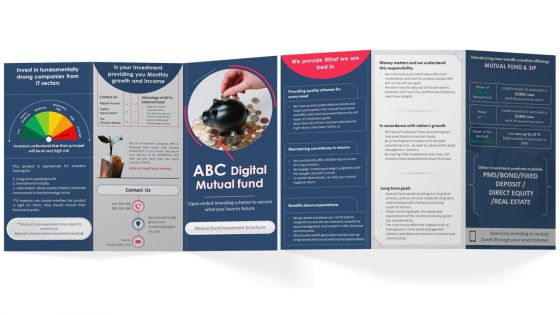
Advertise your mutual fund investment firm using our outwardly engaging brochure catalogue design template. Use the investment catalogue presentation to give a brief introduction about the firm along with its essential points, including its vision, mission, timing, address, and contact details, along with ways or suggestions for funding investment. The catalogue refers to the firms services, such as quality schemes, consistent returns, long-term goals being met, and so on. With our template, you can highlight your wealth creation offerings such as mutual funds and SIPs we also provide other products such as PMS, bonds, etc. Shed the spotlight on investment opportunities or simply buying a home for you, your loved ones, or your firm by generating funds via investments. Leverage the presentation by adding customer feedback to boost credibility.
People who downloaded this PowerPoint presentation also viewed the following :
Investment Mutual Fund Brochure Trifold with all 1 slides:
Use our Investment Mutual Fund Brochure Trifold to effectively help you save your valuable time. They are readymade to fit into any presentation structure.
FAQs for Investment Mutual
Honestly, start with the basics - is there real demand and is the market actually growing? Nobody wants to jump into a sinking ship. Competition's huge too - see how crowded it already is and who you're up against. Regulations can be a total pain depending where you are, plus tax stuff varies like crazy. If it's international, cultural differences are weirdly important (learned that one the hard way). Do your homework first, maybe run a small test to see how it goes. Way better than diving in blind and regretting it later.
So basically, you spread your money around different stuff - stocks, bonds, maybe some international things. When one investment crashes, others might stay put or even rise. It's that whole eggs-in-a-basket deal, but with your cash. Different investments don't all tank together at the same time, which is honestly pretty cool when you think about it. You can't dodge risk completely, but at least you won't get absolutely destroyed when one sector goes to hell. Mix it up and you'll see way less crazy swings in your account.
Dude, behavioral finance is basically why we're all terrible at investing even when we think we know what we're doing. Your brain tricks you with stuff like FOMO and loss aversion - like when you panic and dump everything during a crash or chase whatever stock is trending on Reddit. Most of our choices come from emotions and gut reactions, not actual analysis (which honestly makes sense if you think about it). The fix? Set up automatic investing so you can't mess with it when you're feeling panicky. Also make some basic rules ahead of time for buying and selling. Takes the drama out of it.
Honestly, I'd split it like 70% long-term and 30% short-term stuff right from the start. Put most of your money in boring index funds or dividend stocks that'll grow over years. Save that smaller chunk for swing trades or whatever sectors look hot. Trust me, I learned this lesson the expensive way when I kept chasing "guaranteed" quick wins lol. Never, ever raid your long-term money for short-term bets - doesn't matter how confident you feel about them. Maybe look at what you've got now and see if it actually lines up with your goals?
Honestly, I'd go mostly passive if I were you. Index funds are dirt cheap and you're not spending weekends researching stocks. Sure, you'll never beat the market, but most "expert" fund managers can't either - which is kind of embarrassing for them lol. Active investing costs way more in fees. Plus it takes forever to research everything properly. Maybe do like 80% boring index funds, then mess around with individual picks for the other 20% once you get the hang of things? That way you won't stress about it but can still scratch the itch if you want to try picking winners.
Think of economic indicators as your cheat sheet for investing. GDP shows if countries are growing or shrinking. Inflation tells you if your dollar's getting weaker (ugh). Employment numbers? That's all about whether people have money to spend. Interest rates are probably the biggest deal though - they basically decide if stocks or bonds are worth it. I mean, sometimes this stuff feels random anyway, but at least you've got real numbers instead of just guessing. Pick maybe 3 or 4 indicators from whatever markets you're into and check them monthly. Then tweak your portfolio based on what you're seeing.
Think of interest rates like a see-saw for your investments. Bonds and savings accounts look way better when rates climb because you're actually earning decent money on safe stuff. Meanwhile, stocks usually get hammered since companies pay more to borrow money. Real estate gets crushed too - nobody wants those expensive mortgages. Flip side happens when rates drop. Everyone starts hunting for riskier investments to get any kind of return. Honestly, the whole thing drives me crazy sometimes because it affects literally everything you own. Don't just ignore it when the Fed moves though - you'll want to adjust your portfolio mix accordingly.
Dude, the investing game has totally changed. Ten years ago you needed serious money to get started, but now? Fractional shares let you buy into Amazon with like $20. Those robo-advisors are actually pretty solid for basic portfolio stuff, and AI keeps getting better at the risk analysis thing. I'll be honest though - some of this crypto/DeFi stuff still feels sketchy to me, even if it's creating new opportunities. Mobile trading is almost too convenient now, which kinda worries me. My advice? Play around with the new tools but don't get too caught up in the hype. The boring fundamentals still matter most.
Honestly, you should check if your investments actually match what you believe in. Look at the companies you're backing - do they treat workers well? Are they trashing the environment? ESG funds are blowing up right now because people want their money doing good, not just making profits. Some folks skip "sin stocks" like tobacco or weapons entirely. I mean, there's no point getting rich off stuff that keeps you up at night, right? Start by going through your current portfolio and see what doesn't sit right with you. Find that balance between decent returns and feeling good about where your cash is going.
Honestly, think of investment education like learning to drive before hitting the freeway. You'll pick up the basics - risk vs return, how compound interest actually works, different types of investments. Reading financial statements becomes way less intimidating once you know what to look for. Markets will dip (they always do, it's annoying but normal), and education helps you not freak out when it happens. You'll also learn to spot obvious red flags and ask better questions. My cousin jumped in without any knowledge and lost like $3k immediately. Start with some solid online courses or books from legit financial educators before putting real money anywhere.
Biggest mistakes I see? People go way too hard on leverage right out the gate. Also, repair costs always end up higher than you think - like, always. Don't buy in sketchy neighborhoods just because they're cheap without really digging into why. Oh, and that HGTV thing is so real - not every house is gonna make you rich, sorry. Cash flow math trips people up constantly too. Run your numbers super conservatively. Research the area like crazy. Have a backup plan if things go sideways. Start with just one property first, seriously. Find contractors who won't screw you over and a realtor who actually gets investment stuff.
Honestly, geopolitical stuff always freaks markets out initially. People see conflict or trade war headlines and just start dumping stocks left and right. The volatility is crazy during those first few days. But here's what I've noticed - once everyone calms down and actually looks at the real economic impact (not just the scary news), things usually bounce back. I mean, unless it's something truly massive. My advice? Don't panic-sell with everyone else. Stick to your long-term plan and maybe have some cash sitting around. You can actually find decent opportunities when others are being dramatic about headlines.
So asset allocation is just how you divvy up your investments - stocks, bonds, real estate, whatever. Basically don't dump everything into one thing because when it crashes (and it will), you're screwed. Different investments move differently, so some might tank while others stay solid or even go up. You want to match this split to how long you're investing and how much risk makes you sweat at night. I usually tell people to pick target percentages first, then check back every so often to rebalance. It's honestly one of those boring things that actually matters way more than picking hot stocks.
Hey! So expense ratios are huge - those fees add up over time and just kill your gains. Don't get sucked into those flashy recent returns either, look at 3-5 year performance vs the benchmark instead. Check the Sharpe ratio too so you know if the risk is actually worth it. One thing that always bugs me - some "growth" funds are packed with value stocks, so definitely peek at what's actually in there. I learned that the hard way lol. Just compare similar funds and focus on consistency rather than chasing whatever's hot right now.
Honestly, diversification is your best friend here - spread stuff across different sectors, countries, whatever. Don't dump everything in one place. Keep some cash on hand too because those market drops? Actually perfect buying opportunities if you've got the money ready. I get it though, not panicking when everything's red is brutal. But seriously, just staying in the market long-term beats trying to time it perfectly. Oh and dollar-cost averaging helps - you're basically buying a little at a time so you don't stress about picking the "perfect" moment to jump in.
-
Good research work and creative work done on every template.
-
Use of icon with content is very relateable, informative and appealing.