

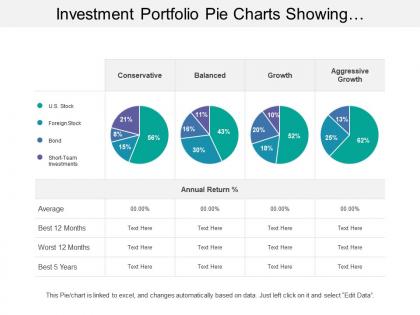
Investment portfolio pie charts showing conservative and balanced growth




Try Before you Buy Download Free Sample Product
 Impress Your
 Audience
 100%
100% Editable
 Save Hours
 of Time


Draw attention to your ideas with our Investment Portfolio Pie Charts Showing Conservative And Balanced Growth. Folks feel compelled to hear you out.
People who downloaded this PowerPoint presentation also viewed the following :
Investment portfolio pie charts showing conservative and balanced growth with all 6 slides:
You have evolved a process to improve diagnosis. Inject it into the system with our Investment Portfolio Pie Charts Showing Conservative And Balanced Growth.

FAQs for Investment portfolio pie charts showing conservative
So basically, equities mean you're buying little chunks of actual companies. Bonds? You're just loaning money out to companies or the government and they pay you back with interest. Stocks can make you way more money but they're all over the place - seriously, last year was brutal. Bonds are boring but steady, just don't expect to get rich off them. Your stock portfolio will go crazy with whatever the market's feeling that day. Bonds mostly just send you regular payments and give your money back when they're done. Most smart people do a mix of both depending on how much risk makes them want to throw up, honestly.
So basically you want to spread your money around different types of investments. If tech stocks crash, you won't lose everything because maybe your bonds or international stuff is doing fine. I know the "don't put all eggs in one basket" thing sounds cheesy but it actually works. Mix up industries, throw in some bonds, maybe some overseas investments - whatever matches how much risk you can handle. The tricky part is rebalancing every so often to keep everything in line. Honestly beats having all your money in one place and watching it tank.
So alternative investments are pretty cool for diversifying beyond just stocks and bonds. Real estate, commodities, private equity - that kind of stuff doesn't always tank when the market does. Less volatility overall, plus you get different ways to make money. Oh and they're decent inflation hedges too, unlike bonds right now (yikes). But here's the catch - they're way less liquid and the fees are brutal. I'd honestly keep it under 20% of your portfolio, maybe even closer to 10%. Don't go crazy with them.
So basically, your age and how much risk freaks you out are the two big factors here. Young people can go crazy with stocks - like 80/20 stocks to bonds - because you've got forever to bounce back from crashes. Older folks should play it safer to protect their nest egg. But honestly? Some people just hate watching their portfolio swing around no matter how young they are. There's this old rule about subtracting your age from 100 for stock percentage, but that's kinda outdated now. Really comes down to what lets you sleep at night.
So asset allocation is basically how you divvy up your money between stocks, bonds, real estate, all that stuff. Way more crucial than stressing over which specific stocks to buy, tbh. You gotta match it to your age and how much risk freaks you out - like a 25-year-old can handle 80% stocks, but someone close to retirement probably wants 60% bonds for safety. I always forget to rebalance mine but you're supposed to adjust when your percentages get off track. Start by figuring out if you're a nervous investor or not, then build from there.
I do mine once a year, usually around tax time since I'm already looking at everything anyway. Most people say 6-12 months but honestly? Don't stress about it too much. You could set up threshold rebalancing - like when something drifts 5-10% from your target allocation. That works well too. Just don't become one of those people checking their portfolio every day and constantly moving money around. You'll kill yourself with fees. Pick a date that's easy to remember - your birthday, New Year's, whatever - and stick to it. Way better than trying to guess the perfect timing.
Look, active funds *could* beat the market if you've got a manager who really knows their stuff. They can pick stocks, time things better, pivot when markets get weird. But here's the thing - most don't actually outperform after you factor in those hefty fees. Index funds are boring but they work. Cheaper, less drama, and they usually win long-term. I'd probably go passive unless you've found some hotshot manager you really trust. Why pay extra for the slim chance of beating something that already works pretty well, you know?
So sector rotation is basically moving your money between different parts of the market depending on what's happening economically. Like when things are going well, you'd shift from boring stuff like utilities into tech or growth stocks. Then when the market gets sketchy, you rotate back to the safer defensive plays. Honestly it's super hard to time right - I've definitely screwed it up before. You can use sector ETFs or just reweight what you already own. I'd probably start with like 10-20% for tactical moves and keep your main holdings steady.
Yeah so basically aggressive portfolios get crushed when markets tank but they also rocket up during good times. Bonds and dividend stuff? Way more stable but you'll miss the big wins. I honestly think most people should just go diversified - boring but it works. Here's the thing though - your timeline matters way more than trying to time the market. Need cash in the next few years? Don't touch risky stuff no matter how tempting it looks. I learned that one the hard way back in college.
So basically you're using your values as a filter when picking investments. Some people avoid stuff they hate - tobacco, weapons, whatever. Others hunt for companies doing good things like clean energy or treating workers well. Honestly, it's gotten pretty complex now with all these ESG scores and impact metrics (kinda overwhelming tbh). You can also do thematic investing around specific causes. The main thing is figuring out what matters to you first, then let that guide which stocks you pick and how much you put into each one. Don't just tack it on later as an afterthought.
Okay so retirement stuff - the basic rule is more stocks when you're young, then shift toward bonds as you get older. Target-date funds are honestly amazing for this because they do all the rebalancing automatically (I wish I'd known about these sooner). There's also this bucket approach where you split money between cash, bonds, and stocks based on when you'll need it. Dollar-cost averaging works well too - just invest the same amount regularly no matter what the market's doing. Figure out your timeline first and how much risk makes you comfortable, then go from there.
Currency swings can totally mess with your international investments - sometimes more than the actual stocks do. You're betting on two things: the company AND the exchange rate. Super annoying when your stocks do great but the currency tanks against the dollar, wiping out your gains. Though honestly, it works both ways - strong foreign currency can juice your returns too. I learned this the hard way with my European funds last year. If currency risk stresses you out, look into hedged funds. Otherwise just roll with it as part of going global.
Look at total return first - that's the baseline. But honestly, you need more than just that number. Sharpe ratio shows your return per unit of risk, which is way more telling than raw returns. Maximum drawdown is brutal to calculate but shows your worst losing streak (I always cringe when I run mine). Compare everything against benchmarks too. Like, who cares if you made 8% when the S&P did 12%? Run these numbers monthly and patterns start jumping out. Oh, and don't get too obsessed with daily moves - that'll drive you crazy.
Dude, the tech stuff for investing is honestly pretty crazy these days. Robo-advisors will rebalance your portfolio automatically while you're sleeping. Real-time data analysis catches trends way faster than you ever could manually - we're talking thousands of data points getting crunched instantly. Portfolio apps give you performance analytics and stress testing on demand too. I mean, my buddy uses one and swears by it, though I still think you need some human judgment mixed in. Start with a basic portfolio tracker or try a robo-advisor to see what clicks with how you invest.
Ugh, taxes will totally mess with your gains if you don't think ahead. Short-term stuff (under a year) gets hit with your regular tax rate, which sucks. Long-term is way better though. Dividends and interest count too, obviously. But here's what caught me off guard when I started - those "tax-efficient" mutual funds can still dump surprise distributions on you at year-end. Super annoying. Best move is putting your tax-heavy investments in your 401k or IRA, then stick with index funds in regular accounts.
-
I discovered this website through a google search, the services matched my needs perfectly and the pricing was very reasonable. I was thrilled with the product and the customer service. I will definitely use their slides again for my presentations and recommend them to other colleagues.
-
Unique research projects to present in meeting.