

It Service Management Powerpoint Presentation Slides





Try Before you Buy Download Free Sample Product
 Impress Your
 Audience
 100%
100% Editable
 Save Hours
 of Time


IT service management is the process of managing IT services. It includes the planning, design, delivery, and support of IT services. IT service management is a key part of any business that relies on IT to deliver its services. There are many benefits to IT service management. It can help businesses to reduce costs, improve efficiency, and improve customer satisfaction. IT service management can also help businesses to avoid or resolve IT problems. So, if you want to know more about IT service management and how to improve your team's productivity, then be sure to download our project management PowerPoint templates. These resources are packed with information and examples that will help you get started on the right path. Plus, they're easy to use and can be customized for your own needs. Download our
People who downloaded this PowerPoint presentation also viewed the following :
Content of this Powerpoint Presentation
In today’s fast-changing technological scenario, effective management of IT services referred to as IT Service Management (ITSM) is critical for the success of the business. It helps ensure that technology, processes, and employees are aligned to work toward attaining business goals.
According to a report, the global IT Service Management (ITSM) Market size was USD $10.5 billion in 2023. Currently, it is expected to grow to USD $22.1 billion by 2028. This data highlights the rapid increase in the utility of ITSM by organizations to streamline IT services. There are enablers of IT Service Management Process. To learn about them, click here!
Let us consider an example to understand ITSM in a better way. If you enter a new organization and it needs to deliver a phone to you right on the first day of joining, an ITSM process will be undertaken to ensure that you get the correct phone. It is fundamentally a strategic method used to craft, deliver, and manage the way IT is used within an organization resulting in increased productivity, lower costs, and improved end-user satisfaction.
Find out the best templates on ITIL Service Management to get an overview. Click here!
If you are involved with IT services in your company and seeking help to simplify IT Service Management process, you must refer to the management guide from SlideTeam. This guide in the form of ready-to-use and well-researched templates will serve as a roadmap for handling ITSM activities. These are completely editable and customizable to suit your needs.
Let’s explore these unique content-ready templates!
Template 1 CSI Strategy, Goals and Objectives
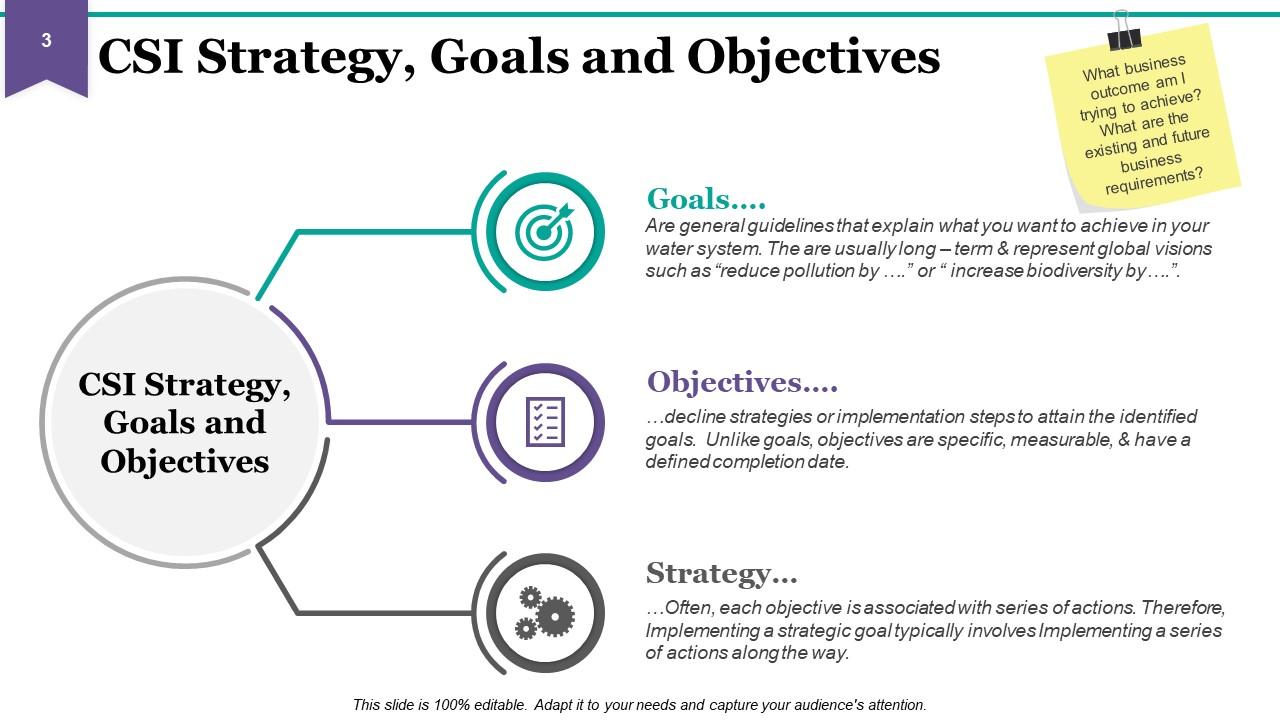
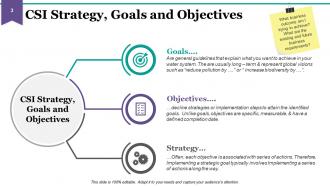
Before starting with any business initiative, it is essential to have a plan. This PPT Template highlights CSI strategy, goals, and objectives for IT Service and Management, all of these elements are key components of an effective business plan. Use this professional template to give a kick-start to the ITSM of your organization. Download it now!
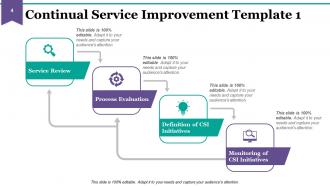
Template 2 Continual Service Improvement Template 1
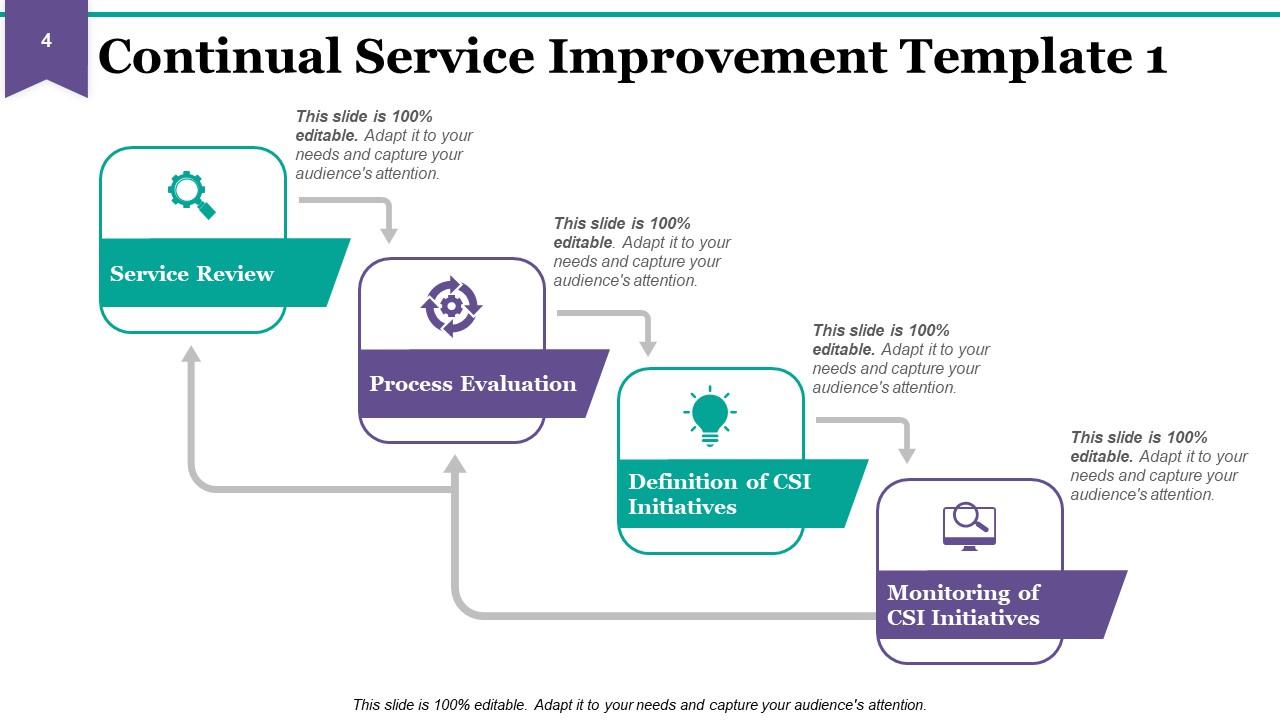
Continual Service Improvement is a method that helps recognize and execute opportunities for improvement of IT processes. This PPT Template depicts some of the crucial steps for conducting CSI such as Service Review, Process Evaluation, Defining CSI initiatives, and Monitoring of CSI Initiatives. Use this template designed to illustrate the major steps of CSI. Get the template to help you understand the complex process of ITSM!
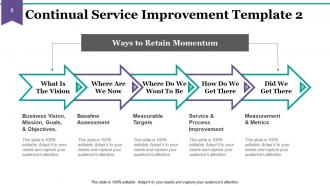
Template 3 - Continual Service Improvement Template 2
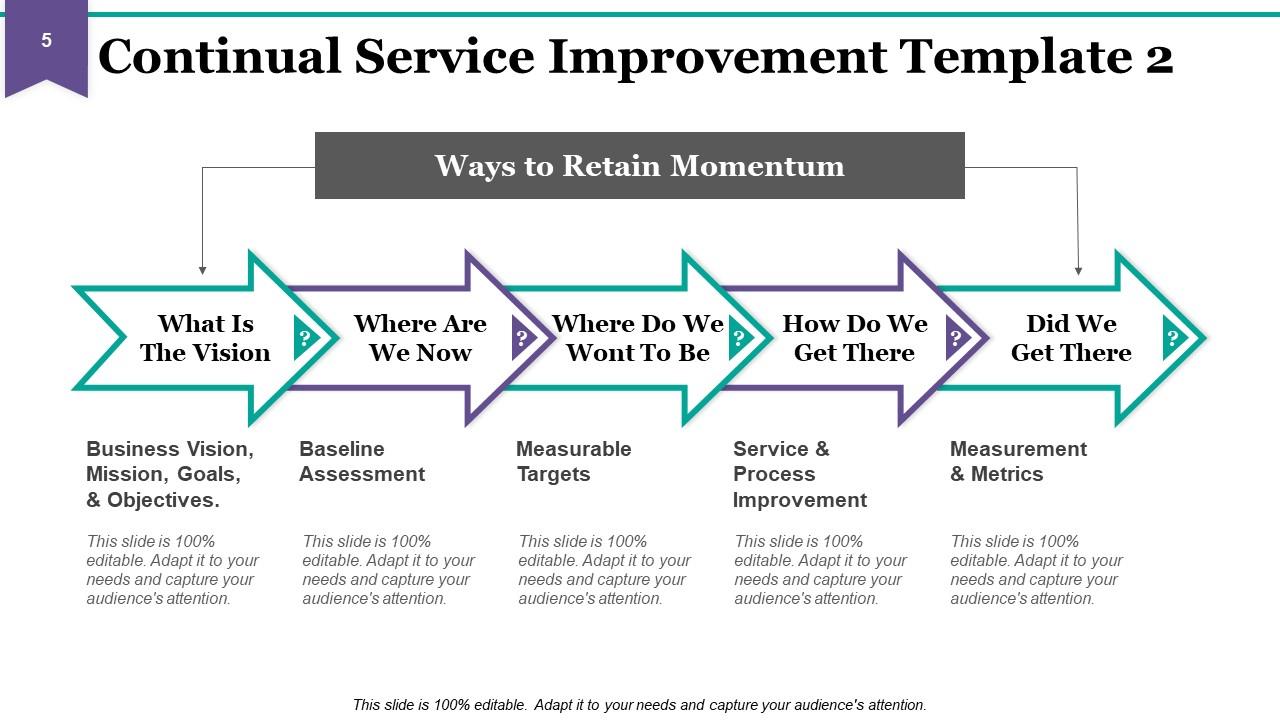
During your ITSM journey, an effective change occurs only when a strategic approach is taken to move systematically from What is the Vision? to Did We Get There? This is what is illustrated in the template above. Use this captivating template during a presentation to highlight your goals and objectives, baseline assessment, measurable targets, services, process improvements and measurement and metrics.
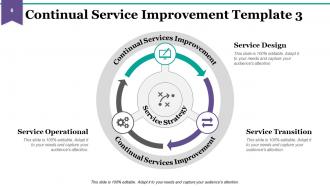
Template 4 Continual Service Improvement Template 3

CSI is the core component for organizations striving for excellence in IT service delivery. It is important to follow a well-organized approach for planning and executing CSI. Here, this PPT Template showcases three stages of IT Service Management such as Service Design, Service Transition, and Service Operational. Each of these stages serves a particular purpose. For instance, the goal of Service Design is to create services based on the business conditions of the client. Service Operations focuses on meeting end-user anticipations cost-effectively. And, lastly, Service Transition helps create and implement IT services. Grab this template for the improvement of IT services in your organization!
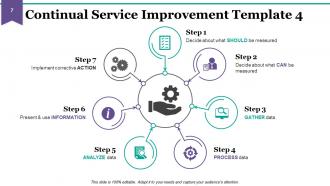
Template 5 – Continual Service Improvement Template 4

Performing CSI in proper steps leads to business success. In the template above, you can see seven steps mentioned for the systematic implementation of CSI. In the first step, one has to decide what should be measured. Next step is to decide what can be measured. After that, gather, process, analyze data. Then, present and use information. In the final step, you have to implement corrective action. Use our template to get started with the ITSM, ensuring continual growth and success of your company. Download it now!
Template 6 - Continual Service Improvement Template 5
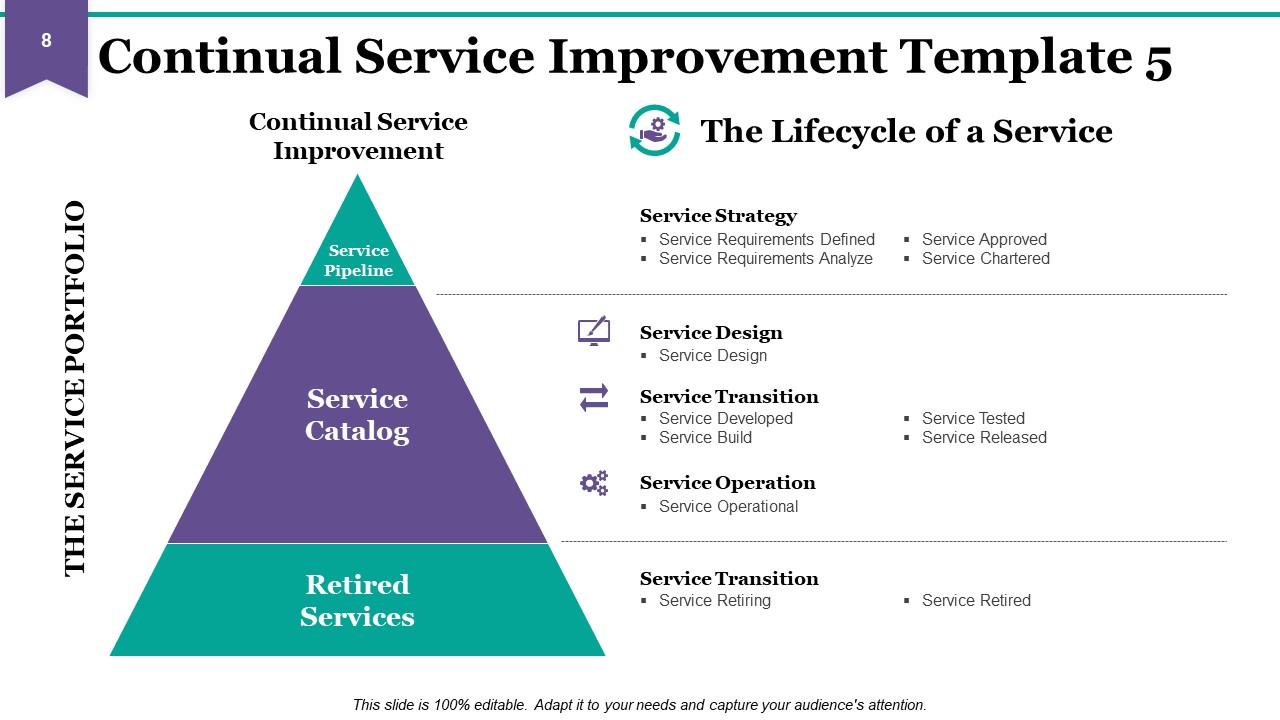
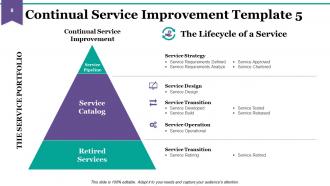
IT Service Lifecycle is the backbone of ITSM framework. It encompasses the journey of IT Service Management, right from crafting the strategy to delivering and improving the services. This PPT Template depicts the lifecycle of IT service which includes crucial components such as Service Pipeline that comprises Service Strategy, Service Catalog which includes Service Design, Operation and more, and Retired Services which covers Service Retiring and Service Retired. Get this template to streamline your IT Services.
Refine Your IT Services to Witness Organizational Success
ITSM helps in standardizing and simplifying IT procedures in your company. It helps boost efficiency, reduce operational costs, improve visibility into performance, and enhance customer experience. All of these benefits will certainly result in the profit and consequently, growth and success of the organization.
PS Every crucial step taken within an organization is attached to accomplishing a defined goal. Explore this template to decode the key objectives of IT Service Management. Click here!
It Service Management Powerpoint Presentation Slides with all 28 slides:
Use our IT Service Management Powerpoint Presentation Slides to effectively help you save your valuable time. They are readymade to fit into any presentation structure.


FAQs for It Service Management
Honestly, you'll want the five main lifecycle pieces - strategy, design, transition, operation, and continual improvement. But don't go crazy trying to do everything at once. Pick maybe 2-3 processes that'll actually fix your worst headaches first. Incident management's pretty much mandatory for when stuff breaks. Change management saves you from updates that wreck everything. Oh, and configuration management is clutch - seriously, losing track of your assets is a nightmare. Problem management helps you fix root causes instead of just putting band-aids on symptoms. A decent service catalog doesn't hurt either.
Track the obvious stuff first - incident response times, how often you fix things on the first try, customer satisfaction. Those show quick wins. But here's the thing, pretty charts don't tell the whole story. You've gotta look at the bigger picture too: are you actually saving money on downtime? Is productivity up? Meeting those SLAs you promised? Pick maybe 5-7 metrics your boss actually cares about and check them monthly. Don't overthink it at first - you can always add more later once you get the hang of it.
ITIL's like the go-to framework for managing IT services - gives you structure for handling everything from when stuff breaks to rolling out changes. Most companies use it because honestly, making up IT processes as you go is a recipe for chaos. It standardizes service delivery so you get consistent results and fewer angry users calling. The whole point is aligning your IT with what the business actually needs instead of just firefighting all day. Oh, and if you're starting out, begin with incident management - that's usually where you feel the pain most. Way better than winging it.
Dude, automation is seriously worth it for ITSM. Start with something easy like password resets - that alone will save your sanity. It handles all the boring stuff automatically: ticket routing, basic troubleshooting, you name it. Your team stops doing mindless clicking and actually gets to solve interesting problems. Resolution times get way faster too since there's less human error. I'd probably focus on incident management and service requests first, maybe change approvals if you're feeling ambitious. But honestly? Pick one thing and nail it before moving on. Trust me on this one.
Ugh, the worst part is always people fighting you on changing how they do things. Everyone's super comfortable with their current setup and nobody wants to learn new stuff. Data migration from old systems is a nightmare too - way messier than you'd think. Integration with existing tools gets tricky, and honestly most companies totally lowball how long training actually takes. Role clarity becomes this whole thing where nobody knows who's supposed to do what. My move would be starting with just one small team first. Get a few people really excited about it before going company-wide. Don't try to fix everything at once or you'll go crazy.
Honestly, ITSM and DevOps work great together once you figure out the balance. Start with automating change approvals for your low-risk stuff - manual ticket routing is the worst. You'll still get ITSM's governance and visibility, but now you're also getting DevOps speed and automation. It's like having your cake and eating it too, except less cliché. The trick is keeping those structured processes for incidents and changes while letting automation handle the repetitive junk. Better risk management, faster deployments, cleaner audit trails. Win-win situation if you ask me.
Honestly, focus on the basics first - incident resolution times, first-call resolution rates, and whether you're actually hitting your SLAs. Customer satisfaction scores matter way more than people think (sometimes even more than perfect uptime, which sounds crazy but it's true). Track your availability percentages and how often changes go smoothly. Problem resolution effectiveness is huge too. Don't go overboard though - pick like 5-7 metrics max that actually tie to what your business cares about. Set up some automated dashboards and review monthly so you catch problems early.
Don't just copy-paste those standard ITIL frameworks - they're garbage if they don't match how your company actually works. Map everything to what drives your revenue and keeps customers happy. Your service catalogs and SLAs should reflect real business priorities, not some consultant's template. I've watched teams waste months trying to force textbook processes that made zero sense for their workflow. Honestly? Take the basic structure but build around how your business operates day-to-day. Oh, and make sure your metrics track stuff leadership cares about, not just whether servers are up.
Honestly, moving to cloud services means throwing out your old ITSM playbook. Those rigid, control-heavy approaches? They're dead now. When incidents happen, you're basically coordinating with vendors instead of fixing stuff yourself - which can be frustrating but whatever. Change management gets weird too since cloud providers update things whenever they want (super annoying). But here's the upside: you'll spend way less time babysitting servers. Focus on user experience instead. Just make sure you bake cloud provider SLAs into your processes and create better communication channels with vendors.
SLAs are basically your rulebook for what counts as "good service" - specific metrics, response times, all that stuff. Your whole day revolves around hitting those targets honestly. Response times, uptime goals, resolution deadlines... it gets annoying but keeps everyone focused on what matters. The way your team handles everything from ticket categories to escalations? Yeah, that's all built around meeting those commitments. Oh and actually read what your SLAs promise - I've seen people get burned by not knowing the details. They're a pain but they work.
Honestly, just get everyone on the same page with a solid process first. Prioritize by business impact and assign someone to own each incident right away. I've seen way too many teams spiral trying to figure out root cause while everything's still on fire - restore service first, investigate later. Document everything as you go and set up clear escalation paths. Regular status updates are huge too. After major outages, do post-mortems to actually learn something. Start by mapping your current flow and see where stuff gets stuck - that's where you'll get the biggest improvements.
Honestly, ITSM is a game-changer for getting other departments to actually work with IT instead of against you. You'll have proper ticketing instead of random people wandering over like "my computer's doing the weird thing again." SLAs set realistic expectations too - no more angry emails 5 minutes after they submit a request. The dashboards are pretty cool because you can literally show everyone what you're juggling and why their stuff might take a bit. Oh, and the training part is crucial - took us forever to get marketing to stop just calling instead of logging tickets. Start simple with basic ticketing and build from there.
Honestly, customer feedback is like having a mirror for your IT processes. Your team thinks everything's running smooth, but then users tell you the "quick" password reset actually takes forever because of some buried approval step nobody remembered. Those complaints? They're gold for finding bottlenecks and the weird workarounds people invent when your system fails them. I'd grab feedback however you can - surveys work, but sometimes just chatting with people tells you more. Then actually use what they say to fix the stuff that sounds great on paper but sucks in real life.
ITSM tools are honestly a game-changer for remote teams. They centralize everything in one place, which is clutch when your people are scattered everywhere. Self-service portals let employees handle their own password resets and equipment requests - saves you from being bombarded with calls. The ticketing system tracks issues across time zones way better than those messy email threads we used to deal with. Set up knowledge bases so people can actually find answers themselves. Oh, and the reporting stuff helps you catch problems early before they snowball into bigger headaches.
Honestly, AI automation is huge right now - it's getting weirdly good at predicting issues before they happen. Self-service portals and DevOps integration are also blowing up. Oh, and companies finally care about employee experience, not just customers (about time, right?). Most teams are ditching reactive support for proactive stuff. Cloud-native ITSM is pretty much standard now with everyone working remotely. I'd start by checking where you can automate things. Maybe try a chatbot for basic requests? That's usually the easiest win.
-
Great designs, Easily Editable.
-
Excellent products for quick understanding.
-
Awesome presentation, really professional and easy to edit.
-
Great designs, really helpful.
-
Great quality slides in rapid time.
-
Use of different colors is good. It's simple and attractive.