


Job evaluation powerpoint presentation slides





Try Before you Buy Download Free Sample Product
 Impress Your
 Audience
 100%
100% Editable
 Save Hours
 of Time


Determine the economic and productive growth of your business by using our Job Evaluation PowerPoint Presentation Slides. With the help of this job analysis PPT template, you can identify the job specifications which help to increase the workforce of an organization. The performance review presentation deck includes a review chart in which the productivity, work consistency, potentiality, and cross-work of an employee is mentioned. There are various factors present in our employee self-assessment PowerPoint slide which mainly targets on the core responsibilities of an individual. This performance review PPT template helps the senior authorities to measure the progress, flexibility, data visualization, advanced data analytics, and enthusiasm of an employee. The professionally designed 360-degree feedback powerpoint deck includes graphs, sheets, tables, and charts which helps you to record your assessment in an easy way. Therefore, download this ready-to-use performance review PPT template and review the annual report in an adequate manner.
People who downloaded this PowerPoint presentation also viewed the following :
Content of this Powerpoint Presentation
Slide 1: This slide introduces Job Evaluation. State Your Company Name and begin.
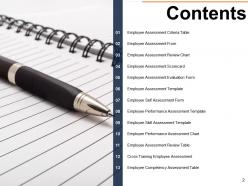
Slide 2: This slide shows Content of the presentation.
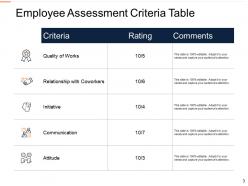
Slide 3: This slide presents Employee Assessment Criteria Table describing quality of works, relationship with coworkers, initiative, communication and attitude.
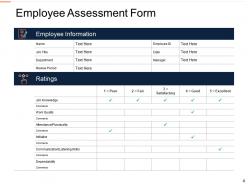
Slide 4: This slide displays Employee Assessment Form with employee information and ratings.
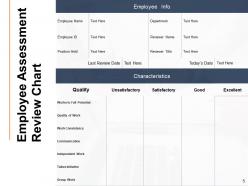
Slide 5: This slide represents Employee Assessment Review Chart with employee information and characteristics.
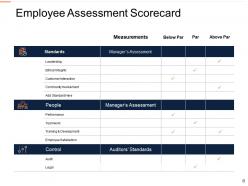
Slide 6: This slide showcases Employee Assessment Scorecard in a tabular form with categories as measurements, below par, par and above par.
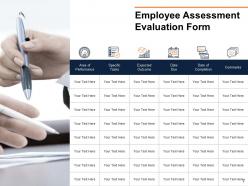
Slide 7: This slide shows Employee Assessment Evaluation Form with categories as- area of performance, specific tasks, expected outcome, date due, date of completion and comments.
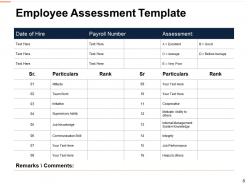
Slide 8: This slide presents Employee Assessment Template with date of hire, payroll number and assessment.
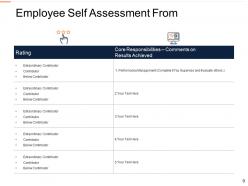
Slide 9: This slide displays Employee Self Assessment Form describing ratings.
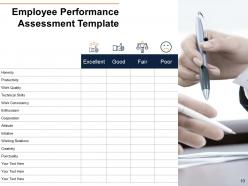
Slide 10: This slide represents Employee Performance Assessment Template.
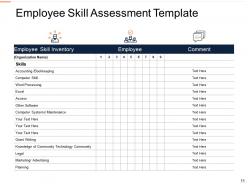
Slide 11: This slide showcases Employee Skill Assessment Template with categories as employee skill inventory, employee and comments.
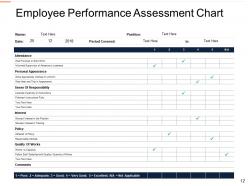
Slide 12: This slide shows Employee Performance Assessment Chart with attendance, personal appearance, sense of responsibility, interest, policy, quality of works and comments.
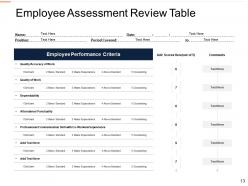
Slide 13: This slide presents Employee Assessment Review Table. You can add or edit data as per requirements.
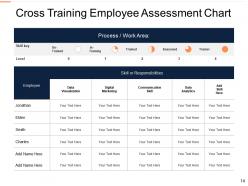
Slide 14: This slide displays Cross Training Employee Assessment Chart with process/work area and skills/responsibilities.
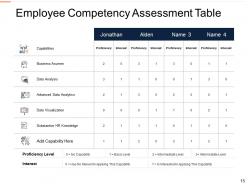
Slide 15: This slide represents Employee Competency Assessment Table with categories as- capabilities, business acumen, data analysis, advanced data analysis, data visualization and substantive Hr knowledge.
Slide 16: This slide showcases Job Evaluation Icons.
Slide 17: This slide is titled as Additional Slide for moving forward.
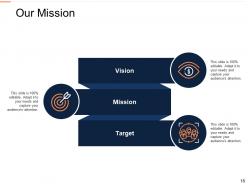
Slide 18: This is Our Mission slide with related imagery and text boxes.
Slide 19: This is Our Team slide with names and designation.
Slide 20: This is Our Goal slide. Show your firm's goals here.
Slide 21: This is another slide for Our Goal.
Slide 22: This is a Quotes slide to convey message, beliefs etc.
Slide 23: This is About Us slide to show company specifications etc.
Slide 24: This is Our Target slide. State your targets here.
Slide 25: This is another Our Target slide.
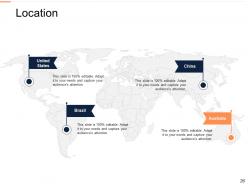
Slide 26: This is a Location slide with maps to show data related with different locations.
Slide 27: This is a Lego slide with text boxes.
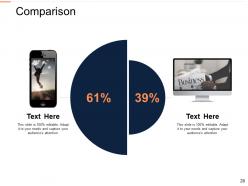
Slide 28: This is a Comparison slide to state comparison between commodities, entities etc.
Slide 29: This is a Financial slide. Show your finance related stuff here.
Slide 30: This slide shows Mind Map for representing entities.
Slide 31: This is a Puzzle slide with text boxes to show information.
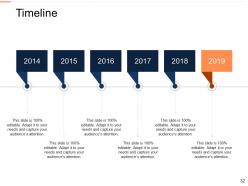
Slide 32: This is a Timeline slide to show information related with time period.
Slide 33: This is Bulb or idea slide to state a new idea or highlight information, specifications etc.
Slide 34: This is a Contact Us slide with address, contact numbers and email address.
Job evaluation powerpoint presentation slides with all 34 slides:
Get in there early with our Job Evaluation Powerpoint Presentation Slides. Get more time to organize your thoughts.









FAQs for Job evaluation
The primary purpose of job evaluation is to systematically assess and rank positions based on their relative worth, responsibilities, skills required, and organizational impact to establish fair compensation structures. This process enables organizations to maintain internal equity, attract talent, reduce turnover, and ensure competitive positioning, with many companies finding that structured evaluation systems ultimately enhance employee satisfaction and operational efficiency.
Different job evaluation methods each offer distinct advantages, with point factor methods providing detailed analytical precision, job classification delivering administrative efficiency, and market pricing ensuring competitive alignment with external benchmarks. While point factor systems excel in large organizations requiring internal equity and defensible structures, market pricing proves most effective for rapidly evolving roles in competitive industries, with many companies finding that strategic combinations of methods ultimately deliver both internal fairness and external competitiveness.
Job evaluation establishes equitable pay structures by systematically assessing job requirements, responsibilities, skills, and working conditions to determine relative worth within organizations. This structured approach enables companies to create transparent compensation frameworks, reduce pay disparities, and ensure fair remuneration across different roles, ultimately delivering consistent standards and competitive advantage in talent retention.
Job evaluation significantly enhances employee motivation and retention by establishing transparent, fair compensation structures that clearly link roles to appropriate pay scales. When employees understand how their positions are valued through systematic evaluation processes, they experience greater job satisfaction, reduced turnover intentions, and increased engagement, with many organizations finding that transparent evaluation systems ultimately deliver improved retention rates and stronger workplace morale.
Job evaluation aligns with strategic goals by linking role assessments to organizational priorities, incorporating future skill requirements, and ensuring compensation structures support talent retention in critical areas. Through strategic job analysis, companies can identify key positions that drive competitive advantage, adjust evaluation criteria to reflect evolving business needs, and ultimately create alignment between workforce planning and long-term objectives.
Organizations face challenges including resistance to change from employees, lack of management support, insufficient resources for proper implementation, difficulty maintaining objectivity in evaluations, and ensuring consistent application across departments. These obstacles can undermine system effectiveness, with many companies finding that inadequate training, poor communication, and failure to align evaluations with organizational goals ultimately compromise their ability to achieve fair compensation structures and improved performance outcomes.
Job evaluations should be reviewed annually at minimum, with updates triggered by significant role changes, organizational restructuring, market shifts, or compensation reviews. Regular evaluation cycles ensure pay equity, reflect evolving responsibilities, and maintain competitive positioning, with many organizations finding that systematic reviews enhance employee satisfaction, reduce turnover, and support strategic workforce planning in increasingly dynamic business environments.
When selecting a job evaluation method, organizations should consider company size, budget constraints, organizational complexity, industry requirements, and available expertise. These factors determine whether point-factor systems work for large corporations, while ranking methods suit smaller firms, with many companies finding that hybrid approaches deliver greater accuracy and cost-effectiveness.
Job evaluation assesses the relative worth and compensation levels of different positions within an organization, while job analysis examines the specific tasks, responsibilities, and requirements of individual roles. Both processes work together strategically, with job analysis providing the foundational data that job evaluation uses to determine fair pay structures, ensure internal equity, and maintain competitive positioning in the market.
Technology enhances job evaluation through automated data collection, AI-powered job matching, real-time market benchmarking, standardized assessment tools, and integrated analytics platforms. These solutions streamline compensation analysis by eliminating manual errors, accelerating evaluation timelines, and providing comprehensive market insights, with many HR departments finding that automated systems deliver greater accuracy and strategic alignment across organizational levels.
Common biases in job evaluations include recency bias, halo effect, confirmation bias, gender and cultural stereotypes, and personal favoritism. Organizations can mitigate these through structured evaluation frameworks, multiple evaluator perspectives, standardized criteria, regular bias training, and systematic review processes, ultimately delivering more equitable assessments and enhanced employee trust across diverse workplace environments.
Labor laws and regulations significantly influence job evaluation by establishing minimum wage requirements, equal pay standards, anti-discrimination guidelines, and classification criteria for exempt versus non-exempt positions. These legal frameworks ensure that organizations maintain compliant compensation structures while conducting evaluations, with many companies finding that systematic adherence to regulatory requirements ultimately delivers greater pay equity transparency and reduced legal risks.
Job evaluation creates structured career pathways by establishing clear role hierarchies, skill requirements, and advancement criteria that guide employee development trajectories. This systematic approach enables organizations to identify talent gaps, design targeted training programs, and build robust succession pipelines, with many companies finding that transparent evaluation frameworks significantly enhance employee engagement and retention rates.
Organizations effectively communicate job evaluation results through transparent documentation, detailed rationale explanations, structured feedback sessions, and accessible appeals processes. These approaches enhance employee understanding by clearly outlining evaluation criteria, providing specific examples of role responsibilities, and offering opportunities for dialogue, with many companies finding that proactive communication ultimately strengthens trust, reduces disputes, and improves overall employee satisfaction.
External market trends significantly influence internal job evaluations by driving salary benchmarking, skill requirement updates, demand-based role prioritization, and competitive positioning adjustments. Organizations increasingly align their evaluation frameworks with market dynamics, especially in technology and healthcare sectors, finding that market-responsive evaluations enhance talent retention, ensure competitive compensation, and maintain organizational agility in rapidly evolving business landscapes.
No Reviews