


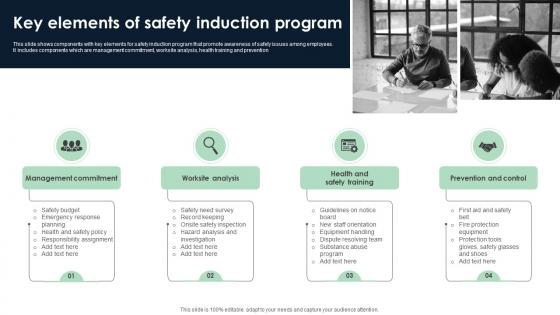
Key Elements Of Safety Induction Program




Try Before you Buy Download Free Sample Product
 Impress Your
 Audience
 100%
100% Editable
 Save Hours
 of Time


This slide shows components with key elements for safety induction program that promote awareness of safety issues among employees. It includes components which are management commitment, worksite analysis, health training and prevention
People who downloaded this PowerPoint presentation also viewed the following :
Key Elements Of Safety Induction Program with all 6 slides:
Use our Key Elements Of Safety Induction Program to effectively help you save your valuable time. They are readymade to fit into any presentation structure.





FAQs for Key Elements Of
Key components of an effective safety induction program include hazard identification training, emergency procedures, personal protective equipment protocols, workplace-specific safety rules, and incident reporting systems. These elements work together by establishing clear safety expectations, reducing workplace accidents, and ensuring regulatory compliance, with many organizations finding that comprehensive induction programs significantly decrease injury rates while enhancing overall operational efficiency.
Organizations tailor safety induction programs by conducting thorough hazard assessments, incorporating industry-specific regulations, using relevant case studies, and adapting training methods to workplace realities. Manufacturing companies emphasize machinery safety and lockout procedures, while healthcare facilities focus on infection control and chemical exposure, with construction firms prioritizing fall protection, ultimately delivering targeted risk reduction and regulatory compliance.
Employee engagement drives safety induction success by fostering active participation, retention of critical safety protocols, and genuine commitment to workplace safety culture. Engaged employees demonstrate higher compliance rates with safety procedures, proactively identify potential hazards, and contribute to peer-to-peer safety reinforcement, ultimately delivering reduced incident rates and stronger organizational safety performance.
Safety induction programs should be updated annually at minimum, with immediate revisions when new regulations emerge, significant incidents occur, or workplace hazards change. Many organizations in manufacturing, construction, and healthcare find that quarterly reviews ensure compliance while incorporating evolving best practices, ultimately delivering enhanced employee protection and reduced liability exposure.
Methods to evaluate safety induction program effectiveness include incident rate analysis, knowledge retention assessments, behavioral observations, employee feedback surveys, and compliance auditing. These evaluation approaches streamline safety performance measurement by tracking accident reduction, assessing comprehension levels, and monitoring procedural adherence, with many organizations finding that comprehensive evaluation ultimately delivers enhanced workplace safety and regulatory compliance.
Technology enhances safety induction training by delivering immersive simulations, standardized content delivery, and real-time progress tracking across organizations. Virtual reality enables trainees to experience hazardous scenarios safely, while online modules provide consistent messaging, automated assessments, and scalable deployment, with many companies finding that digital approaches reduce training costs, improve knowledge retention, and accelerate workforce readiness.
Common challenges include employee resistance, inadequate resources, inconsistent delivery, poor engagement, and lack of management support. These obstacles can be overcome by securing leadership commitment, utilizing interactive training methods, providing adequate funding and staff, standardizing content delivery, and implementing feedback mechanisms, with many organizations finding that comprehensive planning and ongoing evaluation ultimately deliver improved safety compliance and reduced workplace incidents.
A safety induction program can accommodate diverse learning styles by incorporating visual presentations, hands-on demonstrations, interactive workshops, written materials, and multimedia content. These varied approaches enable visual learners to absorb information through infographics, kinesthetic learners to practice through simulations, and auditory learners to engage through discussions, ultimately delivering comprehensive safety understanding across all employee learning preferences.
Safety induction completion requires systematic enrollment processes, mandatory training schedules, digital tracking systems, supervisor accountability measures, and regular compliance audits across all employee categories. Organizations achieve comprehensive coverage by implementing automated onboarding workflows, requiring completion before work authorization, and conducting follow-up assessments, with many companies finding that integrated HR platforms streamline tracking while ensuring no temporary or part-time staff begin duties without proper safety training.
Organizations effectively communicate safety policies during induction through interactive presentations, hands-on demonstrations, digital learning modules, visual aids, and mentorship programs. These approaches enhance understanding by combining theoretical knowledge with practical application, role-playing scenarios, and real-world examples from manufacturing, construction, and healthcare sectors, ultimately delivering improved compliance, reduced incidents, and stronger safety culture across the workforce.
Management demonstrates safety commitment during induction through visible leadership participation, dedicated resource allocation, comprehensive policy communication, and clear accountability structures. By personally conducting safety orientations, sharing real workplace examples from their operations, and emphasizing zero-tolerance policies, leaders establish safety as a core organizational value, ultimately creating stronger safety cultures and reducing incident rates across teams.
Legal implications of inadequate safety induction programs include regulatory fines, criminal charges for workplace injuries, increased liability for accidents, workers' compensation claims, and potential business shutdowns by authorities. Many organizations find that comprehensive safety induction programs significantly reduce legal exposure while enhancing operational compliance, ultimately delivering lower insurance costs and stronger competitive positioning in regulated industries.
Feedback from previous trainees enables organizations to identify knowledge gaps, refine content delivery methods, update outdated procedures, and enhance engagement techniques within their safety induction programs. Many manufacturing facilities and construction companies find that incorporating trainee insights leads to more targeted modules, improved retention rates, and ultimately stronger safety compliance across operations.
**INPUT**: What strategies can help foster a culture of safety immediately after the induction process? **OUTPUT**: Post-induction safety culture strategies include regular safety meetings, peer mentoring programs, continuous feedback systems, recognition initiatives, and leadership visibility on safety matters. These approaches enhance engagement by reinforcing training concepts, encouraging open communication, and demonstrating organizational commitment, with many companies finding that immediate follow-up activities significantly improve safety compliance and employee confidence. [Word count: 54 words]
Safety induction programs are customized based on role-specific hazards, responsibilities, and workplace environments, with frontline workers receiving hands-on equipment training while managers focus on compliance oversight and emergency protocols. Manufacturing operators learn machinery safety and PPE requirements, office staff receive ergonomic and evacuation guidance, and supervisors get incident response training, ultimately ensuring targeted protection and regulatory compliance across all organizational levels.
-
Attractive design and informative presentation.
-
Based on my personal experience, I would recommend other people to subscribe to SlideTeam. No one can be disappointed here!