


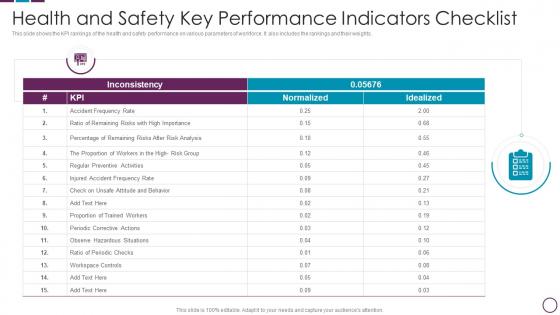
Health And Safety Key Performance Indicators Checklist




Try Before you Buy Download Free Sample Product
 Impress Your
 Audience
 100%
100% Editable
 Save Hours
 of Time


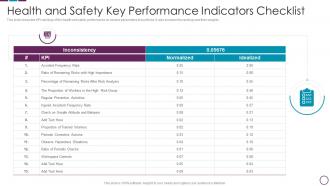
This slide shows the KPI rankings of the health and safety performance on various parameters of workforce. It also includes the rankings and their weights.
People who downloaded this PowerPoint presentation also viewed the following :
Health And Safety Key Performance Indicators Checklist with all 6 slides:
Use our Health And Safety Key Performance Indicators Checklist to effectively help you save your valuable time. They are readymade to fit into any presentation structure.





FAQs for Health And Safety Key
Effective Health and Safety KPIs include leading indicators like training completion rates, safety audits conducted, and near-miss reporting, alongside lagging indicators such as incident rates, lost-time injuries, and regulatory compliance scores. These comprehensive metrics enable organizations to proactively identify risks, measure safety culture effectiveness, and demonstrate regulatory compliance, ultimately delivering reduced workplace incidents and enhanced employee protection across manufacturing, construction, and healthcare sectors.
Organizations ensure KPI alignment with regulatory compliance by conducting regular audits, mapping metrics to specific regulatory requirements, engaging compliance officers in KPI development, and implementing automated monitoring systems. Through strategic integration of compliance frameworks like OSHA standards, healthcare institutions and manufacturing companies streamline reporting processes, minimize regulatory risks, and ultimately deliver enhanced workplace safety while maintaining operational efficiency.
Leading indicators predict future safety performance through proactive measures like training completion rates, safety audits, and near-miss reporting, while lagging indicators measure past incidents such as injury rates and workers' compensation claims. This strategic combination enables organizations to prevent accidents while tracking outcomes, with manufacturing and construction companies finding that balancing both indicator types delivers enhanced workplace safety and reduced operational costs.
Data analytics enhances health and safety tracking by automating incident reporting, identifying risk patterns through predictive modeling, and creating real-time dashboards for comprehensive performance monitoring. Through advanced analytics platforms, organizations streamline compliance documentation, accelerate incident response times, and ultimately deliver proactive safety management, with many manufacturing and construction companies finding significantly reduced workplace accidents and improved regulatory adherence.
Common Health and Safety KPIs include incident rates, lost time injury frequency, near-miss reporting, safety training completion rates, and regulatory compliance scores. These metrics enable organizations across manufacturing, construction, healthcare, and energy sectors to streamline risk management, enhance workplace safety protocols, and reduce operational costs, with many companies finding that comprehensive KPI tracking ultimately delivers improved employee well-being and competitive advantage.
Employee engagement significantly enhances Health and Safety KPI effectiveness by increasing participation in safety programs, improving incident reporting accuracy, and fostering proactive hazard identification across all organizational levels. Engaged employees become safety ambassadors who consistently follow protocols, provide valuable feedback on safety measures, and contribute to creating a culture where safety metrics reflect genuine workplace conditions, ultimately delivering reduced incidents and stronger safety performance.
Organizations can improve Health and Safety KPI results through comprehensive safety training programs, regular workplace hazard assessments, employee engagement initiatives, robust incident reporting systems, and preventive maintenance schedules. These strategies work together by fostering safety culture, identifying risks proactively, and ensuring compliance, with many manufacturing and construction companies finding that integrated approaches ultimately deliver reduced incidents, lower insurance costs, and enhanced operational efficiency.
Health and Safety KPIs should be reviewed monthly for operational metrics and quarterly for strategic indicators, with annual comprehensive assessments to ensure alignment with evolving regulations and organizational goals. Many organizations find that this tiered approach enables proactive risk management, maintains regulatory compliance, and delivers improved safety outcomes while adapting to changing workplace conditions and industry standards.
Health and Safety KPI monitoring tools include safety management software like Intelex, EHS platforms such as Cority, dashboard applications like Tableau, mobile reporting apps, and integrated ERP modules. These technologies streamline data collection, automate incident reporting, and deliver real-time analytics, with many organizations finding that digital monitoring enhances compliance tracking while reducing administrative overhead.
Organizations effectively communicate Health and Safety KPI results through visual dashboards, regular reporting cycles, stakeholder-specific presentations, transparent incident analyses, and interactive town halls that translate data into actionable insights. These approaches enhance accountability by providing clear context around performance trends, benchmarking against industry standards, and demonstrating ROI on safety investments, with many companies finding that transparent communication drives stronger safety culture engagement.
Health and Safety KPI targets should consider historical performance data, industry benchmarks, regulatory requirements, organizational maturity levels, and available resources for implementation. These factors enable organizations to establish meaningful baselines while accounting for sector-specific risks, with manufacturing and construction companies finding that realistic targets drive consistent improvement rather than creating unattainable standards that ultimately discourage progress.
Organizations leverage Health and Safety KPIs by establishing clear safety metrics, tracking incident rates, monitoring employee engagement levels, and measuring training effectiveness across departments. These KPIs enable leadership teams to identify risk patterns, reward safe behaviors, and communicate safety priorities consistently, with many companies finding that transparent reporting and regular safety discussions ultimately enhance employee accountability and create lasting cultural transformation.
Organizations face challenges including inconsistent data collection methods, manual reporting errors, fragmented systems across departments, lack of real-time monitoring capabilities, and insufficient employee training on reporting protocols. These obstacles often result in incomplete datasets, delayed incident responses, and reduced compliance effectiveness, with many companies finding that investing in integrated safety management platforms and standardized procedures significantly improves data accuracy and operational safety outcomes.
Small businesses can develop meaningful Health and Safety KPIs by focusing on fundamental metrics like incident rates, near-miss reporting, training completion percentages, and safety audit scores using simple tracking methods. These organizations often find success leveraging free digital tools, employee feedback systems, and industry-standard benchmarks to monitor workplace safety effectively, ultimately delivering improved compliance and reduced operational risks.
Metrics for measuring training program impact include incident reduction rates, near-miss reporting frequency, safety audit scores, employee compliance assessments, and time-to-competency measurements. These indicators enable organizations to track behavioral changes, knowledge retention, and risk mitigation effectiveness, with many manufacturing and construction companies finding that comprehensive measurement systems deliver improved safety cultures, reduced insurance costs, and enhanced operational efficiency.
-
Kudos to SlideTeam for achieving the high success rate in delivering the top-notch slides.
-
A perfect platform for all your presentation needs. Unlimited products at an affordable price.