


Leadership autocratic leadership advantages and disadvantages ppt professional summary
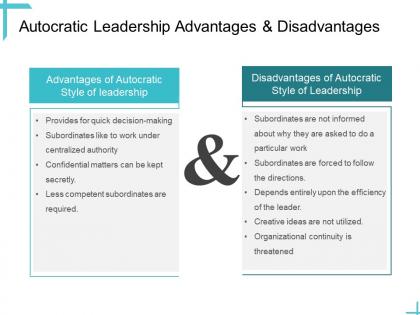




Try Before you Buy Download Free Sample Product
 Impress Your
 Audience
 100%
100% Editable
 Save Hours
 of Time


Our Leadership Autocratic Leadership Advantages And Disadvantages Ppt Professional Summary are topically designed to provide an attractive backdrop to any subject. Use them to look like a presentation pro.
People who downloaded this PowerPoint presentation also viewed the following :
Leadership autocratic leadership advantages and disadvantages ppt professional summary with all 2 slides:
Use our Leadership Autocratic Leadership Advantages And Disadvantages Ppt Professional Summary to effectively help you save your valuable time. They are readymade to fit into any presentation structure.

FAQs for Leadership autocratic leadership advantages and disadvantages
Autocratic leadership features centralized decision-making, minimal employee input, clear command structures, direct supervision, and strict adherence to established procedures and policies. These characteristics enable rapid decision implementation, consistent organizational direction, and streamlined operations, with many organizations in crisis situations or highly regulated industries finding that this concentrated authority delivers faster response times and enhanced accountability.
Autocratic leadership proves most effective during crisis management, tight deadlines, military operations, manufacturing environments, and situations requiring immediate decision-making without consultation delays. This approach streamlines command structures by eliminating lengthy deliberations, ensuring rapid response times, and maintaining strict operational control, with many organizations finding that autocratic methods deliver decisive action and clear accountability when time-sensitive results are paramount.
Autocratic leadership typically decreases employee morale and motivation by limiting autonomy, reducing participation in decision-making, and creating dependency on managerial direction. However, in crisis situations or highly regulated industries like manufacturing or emergency services, this structure can provide clarity and stability that some employees find reassuring, ultimately delivering faster decision implementation while potentially stifling long-term engagement.
Autocratic leadership typically creates long-term dependency and reduced initiative among team members, while potentially stifling innovation, open communication, and collaborative problem-solving capabilities. However, organizations in crisis situations or highly regulated industries like manufacturing and healthcare find that structured decision-making initially streamlines operations, though many ultimately transition toward more collaborative approaches to sustain engagement and retain talent.
Autocratic leadership can stifle creativity by limiting input and discouraging experimentation, though it may drive innovation through rapid decision-making and clear direction in crisis situations. While this approach enables quick pivots and focused execution in fast-moving industries like tech startups, it often reduces long-term creative thinking, with many organizations finding that balanced leadership styles ultimately deliver greater sustainable innovation.
Industries requiring rapid decision-making and strict compliance tend to benefit most from autocratic leadership, including healthcare, military, manufacturing, emergency services, and aviation. These sectors often operate under high-pressure conditions where clear command structures streamline operations, minimize errors, and ensure safety protocols, with many organizations finding that centralized decision-making accelerates response times and maintains operational standards.
Cultural factors significantly influence autocratic leadership acceptance through power distance tolerance, hierarchical traditions, uncertainty avoidance preferences, and collective versus individualistic values. In high power distance cultures like many Asian and Middle Eastern societies, autocratic approaches often enhance organizational efficiency and employee comfort, while individualistic Western cultures may experience resistance, ultimately requiring leaders to adapt their directive styles to cultural expectations for optimal effectiveness.
Autocratic leaders can mitigate drawbacks by incorporating regular feedback sessions, transparent communication about decision rationales, and selective delegation of smaller decisions to build team confidence. While maintaining ultimate authority, these strategies help reduce resistance and improve morale, with many organizations finding that combining autocratic efficiency with collaborative elements enhances both productivity and employee satisfaction.
Autocratic leaders handle conflict through direct intervention, immediate decision-making, and clear directive communication, often resolving disputes quickly by imposing solutions rather than facilitating collaborative resolution. While this approach enables rapid conflict resolution and maintains team focus, it can suppress underlying issues and reduce team members' conflict resolution skills, ultimately creating dependency on leadership intervention rather than fostering autonomous problem-solving capabilities.
Communication serves as the primary mechanism through which autocratic leaders convey decisions, expectations, and directives, with effectiveness depending on clarity, consistency, and timing of message delivery. While this top-down communication streamlines decision implementation and minimizes confusion in crisis situations, organizations increasingly find that incorporating structured feedback channels enhances operational outcomes and employee engagement, ultimately delivering faster execution with improved strategic alignment.
Trust levels significantly impact autocratic leadership effectiveness, with high trust enabling faster decision implementation, reduced resistance, and improved task execution, while low trust creates compliance issues and decreased morale. Organizations in crisis situations, manufacturing environments, and military contexts find that establishing clear expectations and demonstrating competence builds essential trust, ultimately delivering improved performance outcomes and operational efficiency.
Notable examples include Apple under Steve Jobs, Tesla under Elon Musk, Amazon's early years with Jeff Bezos, Ford Motor Company under Henry Ford, and Disney during Walt Disney's leadership. These organizations achieved remarkable innovation and market dominance through decisive leadership and clear vision, while also demonstrating that autocratic approaches can drive rapid growth and competitive advantage when balanced with strategic talent retention.
Feedback mechanisms in autocratic structures can include regular one-on-one sessions, anonymous suggestion systems, structured performance reviews, and designated feedback channels that encourage upward communication. While maintaining centralized decision-making, these approaches enable leaders to gather valuable insights from team members, identify operational improvements, and enhance employee engagement, ultimately delivering better strategic outcomes and reduced implementation risks.
Effective autocratic leaders require strong decision-making abilities, clear communication skills, deep industry expertise, and emotional intelligence to manage team dynamics. They must possess strategic vision, crisis management capabilities, and the ability to delegate appropriately while maintaining control, with many organizations finding that successful autocratic leaders balance authority with empathy to drive results and retain talent.
Employees in autocratic environments often perceive limited career advancement opportunities due to centralized decision-making, reduced autonomy in role development, and fewer chances to demonstrate independent leadership capabilities. However, many organizations find that clear hierarchical structures, defined promotion pathways, and mentorship from strong leaders can accelerate skill development and provide focused career trajectories, ultimately delivering structured growth for ambitious professionals.
-
Qualitative and comprehensive slides.
-
Use of icon with content is very relateable, informative and appealing.
-
Informative presentations that are easily editable.
-
Awesome presentation, really professional and easy to edit.
-
The content is very helpful from business point of view.